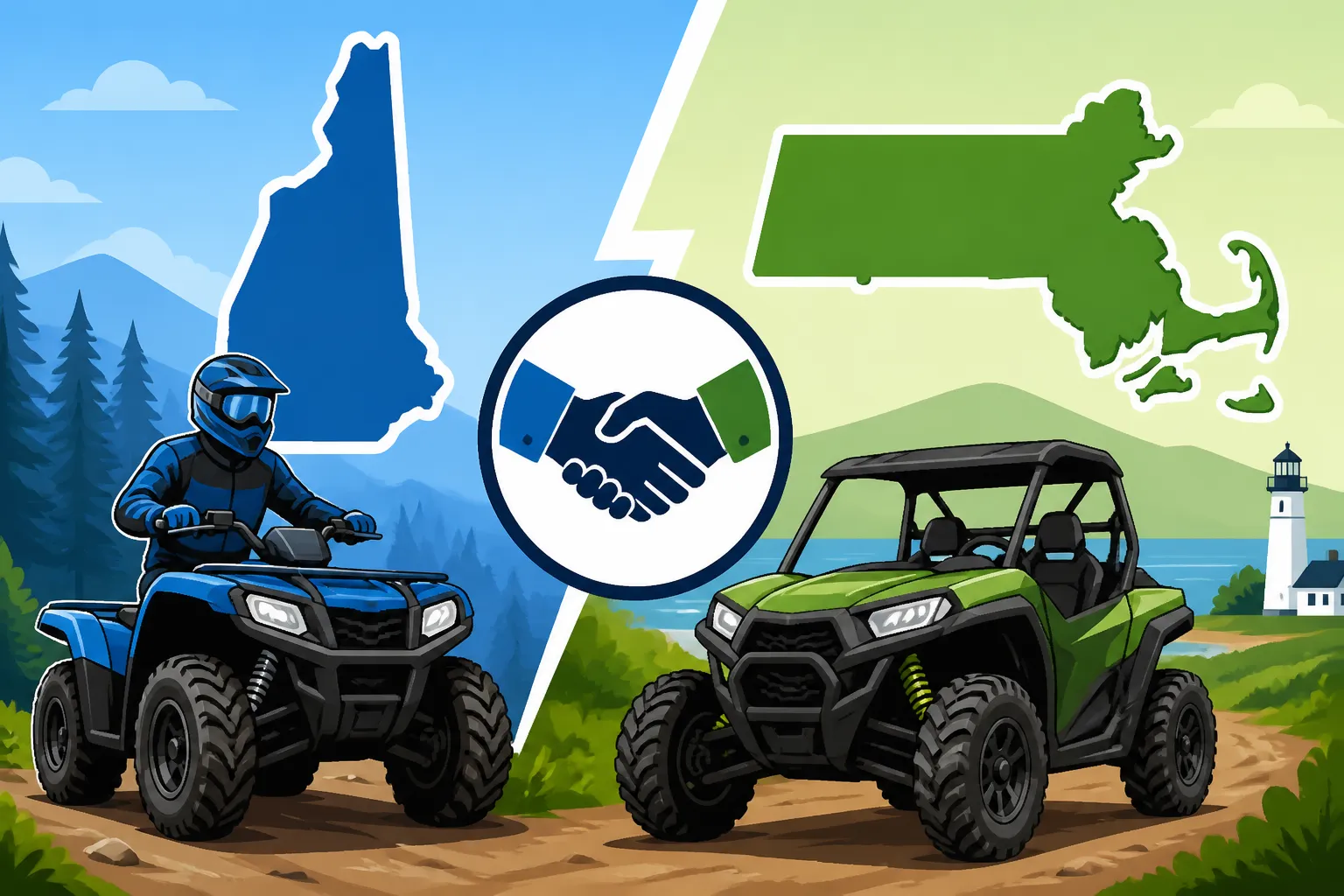
Massachusetts Rules for a Visiting New Hampshire Rider
It can be incredibly frustrating to pack up your ATV or UTV for a road trip, envisioning an epic day of riding in a new state, only to realize at the last minute that your home state's registration isn't valid. Many New Hampshire riders, especially those new to exploring beyond their home trails, assume reciprocity with Massachusetts, but the reality is a bit more complex. This guide is here to walk you through exactly what you need to know and do to legally and safely enjoy the Bay State's trails as a visiting New Hampshire rider, preventing any unwelcome surprises or citations.
Understanding Massachusetts's OHV Registration for Visitors
If you're accustomed to New Hampshire's approach to ATV and UTV registration, getting ready for a ride in Massachusetts requires a bit of a mindset shift. The Bay State has its own distinct rules, and the most crucial one for out-of-state riders is that your New Hampshire registration sticker, no matter how current, simply isn't recognized here for trail access. It's a common point of confusion and a quick way to find yourself on the wrong side of the law.
Why Your New Hampshire Registration Isn't Enough
Many states have reciprocity agreements, where one state will honor another's registration for recreational vehicles. It makes travel and trail access much easier. However, Massachusetts takes a different approach for its Off-Highway Vehicles (OHVs), which include ATVs, UTVs, and dirt bikes. The state requires all OHVs operating on public lands or trails to be registered directly with the Massachusetts Environmental Police. This isn't just a suggestion; it's a firm legal requirement. Your existing New Hampshire registration proves ownership in your home state, but it doesn't grant you permission to ride on Massachusetts public trails. Think of it like needing a separate fishing license for each state you fish in; it’s a distinct permit for a distinct jurisdiction.
The Environmental Police are the authority here, not the Registry of Motor Vehicles, which handles road vehicles. This is a key distinction that sometimes catches people off guard. They are focused on environmental protection, public safety on recreational lands, and ensuring that all users contribute to the upkeep of the state's trail systems. So, while your New Hampshire plates might be fine for towing your rig on the highway to get here, once you unload and hit the dirt, you'll need that Massachusetts sticker. [Massachusetts Requires Its Own Registration] is a concept that can be a tough pill to swallow for some visitors, but it's the reality of riding here.
The Massachusetts Non-Resident Sticker
To ride legally in Massachusetts, you'll need to obtain a non-resident OHV registration sticker. This sticker is your official pass to hit the trails and participate in the Bay State's OHV recreational opportunities. Unlike resident registrations, which are valid for two years, the non-resident sticker is typically a one-year registration. It's important to keep an eye on that expiration date, especially if you plan multiple trips throughout the year. The fee structure reflects the temporary nature of this registration, and it's generally set at a lower rate than what residents pay for their two-year sticker. [Non-Resident ATV Registration Costs $33 for One Year] is the specific charge you can expect for this essential permit.
This fee, like all OHV registration fees in Massachusetts, plays a crucial role in maintaining and expanding the state's trail network. A portion of every registration dollar goes directly into the Massachusetts OHV Trail Fund, which helps pay for trail development, maintenance, and enforcement efforts. So, while it might feel like an extra step, your registration directly supports the very trails you're coming to enjoy. It's a direct investment in the future of riding in Massachusetts, ensuring that the limited public lands available for OHV use remain open and in good condition for everyone.
How to Get Your Massachusetts Non-Resident Registration
Getting your non-resident registration is a straightforward process, but it requires a few specific items. You can typically complete the registration online through the Massachusetts Environmental Police website, which is often the most convenient option for out-of-state visitors. [Registering an ATV on the Environmental Police Website] simplifies the process significantly. You'll need access to a printer to get your temporary documentation right away.
Here’s a general checklist of what you’ll need:
- Proof of Ownership: For a new machine, you'll need the Manufacturer's Certificate of Origin (MCO) or equivalent. For a used machine, a bill of sale is essential. Ensure the bill of sale includes critical information like the VIN, make, model, year, purchase price, and contact information for both buyer and seller. [Massachusetts Requires a Bill of Sale for a Used One] is very specific about this.
- Vehicle Identification Number (VIN): This is crucial for identifying your machine. Ensure it's accurate and legible on your application.
- Payment: Be ready with a credit or debit card for the non-resident registration fee.
- Personal Information: You'll need your full name, address (your New Hampshire address, of course), and contact details.
Once you complete the online application and payment, you'll usually receive a temporary registration that you can print out and carry with you immediately. The actual sticker and card will then be mailed to your New Hampshire address. It's vital to have some form of proof of registration with you whenever you're riding. This means carrying your temporary printout until your official card and decals arrive, and then always having the official card on your person while riding. The decals themselves have specific placement rules, so once they arrive, make sure to affix them correctly to avoid any issues with law enforcement.
Navigating Massachusetts's OHV Operating Laws
Once your machine is properly registered in Massachusetts, the next step is understanding the rules of the road – or rather, the rules of the trail. Massachusetts has a robust set of laws governing OHV operation, and these apply equally to residents and visitors alike. Ignorance of the law is never an excuse, so familiarizing yourself with these regulations is paramount for a safe and enjoyable trip.
Age and Safety Certificate Requirements
Massachusetts has some of the strictest age and supervision requirements for OHV riders in the country, especially for young people. This is largely due to "Sean's Law," which was enacted to enhance safety after a tragic accident. If you're bringing a young rider from New Hampshire, pay very close attention here, as the rules are likely different from what you're used to.
- Under 14: Riders under the age of 14 are generally prohibited from operating ATVs on public or private land in Massachusetts, with very limited exceptions for sanctioned, closed-course events. This means if your child rides regularly in New Hampshire but is under 14, they likely cannot ride on Massachusetts trails. [Massachusetts Bans Riders Under 14] is a critical rule to remember.
- Ages 14 to 16: Riders in this age group may operate an ATV with an engine size of 90cc or less, provided they are directly supervised by an adult over 18 and have successfully completed an approved OHV safety course. The supervising adult must maintain continuous visual contact and be able to communicate verbally with the rider.
- Ages 16 and 17: Riders must complete an approved OHV safety course. They do not have the 90cc engine size restriction, but still benefit from supervision. [Massachusetts Certificate Rules at 16 and 17] outlines these specific requirements.
- Safety Certificates for Public Land: Any rider under the age of 18, regardless of residency, must carry a valid Massachusetts OHV Safety Certificate (or an equivalent from another state recognized by MA) when operating an OHV on public lands. If your young rider completed a safety course in New Hampshire, it's a good idea to confirm its acceptance with the Massachusetts Environmental Police or plan to have them complete the Massachusetts course. [Massachusetts Safety Certificates Under 18] highlights the importance of this document.
For adults 18 and over, while a safety certificate isn't mandatory, it's highly recommended, especially if you're new to the Massachusetts trail system or haven't ridden in a while. Safety is always the top priority, and understanding the nuances of local laws and trail etiquette can make all the difference. When selecting protective gear, many riders turn to robust options. For example, aftermarket suppliers like SuperATV offer helmets and other safety accessories that can help ensure you meet or exceed safety standards, even if they aren't directly mandated.
Equipment and Road Crossing Rules
Massachusetts also has specific requirements for the equipment on your OHV, designed to ensure safety and minimize environmental impact. Before you load up your machine, give it a thorough check.
- Spark Arrestor: Your OHV must be equipped with a U.S. Forest Service approved spark arrestor. This is critical for preventing wildfires, especially in dry conditions. Law enforcement officers frequently check for this.
- Muffler: A functional muffler is required to keep noise levels down. Excessive noise can lead to complaints and is a common reason for citations. [Massachusetts Muffler Requirements] are in place to ensure a peaceful environment for all trail users and nearby residents.
- Brakes: Your machine must have fully operational brakes. This might seem obvious, but any mechanical issues could lead to dangerous situations and tickets.
- Lights: If you plan to ride at any time between sunset and sunrise, or during periods of reduced visibility, your OHV must be equipped with at least one headlight and one taillight, both functioning properly. A red reflector is also required on the rear. [Massachusetts Lighting After Sunset] is a strict rule. Many riders find that standard factory lights might not be enough for true night riding; if you're looking to upgrade, consider the wide range of auxiliary lighting options available from companies like SuperATV to enhance visibility and safety.
- Crossing Public Ways: This is a particularly important rule for New Hampshire riders, as rules for crossing roads can vary significantly between states. In Massachusetts, you may generally not operate an OHV on a public way (street, highway, paved road). The only exception is to cross a public way, and even then, there are strict conditions:
- You must come to a complete stop before crossing.
- You must yield to all vehicular and pedestrian traffic.
- You must cross at approximately a 90-degree angle to the public way.
- The crossing must be made at an intersection with a paved or unpaved road or at a designated crossing point.
- Riders under 16-and-a-half years old must be supervised by an adult over 18 when crossing. [Massachusetts Crossings Require a Full Stop] emphasizes the seriousness of this maneuver. Remember, just because a dirt road looks like a trail doesn't mean it's not considered a public way.
Land Access and Permission
Knowing where you can legally ride is just as important as knowing how to ride. Massachusetts has a mix of public and private lands, and the rules for access are very specific.
- Public Lands (State Forests): Massachusetts offers limited but dedicated OHV trails in a few state forests, primarily in the western part of the state, such as Beartown State Forest, October Mountain State Forest, and Pittsfield State Forest. These are often multi-use trails, so you'll be sharing them with hikers, mountain bikers, and sometimes even horses. Always be respectful and yield to non-motorized users. [Massachusetts ATV Trails: Three Berkshire Forests] are the main destinations for OHV enthusiasts. It's crucial to check the Massachusetts Department of Conservation and Recreation (DCR) website or call the specific forest office before you head out, as trail conditions, closures, and operating seasons (typically May to November) can change.
- Private Land: This is where many New Hampshire riders might get into trouble. In Massachusetts, you must have written permission from the landowner to operate an OHV on private property. Verbal permission is not enough, and it needs to be carried with you. [Massachusetts Requires Written Permission] is not just a polite suggestion; it's a legal requirement. Trespassing laws are strictly enforced, and landowners can press charges. This even applies to riding within 150 feet of a dwelling, which requires explicit permission from the occupant of that dwelling.
- Prohibited Areas: You cannot ride on public ways (except for approved crossings), on sidewalks, or on any posted land. Beaches, dunes, and conservation areas are also generally off-limits for OHVs to protect sensitive ecosystems. Understanding [Massachusetts Bans Riding on Public Ways] is fundamental.
Being a good steward of the land is key. Stick to marked trails, avoid riding off-trail, and tread lightly. This not only keeps you out of trouble but also helps ensure that these precious riding opportunities remain open for everyone.
Practical Tips for a New Hampshire Rider Visiting Massachusetts
Making the most of your Massachusetts OHV adventure means being well-prepared. A little planning can save a lot of headaches and ensure your trip is enjoyable and hassle-free.
Planning Your Ride
Before you even load up your rig, do your homework. This is especially true if you're venturing into a new state with different regulations.
- Check Trail Status: Always, always check the DCR website for the specific state forest you plan to visit. Trail closures due to weather, maintenance, or other issues are common. Nothing's worse than driving hours only to find the gates closed. [Massachusetts Trail Conditions Before You Tow] is a must-do before every trip.
- Parking and Fees: State forests in Massachusetts may have day-use parking fees, especially for out-of-state vehicles. Be prepared to pay these fees upon entry. Some forests might have self-service kiosks, while others have manned gates. Know what to expect so you’re not caught off guard. [Massachusetts Day Use Parking Costs] can add up if you're not planning ahead.
- Maps and Navigation: Cell service can be spotty in the more remote Berkshire forests. Don't rely solely on your phone for navigation. Download offline maps or, better yet, bring a physical map of the trail system. Even with GPS on your machine, having a backup is always a smart move for safety. Aftermarket accessories from brands like SuperATV, such as GPS mounts and durable map cases, can be incredibly useful for keeping your navigation tools accessible and protected while riding.
- Fuel and Supplies: Plan your fuel stops. While some state forests are near towns, others are quite remote, and gas stations might not be immediately available at the trailhead. Pack enough water, snacks, and a basic first-aid kit. Consider [Packing for a Cool Mountain Morning] if you're riding in spring or fall, as temperatures can change quickly.
What to Carry on the Trail
Beyond your machine and riding gear, there are a few essential items you absolutely must have with you when riding in Massachusetts.
- Registration Card: Your Massachusetts non-resident OHV registration card must be carried on your person or in the machine at all times when riding. This is different from some states where just the sticker on the machine is enough. [Massachusetts Registration Cards Carried on Board] is a strict requirement, and an Environmental Police officer will ask for it.
- Proof of Ownership: While the registration card is key, having a copy of your bill of sale or MCO stored securely in your tow vehicle (not necessarily on the trail) is a good backup in case of any questions about ownership.
- Safety Certificate (if applicable): If you or a young rider in your group is under 18, their valid Massachusetts OHV Safety Certificate must be carried with them.
- Written Permission: If you plan to ride on any private land, even if you think it’s just a shortcut, you must have the landowner’s written permission in your possession.
- Identification: Always carry a valid photo ID.
- Basic Tools and Repair Kit: A flat tire or minor mechanical issue can quickly ruin a day. Pack a tire repair kit, a small air pump, basic tools, and perhaps some zip ties or duct tape for trailside fixes.
Common Mistakes to Avoid
Even experienced riders can sometimes make mistakes when visiting a new state. Being aware of these common pitfalls can help you steer clear of trouble.
- Assuming Reciprocity: As discussed, this is the number one mistake. Your New Hampshire registration is not valid for riding in Massachusetts. Get that non-resident sticker first! [Out-of-State OHV Stickers Are Not Valid in Massachusetts] is a clear statement of the law.
- Ignoring Age and Supervision Laws: Massachusetts takes its youth rider laws very seriously. Do not assume your child's age or engine size is okay without checking the specific Massachusetts regulations. Parents can be held liable for violations.
- Riding Off-Trail or on Undesignated Paths: The temptation might be there, especially if you see faint tracks, but stick to clearly marked and authorized trails. Massachusetts has sensitive ecosystems and strict trespass laws.
- Underestimating Road Crossing Rules: A quick dash across a paved road might seem harmless, but it's a serious violation if not done according to the specific protocol. Always stop, look, yield, and cross directly.
- Relying on Your Phone for Directions: Many trail areas have poor to no cell service. Print maps or download offline maps before you leave home.
- Not Carrying Documents: Your registration card and, if applicable, your safety certificate, need to be on your person or securely on your machine. Don't leave them in the truck.
- Disregarding Noise Regulations: While New Hampshire might have different norms, Massachusetts has clear muffler and noise requirements. A loud machine can attract unwanted attention from law enforcement and upset local residents, potentially jeopardizing future trail access.
By taking the time to understand and adhere to Massachusetts's specific OHV laws and guidelines, New Hampshire riders can have a fantastic and worry-free experience exploring the Bay State's trails.
| Aspect | New Hampshire (General) | Massachusetts (Visiting Rider) |
|---|---|---|
| Registration Validity | NH registration for NH trails | NH registration not valid for MA trails |
| Required MA Registration | N/A | Yes, a Massachusetts non-resident sticker |
| Non-Resident Sticker Term | N/A | One year |
| Cost of Non-Resident Sticker | N/A | $33 (approximate) |
| Primary Registration Authority | NH Fish and Game | MA Environmental Police |
| Under 14 Riding | Varies, often with supervision/training | Generally banned on public/private land |
| 14-16 Rider Engine Limit | Varies | Max 90cc (with safety course/supervision) |
| Safety Certificate (Under 18) | Often required | Yes, must be carried on public land |
| Written Permission on Private Land | Often recommended | Legally required, must be carried |
| Road Operation | Varies, some roads may be open | Generally prohibited, strict crossing rules only |
| Carrying Registration Card | Sticker on machine often sufficient | Card must be carried on person/machine |
| Trail Fund Contribution | Yes, through registration fees | Yes, through registration fees |
Disclaimer
This article is for general informational purposes only and does not constitute professional advice. Laws, prices and regulations vary by location and change over time. Consult a qualified professional for guidance on your specific situation.