Massachusetts Rules for Riding Near a House
One of the most common headaches for ATV and UTV enthusiasts in Massachusetts is figuring out exactly where you can and cannot ride, especially when your home or your riding area is close to other people's property. It’s a real challenge to enjoy your machine when you're constantly worried about accidentally breaking a rule or upsetting a neighbor. This guide is going to dive deep into Massachusetts' specific regulations concerning off-highway vehicle (OHV) operation near dwellings, equipping you with the knowledge to ride responsibly and legally.
The Strict Massachusetts 150-Foot Dwelling Rule
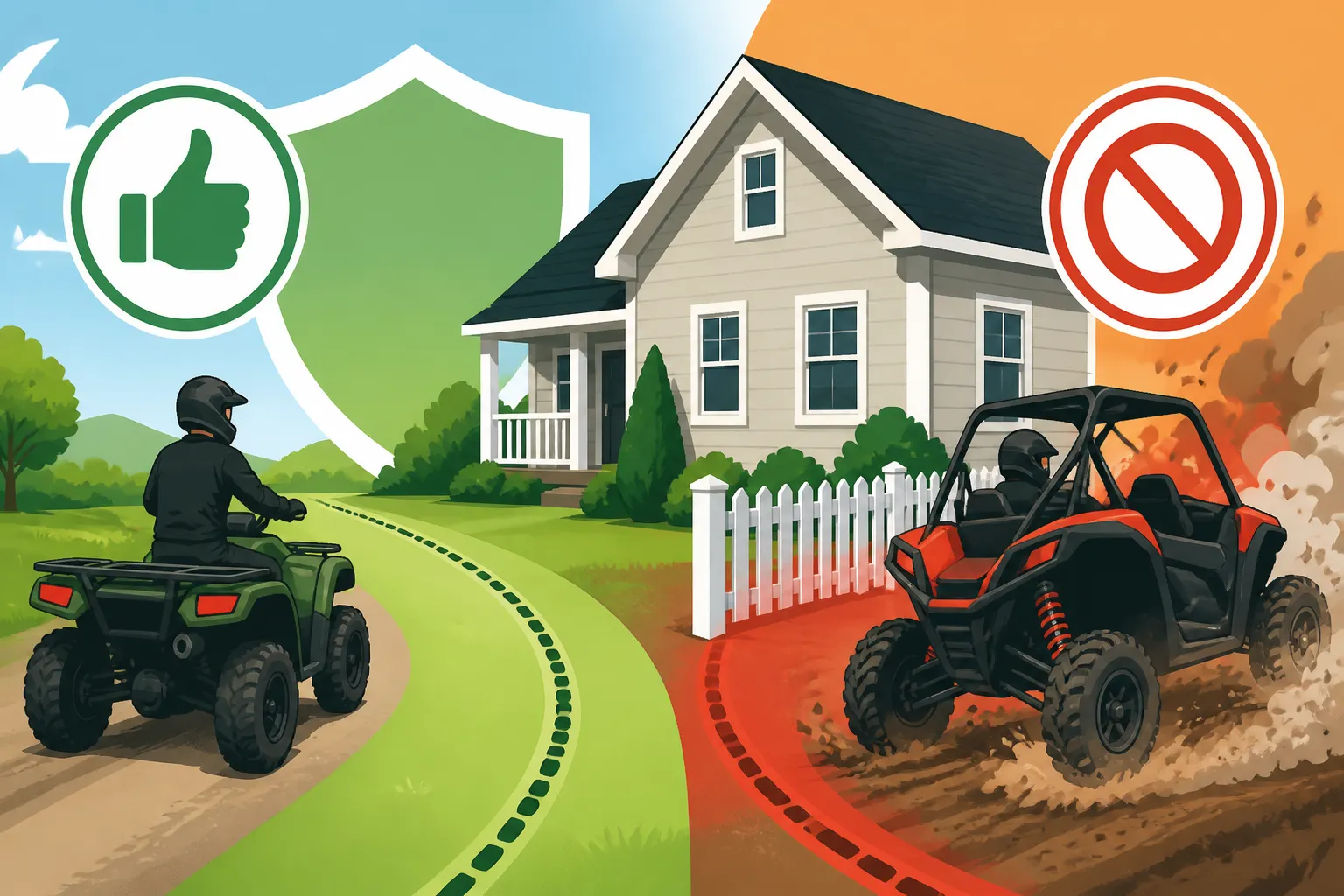
Massachusetts is quite clear about its rules regarding off-highway vehicles and proximity to residential areas. There's a particular statute, part of Chapter 90B, that often catches riders off guard: the 150-foot dwelling rule. This isn't just a suggestion; it's a legally enforceable distance designed to protect the peace, privacy, and safety of residents. It's a rule that can feel restrictive, but understanding its intent and application is key to avoiding penalties.
What "150 Feet From a Dwelling" Actually Means
So, what does it mean to be within 150 feet of a dwelling? Simply put, it means that you cannot operate your ATV or UTV within a stone's throw – or more accurately, a good football field and a half – of any building that is used for human habitation. This measurement is taken from the closest point of your machine to the closest point of the dwelling. It doesn't matter if there's a fence, a hedgerow, or a slight incline in between; the straight-line distance is what counts.
The intent behind this rule is multifold. First and foremost, it's about mitigating noise. ATVs and UTVs, while incredibly fun, can be loud, and that noise can carry quite a distance, disturbing those who live nearby. Secondly, it addresses privacy concerns. No one wants an OHV roaring past their windows or visible from their backyard recreation space. Finally, it's a safety measure, reducing the risk of accidents involving people or pets who might be unaware of an approaching machine. For example, imagine you're on your own sprawling property in a more rural part of Massachusetts, perhaps in the Berkshires. You might think you're perfectly within your rights to ride anywhere on your land. However, if your property line runs within 150 feet of a neighbor's house – even if it's a house you can barely see through the trees – you are still subject to this rule. It’s a common scenario where good intentions can quickly run afoul of the law if you’re not meticulous about checking distances. Understanding [How 150 Feet Is Measured From a Dwelling] can help you map out your riding space more accurately.
Obtaining Written Permission: Your Only Exception
Now, here's the crucial part: there is one way around the 150-foot rule, and that is with explicit, written permission from the owner or legal occupant of the dwelling. And I can't stress "written" enough. A verbal "sure, go ahead" from your neighbor over the fence is absolutely not sufficient in the eyes of the law. If an Environmental Police Officer encounters you riding within the prohibited distance, and you only have a handshake agreement, you're likely still looking at a citation.
What should this written permission entail? It needs to be clear, unambiguous, and comprehensive. At a minimum, it should include:
- The date the permission was granted.
- The full names of the dwelling owner/occupant granting permission and the rider(s) being granted permission.
- A clear description of the specific property where the riding is allowed, ideally with an address or parcel ID.
- The specific areas within that 150-foot zone where riding is permitted.
- Any specific restrictions or conditions (e.g., "only on weekends," "only between 10 AM and 4 PM").
- The duration for which the permission is valid (e.g., "for the 2024 riding season," or "until revoked").
- The signature of the dwelling owner/occupant.
Consider a hypothetical situation: you own a large plot of land, but the only access to a back pasture where you want to ride involves crossing a small section that falls within 150 feet of your next-door neighbor's home. You've always had a good relationship, and they've verbally said it's fine. To be truly compliant, you'd need to sit down with them, explain the specific law, and get them to sign a document outlining their consent. This small step can save you a significant headache, fine, or even having your machine impounded. Always carry this document with you when you ride. You'll find more details on what's required in [Massachusetts Requires Written Permission] and [Getting an Owner's Consent to Ride Within 150 Feet].
Understanding "Dwelling" in Massachusetts ATV Law
The term "dwelling" might seem straightforward, but in the context of Massachusetts ATV law, it's broader than just your primary residence. It's important to understand the full scope of what the law considers a dwelling to ensure you're not inadvertently breaking the 150-foot rule, especially in rural or vacation areas.
Defining "Dwelling" Beyond Just Houses
When the law refers to a "dwelling," it's not exclusively talking about year-round, single-family homes. The definition is generally understood to include any structure used for human habitation. This can encompass a variety of buildings, such as:
- Seasonal homes: Think of those quaint cottages in areas like Cape Cod or the Berkshires that might only be occupied during warmer months. Even if they're vacant for part of the year, they are still considered dwellings.
- Hunting camps or cabins: If a structure is set up, even temporarily, for people to sleep in, cook in, or spend significant time in, it likely falls under the dwelling definition.
- Mobile homes or RVs: If these are set up on a property for habitation, they too would qualify.
- Apartments, condominiums, and multi-family units: Obviously, these are dwellings, and the rule applies to any of their occupied units.
The key is "human habitation." If someone could reasonably live there, even just for a weekend, it's best to assume it's a dwelling. For example, imagine you're riding through a remote area, and you come across a small, rustic hunting cabin that looks completely deserted. You might think it's fair game to ride close by. However, if that cabin is occasionally used by its owner, it’s still considered a dwelling under the law, and the 150-foot rule applies. On the other hand, riding near a barn, shed, or detached garage – buildings not meant for human habitation – would not trigger the 150-foot rule, although other rules about private property and noise may still apply.
The Importance of Property Lines and Public vs. Private Land
The 150-foot rule is particularly tricky because it doesn't distinguish between your own land and your neighbor's land. The rule applies regardless of whose property the dwelling is on. If you are operating your OHV on your own private property, but your path brings you within 150 feet of your neighbor's house, you are in violation unless you have that crucial written permission from your neighbor. This is a critical distinction that many riders overlook, assuming that if they are on their own land, they can ride freely.
This also means that simply being on what seems like "public" land doesn't automatically grant you immunity. If a public trail or access road runs too close to a private dwelling, you're still bound by the rule. This is less common on designated state trails, where routes are usually planned to avoid such conflicts, but it can be a significant issue on unmarked or unofficial trails, or when navigating rural road crossings.
Consider a scenario where you own a large wooded lot, and your property line is adjacent to a smaller residential lot. Your neighbor's house is 100 feet from that shared property line. If you ride your ATV along your side of that property line, you would be well within 150 feet of their dwelling. Even though you are entirely on your own land, you would need their written permission to ride within that 150-foot buffer zone. It really emphasizes the need to understand your property boundaries and those of your neighbors. This highlights the crucial requirement for [Massachusetts Landowner Permission in Writing].
Practical Implications and Enforcement
Understanding the law is one thing, but knowing how it plays out in the real world, and what consequences you might face, is another. The 150-foot dwelling rule isn't just an obscure legal detail; it has very real practical implications for how you ride and how you interact with your community.
Noise, Dust, and Respecting Your Neighbors
Even if you have obtained written permission to ride within 150 feet of a dwelling, or if you're riding in a completely legal spot that is far from any homes, being a responsible rider in Massachusetts means always considering your impact on others. Noise and dust are the two biggest culprits when it comes to neighbor complaints about OHVs.
- Noise: While your ATV or UTV might meet legal sound limits, sustained engine noise or revving can still be incredibly disruptive. Think about trying to have a quiet afternoon in your backyard when a machine is constantly running nearby. If you're riding frequently near homes, even with permission, consider if your machine is excessively loud. Sometimes, aftermarket exhaust systems can actually make a machine louder than stock, but there are also components designed for better flow without extreme noise, or even sound-dampening materials. If you're looking for ways to mitigate noise or dust, exploring accessories from brands like SuperATV can sometimes offer solutions, such as different exhaust configurations or full windshields that can help contain dust better.
- Dust: Kicking up large clouds of dust on dry days is another common complaint. This dust can settle on homes, vehicles, and gardens, creating a nuisance and even health concerns. If you're riding on private dirt roads or trails near homes, riding at a reduced speed can significantly cut down on dust. Watering down a specific section of a private trail, if feasible and permissible, is another way to be a good neighbor.
A real-life scenario: You have a large private woodlot, and you've secured written permission from your closest neighbor to ride near the edge of their property, which is within the 150-foot zone. Legally, you're covered. However, if every time you ride, you're tearing down the trail, kicking up massive dust clouds, and your aftermarket exhaust is rattling their windows, that neighbor might quickly revoke their permission. Even worse, they might start complaining to local authorities or the Environmental Police about noise violations, which can bring unwanted attention to all riders in the area. Being proactive and considerate goes a long way. More on this can be found under [Massachusetts Noise Complaints About Quads].
Penalties for Violating the 150-Foot Rule
Massachusetts takes its OHV laws seriously, and the 150-foot dwelling rule is no exception. Violating this rule can lead to significant penalties, which are primarily enforced by the Massachusetts Environmental Police (MEP). These aren't just minor infractions; they can impact your wallet and even your ability to ride.
- Fines: The most immediate consequence is a fine. While specific amounts can vary, these citations are not cheap and can quickly add up. Each infraction could be a separate offense.
- Machine Seizure: In more serious or repeated cases, an Environmental Police Officer has the authority to seize your ATV or UTV. Getting your machine back can be a lengthy, costly, and frustrating process, often involving impound fees, legal battles, and a lot of paperwork.
- Criminal Charges (in extreme cases): While less common for a simple 150-foot violation, if your riding behavior is deemed reckless, dangerous, or combined with other offenses (like trespassing or operating under the influence), you could face more severe criminal charges.
Imagine you're out for a ride on a Sunday afternoon, perhaps on what you thought was a remote trail. An Environmental Police Officer observes you riding within 100 feet of a cottage that's occupied for the weekend. They stop you, and you can't produce written permission from the owner. You're now facing a fine, and if they've had multiple complaints in that area, they might even decide to seize your machine on the spot. This isn't just a theoretical threat; it happens. Knowing [Massachusetts Penalties for Illegal Riding] can make you think twice before taking a shortcut too close to a home. Remember, the MEP officers are trained to enforce these specific OHV laws. [What an Environmental Police Officer Can Ask] is always part of their routine when they stop a rider.
Strategies for Responsible Riding Near Residential Areas
Riding an ATV or UTV in Massachusetts is a fantastic way to explore the outdoors, but it requires careful planning, especially when you’re near residential areas. Being strategic about your routes and fostering good relationships with landowners can make all the difference in avoiding legal trouble and ensuring continued access to riding opportunities.
Planning Your Route to Avoid Dwellings
One of the best ways to comply with the 150-foot dwelling rule is to simply avoid areas where it might be an issue. This requires a bit of pre-ride planning, but it's time well spent.
- Utilize Maps: Before you head out, study maps of the area you intend to ride. Topographic maps, detailed satellite imagery (available through various online mapping services), or even specific OHV trail maps provided by the state can help you identify residential structures and property lines. Look for clusters of buildings, driveways, or clearings that indicate dwellings.
- Identify Buffer Zones: When planning your route, actively look for natural buffer zones – dense woods, large fields, or significant elevation changes – that will keep you well beyond the 150-foot minimum.
- Designate "No-Go" Areas: If you ride on private land that you own or have permission for, identify and mark areas that are too close to neighboring homes as "no-go" zones. You can use physical markers like flags or signage, or simply note them on a personal map.
- Walk It First: If you’re exploring a new private area, especially one close to homes, consider walking the proposed route first to visually confirm distances and identify any potential issues before you bring your machine in.
For instance, if you're trying to get from your garage to a network of trails on your property, and there are neighboring houses nearby, map out a specific path that takes the longest way around if necessary, ensuring you stay beyond the 150-foot limit. This might mean adding a few extra minutes to your ride, but it's a small price to pay for peace of mind and legal compliance. This kind of route planning is an essential aspect of [Massachusetts Riding Within Sight of a House].
Communicating with Landowners and Neighbors
Beyond just obeying the law, being a good neighbor and maintaining open communication can prevent many issues before they even arise. This is particularly important in rural and semi-rural areas where OHV riding is more common.
- Proactive Engagement: If you know you'll be riding near a neighbor's property, even if you believe you’re outside the 150-foot zone, a friendly heads-up can go a long way. A simple conversation where you explain your intentions and assure them you'll be respectful of their peace and privacy can prevent future complaints.
- Seeking Permission (even if not strictly required): While the 150-foot rule is specific, it's always a good idea to seek permission for any riding on land you don't own. Even if it's an old logging road that seems abandoned, a quick chat with the landowner can clarify access and prevent trespassing issues.
- Address Concerns Promptly: If a neighbor approaches you with a concern about noise, dust, or proximity, listen respectfully and address their concerns. Offering to adjust your riding times, routes, or even considering sound-reducing modifications to your machine can resolve conflicts amicably.
- Offer Mutual Benefits: In some cases, you might be able to offer a mutual benefit. Perhaps you can help clear brush on a shared access road or assist with minor property maintenance in exchange for continued riding permission.
Imagine you've just moved to a new property in central Massachusetts, and you have some fantastic riding land behind your house. You want to be a responsible member of the community. Before you even fire up your quad, take the time to introduce yourself to your closest neighbors. Explain that you enjoy riding your ATV and that you’ve studied the local laws, particularly the 150-foot rule. Reassure them you’ll always respect their property and privacy, and offer to share your contact information in case they ever have a concern. This proactive approach to communication helps build trust and can prevent minor issues from escalating into major disputes. Building these relationships is key to sustainable riding, and it ties directly into the spirit of [Getting an Owner's Consent to Ride Within 150 Feet].
Disclaimer
This article is for general informational purposes only and does not constitute professional advice. Laws, prices and regulations vary by location and change over time. Consult a qualified professional for guidance on your specific situation.