Refunds When Rain Closes a Riding Park
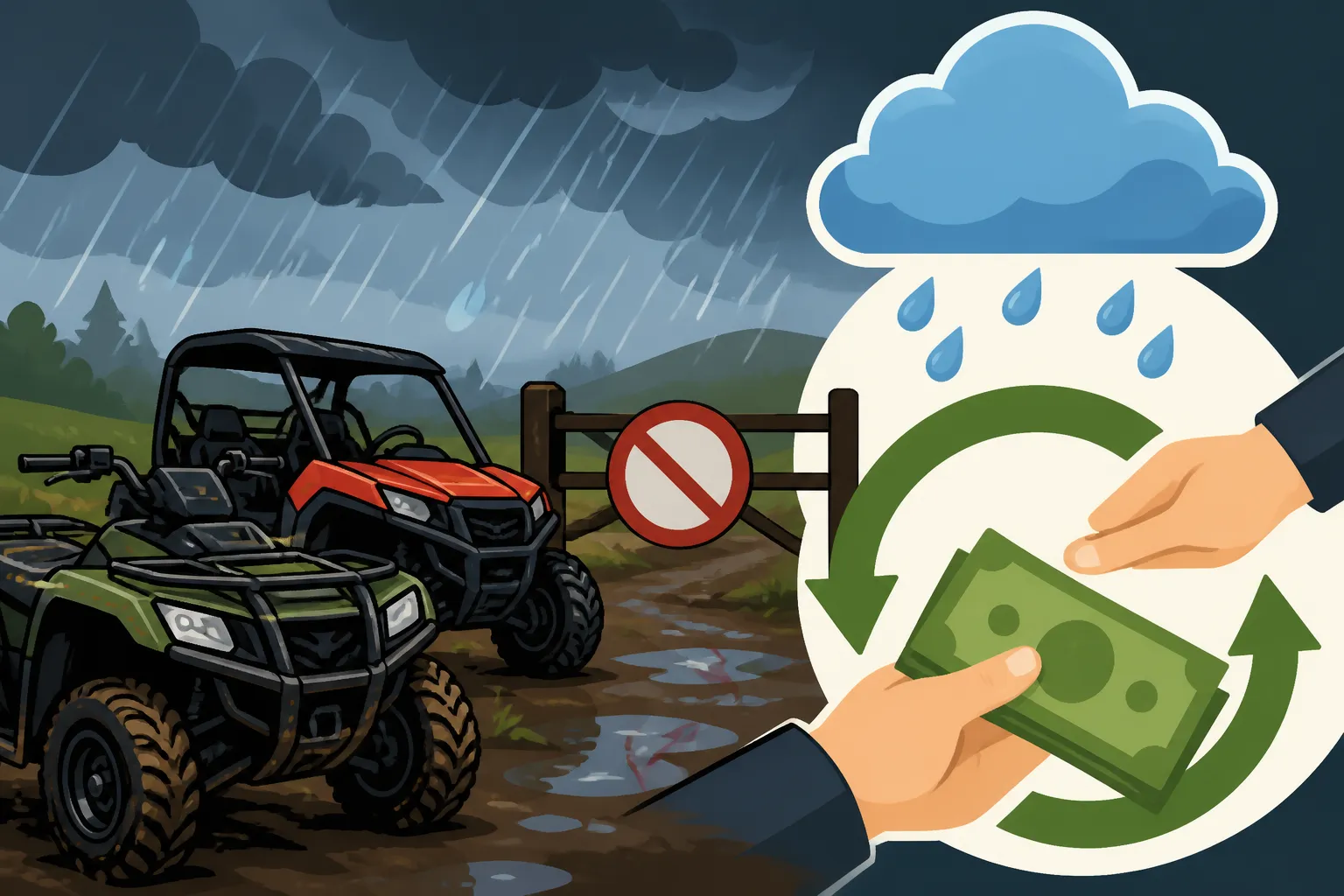
A rainy forecast can turn a Massachusetts riding day into a long drive to a locked gate. Whether you get your money back depends on who cancels, what the park’s written policy says, and which charges you paid. Here’s how to check the terms before booking, document a closure, and ask for a refund or credit without relying on assumptions.
First, find out who is closing what
A forecast calling for rain does not necessarily mean a riding park will close. The operator may stay open in light rain, restrict certain trails, delay opening, or close the whole property if conditions make riding unsafe or risk damaging the land. A park can also close for reasons unrelated to weather.
That distinction matters because a rider who decides not to go is in a different position from a rider whose booked session the operator cancels. If the park remains open and you cancel because the weather looks unpleasant, the park may treat that as a voluntary cancellation. If the operator announces that it will not admit riders, its own closure or cancellation policy will usually be the first place to look for what happens to your payment.
Do not assume that every Massachusetts riding area follows the same rules. Private parks set their own booking terms, while state-managed riding areas have different access arrangements and may close trails or facilities without operating like a private ticketed park. For general differences between park types, see Massachusetts Private Riding Parks. State forest access and closures are a separate issue; Massachusetts Trail Closures After a Storm can help clarify what to check before hauling your machine.
| Situation | What to check first | Possible outcome |
|---|---|---|
| Park closes before your reservation | Closure notice and booking terms | Refund, credit, rescheduling, or another remedy stated by the operator |
| Park opens, but you choose not to ride | Cancellation deadline and no-show terms | The reservation may be treated as a voluntary cancellation |
| Only some trails close | Whether your ticket or booking still provides access | Partial restriction may not trigger the same remedy as a full closure |
| Park closes after you arrive | Posted closure policy and staff instructions | Ask whether unused time, entry, or other charges are covered |
| State forest trail is closed | Official notice for that forest and the specific access rules | A private-park refund policy does not apply |
The table is a starting point, not a promise. The exact result depends on the operator’s terms, what you bought, and how the closure was announced.
Read the cancellation and closure terms before paying
Look for the policy before checkout, not after a storm is on the radar. It may appear on a reservation page, in an email confirmation, in a waiver, or in separate terms and conditions. Save a copy or screenshot so you can refer to the version that applied when you booked.
Read closely for the difference between a customer cancellation and an operator cancellation. The terms may explain whether a weather closure produces a refund, a date change, or a credit. They may also describe how much notice the park will give, whether a decision is made on the day of the ride, and whether a closure applies to the whole property or only certain trails.
Check what your payment covered. A reservation may include admission, parking, a campsite, equipment rental, or another service, each with its own conditions. A park might address the riding session but say nothing about a separate charge. Do not assume a refund for one part of a booking automatically covers every add-on.
Review these details before you reserve:
- The closure trigger: Does the operator need to shut the entire park, or does a significant trail restriction count?
- The decision-maker: Does the park make the call, or does the policy rely on a particular alert or condition?
- The notice method: Will the park post an update online, email guests, text them, or ask riders to call?
- The remedy: Does the policy specify a refund, credit, rescheduled date, or no refund?
- Credit conditions: Check the expiration date, eligible dates, transferability, and whether the credit covers the original booking type.
- Separate charges: Look for terms covering parking, rentals, camping, or booking fees separately.
- Your own cancellation deadline: Find out what happens if you cancel before the operator announces a closure.
- No-show rules: A closure notice sent to one channel can be easy to miss, so confirm where updates will appear.
A waiver is not necessarily the same thing as a refund policy. It may address riding risks or release of liability without explaining what happens to your reservation payment. The park’s Massachusetts Private Park Waivers and Rules are worth reviewing for the broader terms, but check the actual booking conditions for cancellation and weather language.
If a policy is unclear, ask before you book. A short written question such as, “If the park closes for rain on my reservation date, is the remedy a refund, credit, or rescheduling?” is more useful than relying on a vague statement that bookings are “weather permitting.” Keep the reply with your confirmation.
What to do when rain closes your riding day
When a closure is announced, act promptly and keep the communication factual. The goal is to confirm the park’s decision and identify the remedy that applies to your booking.
- Verify the closure through an official channel. Check the park’s website, booking portal, email, text alert, or social media account. If the information is unclear, call the operator. Save a screenshot or the closure message.
- Confirm what is closed. Ask whether the whole park is shut, your booking period is canceled, or only certain trails or facilities are unavailable. A partial restriction may not be treated like a full closure under the park’s terms.
- Contact the booking provider if needed. If you reserved through a third-party service, check whether the park or that service handles changes and refunds. Do not assume one has automatically notified the other.
- Ask for the stated remedy. Refer to your reservation date and confirmation number, and ask whether the policy provides a refund, credit, or date change. If you prefer one option, say so, but do not present a preference as a guaranteed entitlement.
- Get the answer in writing. Keep emails, texts, receipts, and any revised reservation details. If the operator offers a credit, ask about its deadline and how to use it.
- Avoid traveling until you have a clear answer. If the park’s status is uncertain, check again before loading up. Trail conditions can change after heavy rain, and driving to the gate does not improve your position if the operator has already announced a closure.
Be specific if you have already arrived. Record when you were admitted, when the closure was announced, and whether staff directed riders to stop. If the park closes after you start riding, ask how it handles unused admission time. The answer may differ from a closure announced before a guest leaves home, and the policy may not address every circumstance.
Keep your tone calm and direct. For example:
My reservation was for date, and the park announced that riding was closed because of rain. Could you confirm which cancellation policy applies and whether my booking qualifies for a refund, credit, or rescheduled date?
The square brackets in that sample are placeholders, not text to send; replace them with your actual date. If you are writing to an operator, include the reservation details in ordinary text.
If the operator says the park stayed open, ask what access remained available and whether your booking terms address partial closures. Avoid arguing from a weather app alone. Rain at home does not establish that a separate property was closed, and a park’s own notice or written response is more relevant to your reservation.
If the park refuses a refund
Start by comparing the response with the terms you saved. Note the specific clause the operator relies on and whether it addresses the circumstances you experienced. If the wording is ambiguous, ask the operator to explain how it applies to a full closure, a partial trail closure, or a closure after admission.
A concise follow-up can help:
I reviewed the terms included with my confirmation. They say briefly describe the relevant wording. The park announced what closed and when. Could you explain how the policy applies and confirm whether any unused services are eligible for a refund or credit?
Keep records of the original payment, confirmation, closure notice, messages, and any proposed credit. If you paid through a booking platform, contact its support team as well and follow its process. A card dispute should not be the first step simply because you would rather have cash than a credit. Payment-provider procedures and deadlines vary, and disputes should be based on accurate information about what was purchased and what the operator provided.
When a reservation bundles several services, ask for an itemized explanation. The riding portion, parking, rental equipment, and overnight stay may be handled differently. For state forest visits, admission and access arrangements are not necessarily the same as a private park’s booking contract; check the relevant forest information and Massachusetts Day Use Fees at a Forest rather than applying a private operator’s policy.
For future trips, check trail conditions again before you tow, especially after sustained or heavy rain. Massachusetts Trail Conditions Before You Tow offers a useful reminder to verify access close to departure. If your plans include an overnight stay, review that reservation separately; Massachusetts Camping Reservations at a Forest covers a different booking process from riding admission.
The simplest way to avoid a frustrating dispute is to settle the important questions before paying: who makes the closure call, how the park will notify you, and whether a rain closure means a refund, credit, or rescheduling. Get the answer in writing, save the confirmation, and check for updates before leaving home.
Disclaimer
This article is for general informational purposes only and does not constitute professional advice. Laws, prices and regulations vary by location and change over time. Consult a qualified professional for guidance on your specific situation.