Registering an ATV With the Environmental Police
It can feel like navigating a dense forest when you're trying to figure out how to legally get your ATV or UTV out on the trails here in Massachusetts. Many folks assume they just need to head to the Registry of Motor Vehicles (RMV) like they would for a car, only to find themselves running in circles. This comprehensive guide is here to clear up that confusion, explaining exactly why and how you register your off-highway vehicle (OHV) with the Massachusetts Environmental Police (MEP), and walking you through every step to ensure your machine is trail-ready and legal.
Why the Environmental Police, Not the RMV?
It's a common initial thought for many Bay State residents: "I need to register a vehicle, so I go to the RMV, right?" But for ATVs, UTVs, and snowmobiles, the process takes a different path entirely, often leading to frustration if you don't know the specific nuances of Massachusetts law. The truth is, your trusty off-highway vehicle isn't treated like a typical road vehicle in the eyes of the Commonwealth, and understanding this distinction is the first step toward a smooth registration process.
The Unique Role of the Environmental Police
Unlike cars, trucks, or motorcycles that primarily operate on public roads and are overseen by the RMV, ATVs and UTVs in Massachusetts are generally intended for off-road use. This fundamental difference places them under the jurisdiction of the Massachusetts Environmental Police. These officers aren't just patrolling our state forests and waterways; they're also responsible for enforcing laws related to recreational vehicles, including registration, safety, and proper trail etiquette. It makes sense when you think about it: the agency that patrols the lands where you'll be riding is also the one tasked with ensuring your machine is properly documented for that environment. They are experts in the specific types of terrain, equipment, and regulations unique to OHV use, which is a far cry from the typical road-going vehicle concerns of the RMV. For more detail on this, check out [Why the Environmental Police Register ATVs, Not the RMV].
This specialization means that the MEP has developed a registration system specifically tailored to the nuances of off-highway vehicles. They understand the types of machines, the proof of ownership documents common in the OHV world (which can differ from traditional vehicle titles), and the safety requirements that are paramount when operating in natural settings. This focus allows for a more streamlined and knowledgeable process for OHV owners, even if it feels a little unconventional at first. It’s about ensuring that the right agency, with the right expertise, is handling the specific needs of these recreational machines.
Understanding Chapter 90B
The legal framework governing ATVs and UTVs in Massachusetts falls under Chapter 90B of the Massachusetts General Laws. This chapter specifically addresses "motorboats, other vessels, and recreation vehicles," clearly distinguishing them from the road vehicles covered under Chapter 90. This legislative separation is precisely why you'll be dealing with the Environmental Police for your registration needs. Chapter 90B outlines everything from registration requirements to operating rules, age restrictions, and equipment mandates, all designed to promote safety and responsible use of these machines in Massachusetts' diverse natural environments.
For many riders, delving into legal statutes might seem daunting, but understanding that Chapter 90B is the guiding force behind OHV regulations can alleviate confusion. It explains why helmets are mandatory, why certain age restrictions apply to engine sizes, and, most importantly, why your registration is handled by the MEP. The laws are designed to protect both riders and the environment, ensuring that recreational opportunities can be enjoyed responsibly. So, when you're filling out forms or asking questions, remember that the MEP operates firmly within the guidelines set forth by Chapter 90B, ensuring consistency and adherence to state policy.
Understanding Massachusetts OHV Registration Requirements
Before you even think about filling out paperwork, it's crucial to understand who needs to register their ATV or UTV in Massachusetts and what specific requirements apply to your situation. This isn't a one-size-fits-all process, and misinterpreting the rules can lead to delays or even fines. Knowing whether you're a resident or a visitor, and where you plan to ride, will directly impact the type of registration you need and the process you'll follow.
Who Needs to Register Their ATV or UTV?
Simply put, almost everyone who plans to operate an ATV or UTV in Massachusetts on public or authorized private land needs to register their machine. This isn't just a suggestion; it's a legal mandate. Whether you're hitting the trails at October Mountain State Forest, exploring the designated routes at Beartown, or even just crossing a public way to get from one section of private land to another, your machine must be registered. The only real exception to this rule is if you exclusively operate your OHV on your own private property, completely isolated from any public access or crossing.
However, even if you do stick solely to your own land, many owners find value in registering their machines anyway. It not only keeps your options open should you decide to explore other riding areas but also provides an official record of ownership. Plus, if you ever plan to sell your machine, a current registration can make the transfer process smoother. It’s always best to err on the side of caution and ensure your machine is fully compliant, especially given the strict enforcement by the Environmental Police.
Resident vs. Non-Resident Distinctions
Massachusetts takes residency seriously when it comes to OHV registration, and the distinction has practical implications for both the cost and term of your sticker. If you're a Massachusetts resident, you'll be applying for a two-year registration. This means your sticker is valid for a full 24 months from the date of issuance, offering a longer period of validity before needing renewal. This is generally preferred by local riders as it cuts down on annual paperwork. For more specific details on this, see [Massachusetts Two-Year OHV Registration].
On the other hand, if you're visiting Massachusetts from another state and plan to ride your ATV or UTV here, you'll need to obtain a non-resident registration. This sticker is typically valid for one year. It's important to note that an OHV registration from your home state is generally not honored here, so don't assume your New Hampshire or Vermont sticker will suffice. You'll need to secure a Massachusetts non-resident registration to legally ride on Bay State trails. This ensures that all machines operating within the state contribute to trail maintenance and are accounted for by the Environmental Police. You can find more information here: [Massachusetts Non-Resident OHV Registration].
Age and Machine Size Considerations
While not directly tied to the registration process itself, it's absolutely vital to be aware of the strict age and engine size restrictions that apply to ATV and UTV operators in Massachusetts. Registering your machine makes it legal, but it doesn't automatically mean anyone can ride it. Massachusetts has some of the most stringent youth ATV laws in the country, largely due to "Sean's Law" (Chapter 90B, Section 26). For instance, riders under 14 years of age are generally prohibited from operating ATVs on public or private lands, with very limited exceptions for sanctioned events.
Furthermore, there are engine size caps for riders between 14 and 16 years old. These young riders are typically restricted to machines with engine displacements of 90cc or less. A supervising adult is also required for riders under 18 on public lands. Failing to adhere to these rules can lead to serious penalties, not just for the young rider but also for the supervising adult. So, while registering your large side-by-side is straightforward, make sure the person operating it meets all the age and safety requirements set forth by state law. Understanding [Massachusetts ATV Age Requirements] is critical before anyone hops on the seat.
The Registration Process Step-by-Step
Once you understand the 'why' and the basic requirements, it's time to dive into the 'how'. Registering your ATV or UTV with the Massachusetts Environmental Police is a fairly straightforward process, but like any bureaucratic task, it involves specific steps and attention to detail. Skipping a step or forgetting a crucial piece of information can send you back to square one, prolonging the wait until you can hit the trails.
Gathering Your Information and Documents
Before you even touch an application form, it's wise to gather all the necessary personal and machine-related information. This includes your full name, address, phone number, and email. For the machine itself, you'll need the make, model, year, and most importantly, the Vehicle Identification Number (VIN). The VIN is crucial for identification and tracking, so double-check that you have it accurately recorded.
Beyond your personal details and the machine's specs, you'll need specific documents to prove ownership and tax compliance. We'll dive into these in more detail in the next section, but generally, be prepared with either a Manufacturer's Certificate of Origin (MCO) for new machines or a Bill of Sale for used ones. You'll also need to address sales tax, which often involves specific forms. Having all these items organized beforehand will make filling out the application much quicker and less prone to errors.
Online, Phone, or Mail Options
The Massachusetts Environmental Police offer a few convenient ways to process your OHV registration, allowing you to choose the method that best fits your schedule and preferences. The most popular and often fastest method is their online registration system. This portal allows you to input your information, upload required documents, and pay your fees digitally. It's available 24/7, meaning you can complete the process whenever it's most convenient for you. For many, this is the go-to option, especially for renewals or straightforward registrations. You can directly access this at [Registering an ATV on the Environmental Police Website].
If you prefer a more traditional approach, you can also register by mail. This involves printing out the application form from the MEP website, filling it out manually, attaching copies of your documents, and mailing it along with a check or money order for the fees. While reliable, this method naturally takes longer due to postal transit and processing times. Finally, for questions or sometimes even to complete parts of the process, you might be able to interact over the phone with an MEP representative, though full registration typically requires submitting forms.
Submitting Your Application
Once you've completed your application form and gathered all your supporting documents, the final step is submission. If you're using the online system, this means digitally uploading your documents and hitting the 'submit' button after payment. The system typically provides immediate confirmation, and you'll often receive an email verifying your application. Keep this confirmation for your records.
For mail-in applications, ensure all forms are signed where required and that you've included clear copies of your supporting documents. It's highly recommended to send your application via certified mail with a return receipt requested. This provides proof that your application was sent and received, which can be invaluable if there are any questions or delays later on. Once submitted, the MEP will process your application, and upon approval, they will mail you your registration card and decals. This process isn't always instant, so plan ahead, especially if you have a specific date in mind for your first ride. For a comprehensive overview of the process, refer to [How to Register an ATV in Massachusetts].
Essential Documents for Registration
One of the biggest hurdles many people face when registering an ATV or UTV is ensuring they have the correct documentation. Unlike passenger cars with their standard titles, off-highway vehicles sometimes have different forms of ownership proof, and understanding these is key to a smooth registration experience. Massachusetts is particular about its paperwork, and getting it wrong can cause significant delays.
Proof of Ownership: MCO or Bill of Sale
For a brand-new ATV or UTV purchased from a dealership, the primary document you'll need is the Manufacturer's Certificate of Origin (MCO), sometimes also called a Manufacturer's Statement of Origin (MSO). This document is the equivalent of a birth certificate for your machine; it certifies that the vehicle is new and has not been previously titled or registered. The dealership should provide this to you at the time of purchase. It's absolutely crucial that you receive this original document, as the Environmental Police will need it to process your initial registration. You can learn more about this vital document here: [Massachusetts Requires an MCO for a New Machine].
If you're registering a used ATV or UTV that you purchased from a private seller, you'll need a clear and complete Bill of Sale. This document serves as proof of the transfer of ownership from the previous owner to you. The Bill of Sale must include specific information: the full names and addresses of both the buyer and seller, the date of sale, a detailed description of the machine (make, model, year, and VIN), and the purchase price. A generic template might not cut it; ensure all required fields are present. Websites like LawDepot offer templates for a comprehensive bill of sale, which can be a helpful resource to ensure you include all the necessary details. For used machines, see [Massachusetts Requires a Bill of Sale for a Used One].
Sales Tax Documentation
Massachusetts has a 6.25 percent sales tax that applies to the purchase of ATVs and UTVs, just like most other tangible goods. Whether you bought your machine from a dealership or a private seller, this tax must be paid or accounted for before your registration can be finalized. If you purchased from a registered Massachusetts dealer, they are typically responsible for collecting the sales tax from you at the time of purchase and remitting it to the state. In this scenario, your Bill of Sale or purchase agreement from the dealer will usually serve as proof that the tax has been handled.
However, if you bought your ATV or UTV through a private sale, the responsibility for paying the sales tax falls squarely on you, the buyer. You will need to file a Massachusetts Sales and Use Tax Return (Form ST-6) and pay the tax directly to the Massachusetts Department of Revenue. This must generally be done within 20 days of purchase. The Environmental Police will require proof that this tax has been paid or that you've filed the necessary forms before they will issue your registration. Sometimes, an exemption might apply, such as for a gift or if sales tax was paid in another state (and the tax rate there was lower, you'd pay the difference to MA). Always be prepared to show proof of sales tax payment. For more details, consult [Massachusetts Sales Tax Forms at Registration] and [Paying the Sales Tax Before You Can Register].
Proof of Identity and Residency
While the primary focus is often on the machine's paperwork, don't forget about providing proof of your own identity and residency. When you fill out the application, you'll provide your personal details. For online submissions, you might need to upload a copy of your driver's license or state ID. For mail-in applications, simply ensuring your application details match your official identification is usually sufficient, as they will verify based on your signature.
For residents, this typically means a Massachusetts driver's license or a state-issued ID. For non-residents, an out-of-state driver's license or ID is appropriate. The purpose of this is to confirm that the person registering the OHV is who they say they are and that their residency status (resident or non-resident) is accurately reflected, which, as discussed, impacts the term and cost of the registration. Make sure your address on the application matches your official ID to avoid any red flags during the review process.
Fees, Terms, and What Your Sticker Covers
Understanding the financial aspects of ATV and UTV registration in Massachusetts is just as important as knowing the paperwork. The fees contribute directly to the state's efforts to maintain and expand riding opportunities, and knowing what you're paying for can provide some peace of mind that your money is going to a good cause. There are distinct differences in costs and terms depending on whether you're a Massachusetts resident or a visitor.
Breakdown of Resident and Non-Resident Fees
The cost of registering an ATV or UTV in Massachusetts differs based on your residency. For Massachusetts residents, the standard fee for a two-year OHV registration is set at a specific amount. This covers the administrative costs of processing your registration and contributes to vital trail funds within the state. It's a single fee for the full two-year term, simplifying the renewal process down the line. To see the exact current figure, check [Massachusetts Charges $44 for Residents].
For non-residents, the fee for a one-year OHV registration is a different specific amount. While it's generally lower than the two-year resident fee, it does need to be renewed annually. This distinction ensures that even temporary visitors contribute to the upkeep of the trails they enjoy while in Massachusetts. It's crucial for visitors to understand that their out-of-state registration is not valid here, and they must obtain this specific Massachusetts non-resident sticker to ride legally. For more on visitor costs, look at [Massachusetts Charges $33 for Visitors]. It's always a good idea to confirm the latest fee structure directly on the Massachusetts Environmental Police website before submitting your application, as these figures can occasionally change. For a general overview, see [Massachusetts OHV Registration Cost].
What the Two-Year Term Means for Residents
For Massachusetts residents, the two-year registration term is a definite convenience. Once your application is approved and you receive your new decals and card, you're set for a full 24 months. This means you won't have to worry about annual renewals, giving you more time to focus on riding and less on paperwork. The expiration date will be clearly marked on your decal and registration card, so it's easy to keep track of when your next renewal is due.
This longer term also signifies a commitment to the state's OHV program. It reflects a resident's more sustained use of the trails and contributes to the long-term planning for recreational areas. It's important to remember that even with a two-year sticker, you still need to adhere to all operating laws and safety regulations throughout that entire period. The convenience of the longer term doesn't negate your responsibilities as a rider.
Funding Trails: Where Your Money Goes
It's natural to wonder where your hard-earned money goes when you pay for a state registration. In Massachusetts, a significant portion of your ATV and UTV registration fees is allocated to the Off-Highway Vehicle (OHV) Trail Fund. This fund is specifically designed to support the development, maintenance, and expansion of OHV trails and facilities across the Commonwealth. This means that when you pay your registration fee, you're directly contributing to the very trails you and other riders enjoy. This is a critical point that many riders appreciate, as it shows a clear link between their financial contribution and the improvement of their recreational opportunities.
The funds can be used for a variety of purposes, including trail grading, signage, bridge repairs, erosion control, and even land acquisition for new riding areas. This direct investment helps ensure that Massachusetts' limited but valuable OHV trail system remains safe, accessible, and enjoyable for all registered users. So, while paying fees might not be anyone's favorite task, knowing that your contribution helps maintain and improve the trails makes it a worthwhile investment in the sport. You can dive deeper into this aspect at [Massachusetts Registration Fees Fund Trails].
| Category | Resident | Non-Resident | Term | Cost Example (Confirm current fees) |
|---|---|---|---|---|
| Registration Fee | Yes | Yes | Two Years | Check MEP for current Massachusetts Charges $44 for Residents |
| Registration Fee | No | Yes | One Year | Check MEP for current Massachusetts Charges $33 for Visitors |
| Transfer Fee | Yes | N/A | Per Transfer | Check MEP for current Massachusetts Transfer Fee of $16.50 |
| Duplicate Sticker/Card | Yes | Yes | Per Item | Check MEP for current Massachusetts Duplicate Sticker at $5.50 |
| Trail Fund Share | Yes | Yes | % of Fee | Contributes to Massachusetts Trail Fund Share of Fees |
After Registration: Decals, Cards, and Renewals
Getting your ATV or UTV registered is a major milestone, but the process doesn't end there. Once your application is approved, you'll receive your physical registration card and decals. Proper placement of these decals and knowing how to carry your card are crucial for compliance. Furthermore, understanding the renewal process and what to do if you lose a decal or card will save you headaches down the road.
Proper Decal Placement
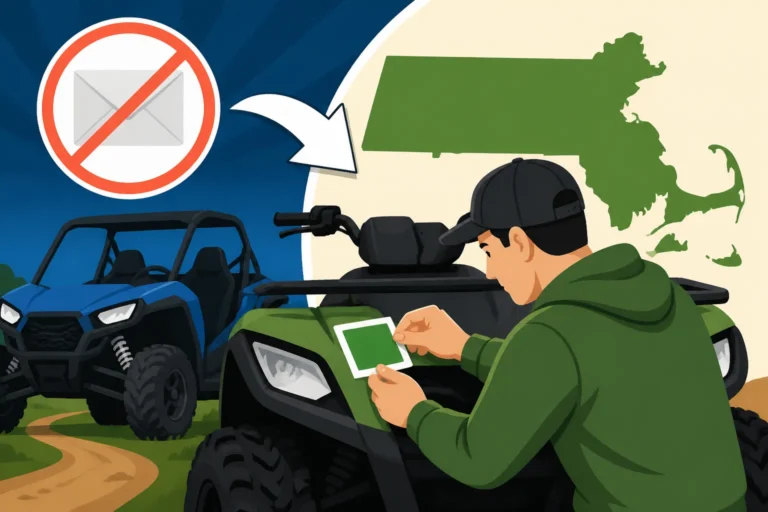
Upon successful registration, the Massachusetts Environmental Police will mail you a set of registration decals. These aren't just decorative stickers; they are essential proof that your machine is legally registered. The state has specific rules about where these decals must be placed on your ATV or UTV. Generally, the main registration decals, which display your unique registration number, must be affixed conspicuously on both sides of the forward half of the machine. They must be visible and legible.
In addition to the main decals, you will also receive a smaller expiration decal. This decal indicates the year your registration expires and must be placed on the left side of your machine, adjacent to the main registration decal. It's important to follow these guidelines precisely. Improper placement can lead to questions from Environmental Police officers during trail checks, potentially causing unnecessary delays or even a citation. Make sure the surface is clean and dry before applying the decals for maximum adhesion. For precise instructions, refer to [Massachusetts Decal Placement Rules].
Carrying Your Registration Card
Think of your ATV or UTV registration card like your driver's license for your off-highway vehicle. It's a small, physical card that contains all the pertinent information about your machine and its registration status. Massachusetts law specifically requires that this registration card be carried on board the ATV or UTV whenever it is being operated. This means it needs to be with you – in your pocket, a fanny pack, or a secure, waterproof compartment on your machine – whenever you're out riding.
It is vital that you can produce this card upon demand by an Environmental Police Officer. Just having the decals on your machine isn't enough; the card serves as the official document proving legal ownership and registration. Losing this card means you need to obtain a duplicate, and operating without it can result in penalties. Always ensure you have it before heading out to the trails. This rule is clearly outlined in [Massachusetts Registration Cards Carried on Board].
How to Handle Renewals and Lost Items
All good things, even ATV registrations, eventually expire. For Massachusetts residents, your two-year registration will need renewal after its term. For non-residents, it's an annual renewal. The MEP typically sends out renewal reminders, but it's ultimately your responsibility to track your expiration date and initiate the renewal process. Renewing is usually simpler than the initial registration, often doable online through the MEP portal, requiring updated information and payment of the renewal fee. Planning ahead for [Massachusetts ATV Registration Renewal] ensures you don't have a lapse in legal riding.
What happens if you lose your registration card or one of your decals? Accidents happen, and decals can peel or get damaged on the trail. If your card goes missing, you'll need to apply for a duplicate. Similarly, if a decal is lost or destroyed, you'll need to request a replacement. There is a nominal fee for duplicate cards and decals. It's important to do this promptly, as operating without a valid card or proper decals can lead to fines. The process for requesting these replacements is usually outlined on the Environmental Police website. For replacing a lost decal, specifically, see [Massachusetts Duplicate Sticker at $5.50].
Special Scenarios for ATV Registration
While the general registration process covers most situations, there are a few special scenarios that might arise, each with its own set of nuances. Whether you're buying a used machine from a friend, receiving one as a gift, or registering an OHV for a business, understanding these specific requirements can prevent headaches and ensure compliance.
Registering a Used Machine After a Private Sale
Buying a used ATV or UTV from a private seller is a common way to get into the sport, but the registration process differs slightly from buying new. As mentioned before, the most critical document here is a comprehensive Bill of Sale. This document must clearly identify both the seller and the buyer, detail the machine (make, model, VIN), list the sale price, and be signed by both parties. It's a good practice to use a robust template for this, such as those available on LawDepot, to ensure all legal requirements are met and to protect both parties. Make sure the VIN on the bill of sale matches the actual VIN on the machine perfectly.
Beyond the Bill of Sale, you'll also be responsible for paying Massachusetts sales tax directly to the Department of Revenue using Form ST-6, as the private seller typically won't collect it. The Environmental Police will want to see proof that you've filed this form and paid the tax. It's also wise to ensure the previous owner's registration is officially "canceled" or that they provide you with a valid transfer of ownership document if they had one. For more information, read [Massachusetts Registration After a Private Sale].
Inherited or Gifted Machines
Receiving an ATV or UTV as a gift, or inheriting one after the passing of a family member, is a thoughtful gesture, but it doesn't exempt you from the registration process. The good news is that in cases of bona fide gifts between immediate family members (or certain other circumstances), you might be exempt from paying the Massachusetts sales tax. To claim this exemption, you'll typically need to file a Form ST-6E, the Sales Tax Exemption Certificate. This form will explain the nature of the gift or inheritance and why the sales tax should not apply.
However, even with a sales tax exemption, you still need to provide proof of ownership. For a gifted machine, a notarized gift letter or a bill of sale indicating "gift" as the purchase price is usually required, clearly stating the transfer of ownership. For an inherited machine, you might need to provide documentation such as a death certificate, probate court documents, or a letter from the estate executor demonstrating your legal right to the machine. Always check with the Environmental Police or the Department of Revenue for the specific documentation required for your situation to ensure a smooth transfer and registration. See [Massachusetts Registration for an Inherited Machine] for more context.
Business or Rental Fleet Registration
If you're operating an ATV or UTV for a business purpose, such as a rental fleet, a commercial guiding service, or for farm work, the registration requirements are generally the same as for personal machines. Each individual OHV in your fleet must be registered with the Massachusetts Environmental Police. This ensures that every machine operating on public or authorized private land is accounted for and contributes to the OHV Trail Fund.
However, businesses may have additional layers of administrative responsibility. For example, maintaining accurate records for each machine, ensuring all operators (especially employees or renters) meet age and safety certificate requirements, and perhaps carrying commercial insurance, even though personal OHV insurance is optional in Massachusetts. When purchasing multiple machines for a fleet, you'll still need MCOs for new vehicles or Bills of Sale for used ones, and you'll manage sales tax for each. Keeping meticulous records and potentially consulting with a legal professional or the MEP directly for large-scale fleet registration can streamline the process for your operation. You can learn more about specific rules at [Massachusetts Registration for a Business Machine].
Common Pitfalls and How to Avoid Them
Even with a clear understanding of the process, it's easy to stumble into common mistakes when registering an ATV or UTV in Massachusetts. These pitfalls often lead to frustrating delays, rejected applications, or even penalties. Being aware of these common issues beforehand can help you navigate the process smoothly and get your machine registered on the first try.
Missing Paperwork Mistakes
One of the most frequent reasons for a rejected or delayed registration application is incomplete or missing paperwork. It's easy to overlook a signature, forget to attach a copy of an MCO, or provide an incomplete Bill of Sale. Forgetting to provide proof of sales tax payment or exemption is another major holdup. The Environmental Police need every piece of the puzzle to verify ownership and compliance. Imagine spending hours filling out forms, only to have it returned because a single box was unchecked or a document wasn't scanned properly.
To avoid this frustration, treat your application like a checklist. Before submitting, review every item requested by the MEP. If you're using a Bill of Sale, double-check that it includes all the necessary details such as the VIN, purchase price, and signatures of both parties. If you obtained a template from LawDepot, ensure you've filled out every field relevant to Massachusetts' requirements. Make copies of everything you submit, whether digitally or by mail, so you have a record. Being meticulously organized here will save you immense time and effort in the long run. For a full checklist, see [Massachusetts Registration Paperwork Checklist].
Misunderstanding Sales Tax Rules
Massachusetts' sales and use tax rules for OHVs can be a significant source of confusion, particularly for those buying from private sellers. Many private buyers mistakenly believe that if they didn't pay sales tax at the point of sale, they don't owe it. This is a critical misunderstanding. If a private seller doesn't collect sales tax (which they generally won't), the buyer is still legally obligated to pay the use tax directly to the Massachusetts Department of Revenue. This must typically be done within 20 days of purchase using Form ST-6.
Failing to pay this tax or provide proof of payment/exemption will halt your registration dead in its tracks. The Environmental Police will not issue a sticker for a machine unless the sales tax obligation has been met. The frustration of having your application paused because of a tax technicality can be immense. If you're unsure about your sales tax obligations, especially for out-of-state purchases or unique scenarios like gifts, it's always best to contact the Massachusetts Department of Revenue directly for clarification before attempting to register.
Ignoring Decal and Card Requirements
Finally, a common pitfall often occurs after the registration is complete: neglecting the proper display of decals and carrying the registration card. Some riders might casually stick their decals wherever they fit, or forget to put the expiration decal on the correct side. Others might leave their registration card at home, tucked away for safekeeping. While these might seem like minor details, they are indeed legal requirements. An Environmental Police Officer conducting a trail check will expect to see correctly placed decals and for you to produce your physical registration card immediately.
Failure to comply can result in a citation. It's not just about having the registration; it's about being able to prove it on demand and displaying it correctly. Take the time to properly affix your decals as per MEP guidelines on [Massachusetts Decal Placement Rules], and get into the habit of always securing your registration card on your person or within a waterproof compartment on your machine before every ride. This simple adherence to the rules ensures your adventures on Massachusetts trails remain hassle-free and fully legal.
Disclaimer
This article is for general informational purposes only and does not constitute professional advice. Laws, prices and regulations vary by location and change over time. Consult a qualified professional for guidance on your specific situation.