How to Get a Massachusetts Safety Certificate
Getting a Massachusetts safety certificate can feel confusing because the process has more than one part, and a certificate is not the same as an ATV registration or trail permit. Here’s how to find the right course, complete the required steps, and understand when young riders need to carry proof.
Who needs a Massachusetts safety certificate
Massachusetts requires riders under 18 to complete an approved off-highway vehicle safety course. The requirement applies to young ATV and UTV operators; the state’s age rules also limit who may ride, what machines they may use, and when adult supervision is required. A certificate does not override those rules.
The requirements differ by age. In particular, riders under 16 have parent-attendance requirements for the course, and a young rider’s certificate does not make an otherwise prohibited ride legal. Check Massachusetts ATV Age Requirements and Massachusetts Rules for Young Riders on Public Land alongside the course requirements.
| Rider situation | What to check |
|---|---|
| Under 18 | Complete the required safety course and carry the certificate where required |
| Under 16 | Confirm the parent-attendance requirement before enrolling |
| Under 14 | Check the strict age limits; a certificate does not make ordinary trail riding legal |
| Adult rider | The under-18 certificate rule does not apply, but other riding rules still do |
| Visiting rider | Confirm Massachusetts requirements rather than assuming an out-of-state card or sticker is enough |
The certificate shows that the young rider completed safety training. It is not a driver’s license, vehicle registration, landowner’s permission, or trail pass. A Massachusetts registration is a separate requirement for machines that must be registered; an out-of-state registration sticker does not automatically take its place. See Massachusetts Requires Its Own Registration for the registration distinction.
For riders under 18, carrying the certificate matters as well as earning it. Keep a usable copy with the rider when operating where the certificate is required, and ask the relevant course or state office how to replace or retrieve it if it is lost. The details are covered in Riders Under 18 Must Carry the Certificate.
How to get the certificate
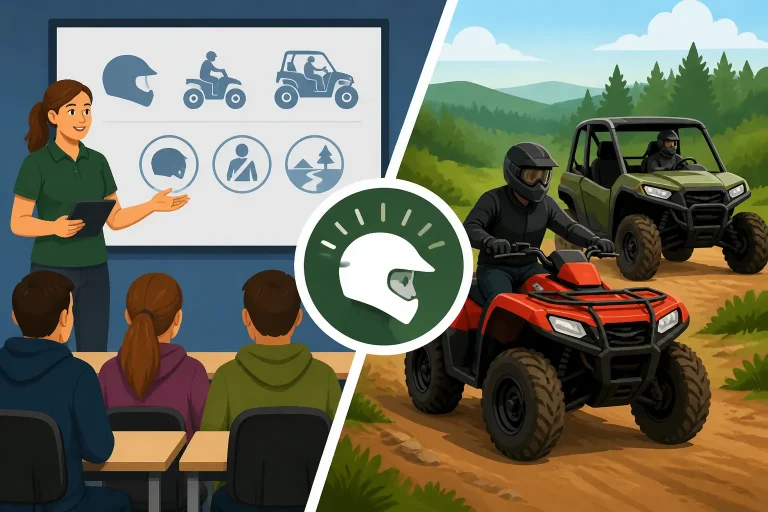
Massachusetts training is organized in two parts: an online course and an in-person component. The exact enrollment steps and available sessions can change, so check the current course provider and schedule before making plans. The overview at Massachusetts Two-Part Safety Course explains how the parts fit together.
- Check the rider’s age and eligibility. Confirm the rider’s age-specific operating rules before enrolling. If the student is under 16, make sure a parent or guardian can attend as required. See Massachusetts Parent Attendance Rules before choosing a date.
- Find the current online course. Use the Massachusetts course information to identify the approved online option and its registration instructions. Do not assume that any general ATV safety course found online will satisfy the state requirement. [Massachusetts Online Course Provider] is a useful place to check the provider details.
- Complete the online portion. Follow the provider’s instructions and save any completion confirmation. If the course requires a record or document to move on to the in-person portion, keep it accessible.
- Book the in-person session. Check the state schedule for an available session and confirm its location, arrival time, and what the student must bring. Dates and locations can vary, so avoid relying on an old schedule or an informal listing. See Massachusetts Course Schedule Lookups.
- Attend and complete the in-person requirements. The in-person component includes safety instruction and a skills evaluation. Ask the course organizer what the evaluation involves and whether the student should bring a machine or any gear; do not assume either is provided.
- Confirm that completion is recorded. Before leaving, ask how the certificate will be issued and how to verify it. Keep the certificate or proof of completion in a safe, accessible place.
The online course and in-person session work together; finishing only one part is not a reason to assume the rider has completed the full requirement. If a student has taken training in another state, ask Massachusetts officials or the course provider whether that credential is accepted. Do not treat a home-state course or sticker as proof of Massachusetts compliance without confirmation.
What to expect from the course and skills test
The online portion gives students a structured introduction to safe off-road riding. Topics generally include operating responsibly, understanding hazards, using protective equipment, and recognizing how rider choices affect other trail users and the environment. The in-person session allows students to work through safety instruction and demonstrate practical skills. For the specific format and requirements, check Massachusetts In-Person Skills Test.
A skills evaluation is not just a formality. It gives the student a chance to show basic control and safe decision-making in a supervised setting. The course provider can explain what equipment or clothing is expected for that session. If the student is nervous about the practical portion, asking questions in advance is better than arriving unsure about what to bring or do.
For a student under 16, the adult should review the attendance instructions before booking. The parent or guardian may need to plan for the full session, not simply drop the student off. Confirm the requirement directly when enrolling, especially if the course listing is brief. See Massachusetts Certificate Rules Under 16 for the age-specific details.
Course availability may depend on location and season. If no convenient session appears, check again or contact the listed course office for guidance rather than assuming the course is unavailable. The contact information and booking process can be found through Massachusetts Safety Bureau Contacts. Since course providers can change schedules and procedures, verify the current details before traveling.
The certificate is only one part of riding legally and safely. A rider may also need to meet age and supervision rules, use a properly registered machine, follow equipment requirements, and have permission to ride on the land. Training does not grant access to a forest, private property, or a trail that is closed to ATVs or UTVs.
After completion: carrying proof and avoiding mistakes
Once the rider has completed both required parts, find out how the certificate is issued and whether the rider receives a physical card, a record, or another form of proof. Keep it in a place where it can be found before a ride. If the certificate is lost or the student’s name is recorded incorrectly, contact the course provider or the relevant state office instead of relying on a photo of an unrelated course document.
Common errors are easy to avoid:
- Stopping after the online course. Confirm that the in-person requirement and skills evaluation are complete, too.
- Enrolling in a course without checking approval. A course that sounds relevant may not meet Massachusetts requirements. Verify the provider before paying or scheduling.
- Forgetting the parent-attendance rule. If the student is under 16, confirm who must attend and when.
- Assuming a certificate changes the age rules. It does not allow a rider to use a machine or trail that is restricted for that age group.
- Confusing a certificate with registration. The rider’s training record and the machine’s registration are separate. Keep the required registration card with the machine as well; The Registration Card You Must Carry in Massachusetts explains that obligation.
- Assuming an out-of-state credential is automatically accepted. Ask for confirmation if the rider trained elsewhere or is visiting Massachusetts.
Before the first ride, check that the certificate requirement is satisfied, the machine’s registration is current, and the rider’s age, supervision, equipment, and location all meet Massachusetts rules. For a visiting rider, separately confirm whether Massachusetts requires its own registration; do not confuse that question with whether safety training is accepted.
Disclaimer
This article is for general informational purposes only and does not constitute professional advice. Laws, prices and regulations vary by location and change over time. Consult a qualified professional for guidance on your specific situation.