Massachusetts Campgrounds Near a Forest
A camping weekend near a Massachusetts forest can sound simple until you realize that a campground, a legal ATV trail, and a route connecting the two are three separate things. This guide explains how to choose a base near Berkshire riding areas, check whether camping and riding actually fit together, and plan the tow, reservation, and trail details before you leave home.
How to choose a campground near a Massachusetts riding forest
Start with the riding area, then look for a place to camp
If riding is the main reason for your trip, choose the forest first. The western Massachusetts riding areas most often discussed by ATV and UTV riders include Beartown State Forest, October Mountain State Forest, and Pittsfield State Forest. Their trails are not interchangeable, and a nearby campground does not automatically give you permission to ride from your campsite to a trailhead.
Make a shortlist of campgrounds within a practical drive of the riding area you want to visit. Then check the campground’s rules, the forest’s riding rules, and the trailhead access details separately. A few miles on a map can still mean a drive by trailer if roads between the campground and forest are not legal or appropriate for your machine.
For a first trip, [Massachusetts ATV Trails: Three Berkshire Forests] can help you compare the main areas, while the individual guides to [October Mountain State Forest Riding in Massachusetts], [Beartown State Forest Riding in Massachusetts], and [Pittsfield State Forest Riding in Massachusetts] can help narrow down which forest best fits your group. Keep in mind that trail mileage, difficulty, permitted vehicle types, and access arrangements can differ by location.
Treat camping access and trail access as separate permissions
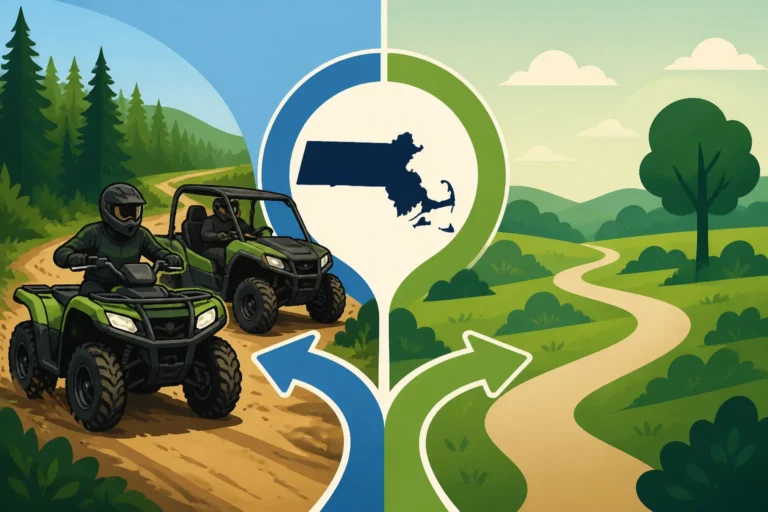
A campground may welcome tents, trailers, and families while prohibiting recreational machines on its internal roads. A forest may allow OHV riding in designated areas but have no campsite beside the legal trail network. Even when both activities are available nearby, the distance between them may need to be covered by a tow vehicle and trailer.
That distinction matters when you are planning a weekend with children or a group. If you expect to ride straight from your campsite, ask the campground directly whether machines may be unloaded and operated on its property, and whether any authorized route connects to the riding area. Do not assume a dirt road, woods road, or marked trail is open to ATVs just because it appears on a general-purpose map.
It is also worth checking whether the campground is inside a state forest, on private land, or in a neighboring town. Each setting can have its own rules for machine storage, unloading, quiet hours, fires, pets, and vehicle movement. For a broader look at where camping and riding may overlap, see [Massachusetts Trails With Camping] and [Camping Overnight Next to a Berkshire OHV Trail].
Berkshire-area camping bases to consider
October Mountain State Forest and nearby Lee
October Mountain State Forest, near Lee, is a natural place to investigate if you want a Berkshire camping trip with a riding day in the same general area. The forest has a campground, but you should still confirm its current operating arrangements and whether the campsite you are considering suits your vehicle and trailer. Camping in the forest does not, by itself, mean you can ride from your site to every trail or road.
This area can work well for a group that is comfortable separating the two parts of the trip: camp at an approved site, then tow the machine to the designated riding access point if needed. That plan may feel less spontaneous than riding out from the tent, but it is often more predictable and avoids an accidental ride on a road or trail that is not open to OHVs.
Lee and nearby Berkshire towns also give you options beyond a forest campground, including privately operated campgrounds and other lodging. Before booking, ask about trailer parking, unloading, machine storage, and whether the property has noise or equipment restrictions. If your group is staying outside the forest, confirm the drive time to the intended trailhead rather than relying only on straight-line distance.
Beartown, Pittsfield, and other nearby options
Beartown and Pittsfield State Forest are also worth considering for a riding-focused visit, but do not assume either offers the same camping setup as October Mountain. Research the legal riding area first, then search for a campground that matches your needs within a manageable towing distance. A site that is close on a map may still be inconvenient if the access roads are narrow, steep, or unsuitable for a truck and trailer.
Nearby communities such as Great Barrington, Becket, and Pittsfield can be useful starting points for checking private campgrounds, cabin stays, and other overnight options. Availability and operating policies can vary, so ask whether a property permits off-road machines on site and whether it has room for your tow vehicle and trailer. If a campground cannot accommodate the trailer, you may need to find another base even if the location looks ideal.
A quick comparison helps keep the decision practical:
| Trip priority | What to look for | Question to ask before booking |
|---|---|---|
| Camp close to a riding area | A campground within a reasonable tow of the legal trailhead | How long is the drive to the specific trail access point? |
| Bring a large trailer | Wide access roads and adequate parking | Can the site accommodate my truck and trailer together? |
| Ride with children | Clear rules, suitable facilities, and a simple daily plan | Where can the machine be unloaded, and what supervision rules apply? |
| Avoid moving camp each day | A base with access to food, fuel, and services | Are nearby roads suitable for towing, and where can I refuel? |
| Camp inside or beside a forest | A designated, bookable campsite with clear recreation rules | Are machines allowed on campground roads or only on a trailer? |
Use [Massachusetts Camping Reservations at a Forest] as a starting point for understanding reservation planning, and check the individual campground’s own information before making plans. A reservation confirms a campsite, not permission to operate an ATV or UTV there.
Planning the ride and campsite together
Verify seasonal access and trail conditions
A campground may be available when the trails you want are closed, muddy, or otherwise unsuitable for riding. Riding seasons and access rules can vary, and conditions can change after storms, during wet periods, or when maintenance work affects a route. Check the relevant forest information before setting a travel date, and check again shortly before departure.
The [Massachusetts DCR Riding Season] guide is useful context, but do not treat a general season window as a guarantee that every trail will be open on your planned weekend. For road and trail conditions, closures, and access questions, use [Massachusetts Trail Conditions Before You Tow]. If information is unclear, contact the forest office or managing agency rather than relying on an old forum post or a map label.
Mapping tools, including onX Offroad, can help you review your route and orient yourself around trail networks. They are planning aids, not proof that a road is open to your machine. Compare map information with official forest rules and posted signs, and stay on routes specifically authorized for the vehicle you are riding. A line that looks like a trail on a map could be a hiking route, an unauthorized path, or a road with restrictions.
Work through the practical details before departure
A little preparation prevents the most common campground headaches. Confirm your campsite dates, arrival procedures, trailer parking, and any restrictions on unloading or storing a machine. If your campground is separate from the riding area, map the tow route and identify the correct trailhead parking area. Check that the lot can accommodate your trailer and that you know where to unload without blocking other visitors.
Make sure the machine is ready for the specific terrain and that its registration is in order. Massachusetts registration and trail access are related but not identical: a registration sticker does not grant access to every forest, road, or private property. Review [Massachusetts Registration and Trail Access] and carry the required registration materials for your machine. If you are visiting from outside the state, check Massachusetts-specific requirements before assuming a home-state sticker is enough.
Pack for a full day away from camp. Cell reception can be inconsistent in wooded and hilly areas, so save key directions and contact information before you lose service. onX Offroad may help you review routes in advance, but keep a paper map or offline directions as a backup. Bring water, basic tools, appropriate protective equipment, and a plan for what your group will do if a machine breaks down or the weather turns.
A sensible itinerary for a Massachusetts camping and riding weekend
Before you reserve
Choose the forest and riding day before committing to a campsite. Confirm that the riding area allows your type of machine, identify the legal trailhead, and check whether the riding season and planned conditions make the trip practical. Then look for a campsite that supports your setup rather than choosing a campground solely because it appears close.
Call or message the campground with specific questions. “Do you allow ATVs?” may not be enough: ask whether machines may be parked, unloaded, or operated on the property, and whether a trailer can remain at the site. Ask about quiet hours and generator rules too, especially if your group expects to work on machines or arrive late after towing.
For navigation, onX Offroad can help you compare the general location of a campground and riding area, but verify every planned connection with the appropriate land manager. If there is no confirmed legal route between the two, plan to trailer. That small adjustment can save a stressful conversation at a gate or an unplanned detour on a public road.
On arrival and during the ride
Set up camp before unloading if the campground allows it, and keep the machine secured when it is not in use. Follow posted instructions for parking, fires, waste disposal, and quiet hours. If your riding plan involves driving to a separate trailhead, check that the whole group knows the route, meeting point, and expected return time.
At the forest, follow signs and stay within designated riding areas. Do not follow another rider onto an unmarked route simply because they appear confident. Posted closures and access restrictions take precedence over assumptions based on maps or previous visits. Keep noise considerate near campsites and homes, and avoid riding on wet or vulnerable trails when doing so could cause damage.
A good trip is not measured by how many miles you cover. A manageable route, a clear return plan, and enough time to enjoy camp usually make for a better weekend than trying to squeeze in every trail. Leave the campsite tidy, secure your equipment, and check for updated access information before planning a return visit.
Disclaimer
This article is for general informational purposes only and does not constitute professional advice. Laws, prices and regulations vary by location and change over time. Consult a qualified professional for guidance on your specific situation.