Massachusetts Trails Near Fall River
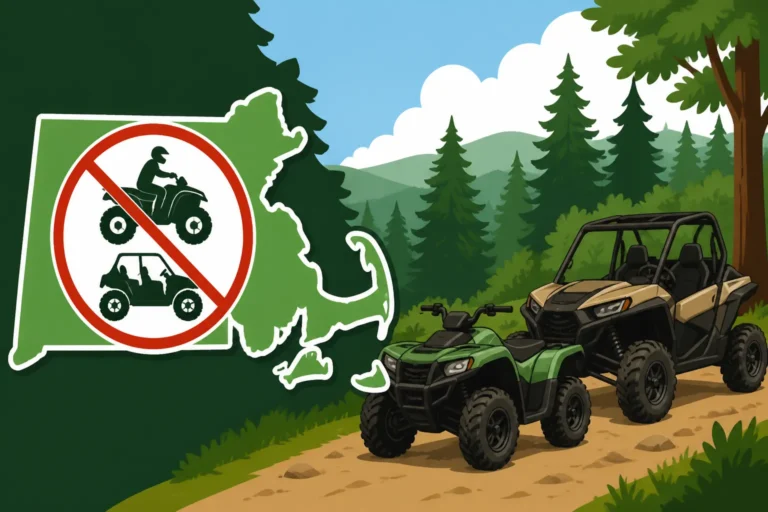
If you’re looking for ATV or UTV trails near Fall River, the first frustrating surprise is that the nearby Freetown-Fall River State Forest is not a general-purpose quad destination: its designated OHV riding is for motorcycles, not ATVs or side-by-sides. This guide explains what that means, how to check options before you tow, and how to avoid arriving at a trailhead where your machine isn’t allowed.
What to know about riding near Fall River
Freetown-Fall River State Forest is not an ATV or UTV trail option
Freetown-Fall River State Forest is the obvious place many riders search for when planning a ride near Fall River. But its well-known OHV trails are single-track routes for motorcycles, not open trails for four-wheel ATVs or UTVs. A quad or side-by-side registration sticker does not change the vehicle restrictions for a trail.
That distinction matters when you’re planning around a truck, trailer, and a full day away from home. You may see “OHV” or “off-road” in a description and assume it includes your machine. It doesn’t necessarily. In Massachusetts, the trail’s designation and land manager’s rules matter; the fact that a vehicle is registered for off-highway use is not permission to ride it on every off-road route.
Before making the drive, check the current forest information and confirm the permitted vehicle type. For more background on the area, see [Freetown-Fall River's Motorcycle Trails in Massachusetts] and [Freetown-Fall River's Single Track Is Motorcycle Only]. The broader distinction is also covered in [Massachusetts Eastern Forests Are Bike-Only].
Why the local search can be confusing
Search results and trail maps often use broad terms such as “OHV,” “motorized trail,” or “off-road recreation.” Those labels can describe a category of recreation without telling you whether a particular route allows ATVs, UTVs, or only motorcycles. A line on a map might show a trail’s location, but not its permitted vehicle type, seasonal status, or current closure.
This can be especially confusing for UTV owners. Side-by-sides are wider than many motorcycles and quads, and a narrow route can be unsuitable even if some kind of motorized riding is allowed nearby. Don’t assume that a route suitable for a dirt bike will accommodate a UTV, or that a quad route automatically allows a larger side-by-side.
A tool such as onX Offroad can help you orient yourself, compare mapped routes, and plan a general area to investigate. Treat it as a planning aid rather than proof of legal access: confirm the route’s current rules with the land manager before you load up. If you’re comparing possible destinations across the state, [Massachusetts Trails That Allow Side-by-Sides] and [Massachusetts Trails That Allow Dirt Bikes Only] can help clarify why vehicle-specific listings matter.
| What you’re checking | Why it matters near Fall River | What to confirm |
|---|---|---|
| Vehicle type | A trail may be motorcycle-only rather than open to ATVs or UTVs | Whether your exact machine type is allowed |
| Trail status | A mapped route may be closed, seasonal, or under review | Current access and closure notices |
| Vehicle width | A route may be too narrow for a side-by-side | Any width restrictions or physical limitations |
| Registration | Massachusetts has its own OHV registration rules | Whether your machine needs Massachusetts registration |
| Parking and access | Trail access may have separate parking requirements | Where to park and whether a fee or permit applies |
How to find a suitable riding option
Start with the vehicle, not just the destination
When you search for “ATV trails near Fall River,” make your first question: what kind of machine is actually permitted? Search separately for ATV access and UTV or side-by-side access. A general OHV listing isn’t enough, and a motorcycle-only route should be crossed off before you plan travel around it.
Then check the land manager’s rules for the specific property. Look for permitted machine types, open dates, trail closures, parking arrangements, and any required permits. If a listing is unclear, ask the office or manager directly. A short call can save a long drive with a trailer, especially if the route is described in a way that doesn’t distinguish between motorcycles and four-wheel machines.
If you use onX Offroad to build a shortlist, note the names of the places and trails you want to verify. Then compare that shortlist with information from the land manager. Apps can help you see where a route appears to run, but they may not answer whether your UTV is allowed there today. Don’t rely on a route line, user comment, or old ride report as permission to enter.
Consider private riding areas only after checking their rules
If public land near Fall River doesn’t offer an appropriate ATV or UTV trail, a private riding park may be another possibility. But private areas set their own rules, and access can depend on the type and size of your machine, age requirements, helmet rules, sound limits, operating dates, and reservation or waiver procedures.
Before making plans, ask whether the park allows your specific ATV or UTV model and whether the trails match your experience level. For a side-by-side, mention its width and seating configuration rather than simply saying “UTV.” Ask about trailer parking, required equipment, current trail conditions, and what happens if weather closes the property. Rules can vary from one private facility to another, so don’t assume that permission at one park carries over to another.
For a useful starting point, review [Massachusetts Private Riding Parks] and [Massachusetts Private Park Waivers and Rules]. If you find a park that appears suitable, verify its details directly before leaving Fall River. A map app such as onX Offroad can help with route planning to the area, but the operator’s current rules should decide whether you ride there.
Prepare before hauling your machine
Check registration and visitor requirements
Massachusetts registration is a separate issue from trail permission. A machine may need to meet state registration requirements even when you’re visiting from nearby Rhode Island or another state. Likewise, having a valid sticker does not grant access to a property that does not allow your vehicle type.
If your machine is registered outside Massachusetts, check the state’s visitor rules before riding. Massachusetts does not treat an out-of-state sticker as automatic permission to use its OHV trails. Review [Massachusetts Requires Its Own Registration] and [Massachusetts Visitors Buy a One-Year Sticker] to understand the registration question before you travel.
Keep the registration card with the machine as required, and make sure the decal is properly displayed. If you are bringing a youth rider, check age, supervision, and safety-certificate rules as well. The regulations can affect whether a ride is appropriate even when the trail itself is open. Start with [Massachusetts Safety Certificates Under 18] if a rider under 18 will be joining you.
Verify land access, parking, and trail conditions
A legal trail and a practical ride day are not always the same thing. You still need a lawful place to park and unload, a route that allows your vehicle, and current access. Before you leave, confirm that the trail is open, the entrance is accessible, and the parking area can accommodate your truck and trailer. Check whether parking or other access charges apply; a registration sticker is not necessarily a parking pass.
Trail conditions can change after heavy rain, storms, or seasonal closures. A route that was open on a previous visit may not be open now, and muddy ground can be especially vulnerable to damage. Check the land manager’s notices close to your planned trip. If the information is uncertain, call rather than assuming that a route shown on a map is currently rideable.
Use onX Offroad or another mapping tool to plan your drive and keep track of potential locations, but make a separate confirmation checklist for each stop: vehicle type, open status, access point, parking, and any required permit. For broader planning, [Massachusetts Trail Planning and Closures] and [Massachusetts Trailhead With Trailer Parking] are useful topics to review. The second title’s exact listing is [Massachusetts Trailheads With Trailer Parking].
A practical plan for Fall River riders
Build a short verification routine
A reliable search is less about finding the most promising map pin and more about ruling out places that don’t fit your machine. Start by listing the vehicle you plan to ride: ATV, UTV, or motorcycle. Then identify candidate locations and verify each one with the land manager or operator. If a listing only says “OHV,” ask what kinds of machines are included.
Next, confirm the details that can derail the day: whether the route is open, whether your machine’s size is permitted, where you can unload, what paperwork or permits are required, and whether any age or safety rules apply to your group. Save the relevant contact details and the directions to the approved entrance. If you’re using onX Offroad, keep your map as a navigation reference, not a substitute for those confirmations.
Finally, have a backup plan that is genuinely legal for your vehicle. If the nearby forest route is motorcycle-only, don’t treat it as a quad ride with a small workaround. Choose a destination that expressly allows your machine, or postpone the trip until you’ve confirmed a suitable option.
Use this checklist before you leave
- Confirm that the property permits your exact type of machine.
- Check the current trail status and any seasonal restrictions.
- Ask whether UTV width or other machine dimensions are limited.
- Verify registration, decals, and any required visitor sticker.
- Check parking, trailer access, permits, and fees with the land manager.
- Review age, supervision, and safety-certificate requirements for young riders.
- Pack the registration card and any other required documents.
- Use a map for navigation, then follow posted signs and land-manager instructions.
- Don’t enter a route simply because it appears on an app or an older map.
For Fall River-area riders, the most important takeaway is straightforward: Freetown-Fall River’s nearby motorized trails are not a general ATV or UTV destination. Confirm the vehicle rules before you tow, and base your plans on current access information—not just a map label or the word “OHV.”
Disclaimer
This article is for general informational purposes only and does not constitute professional advice. Laws, prices and regulations vary by location and change over time. Consult a qualified professional for guidance on your specific situation.