Massachusetts Clubs That Maintain Trails
A Massachusetts riding day can be cut short by a closed gate, a storm-damaged trail, or uncertainty about who is allowed to use a route. Local clubs and volunteer groups help care for designated riding areas, but their work does not make every woods road open to ATVs or UTVs. Here’s how trail stewardship works, how riders can help, and what to check before heading out.
How Massachusetts trail maintenance works
Clubs help care for trails, but they do not open them
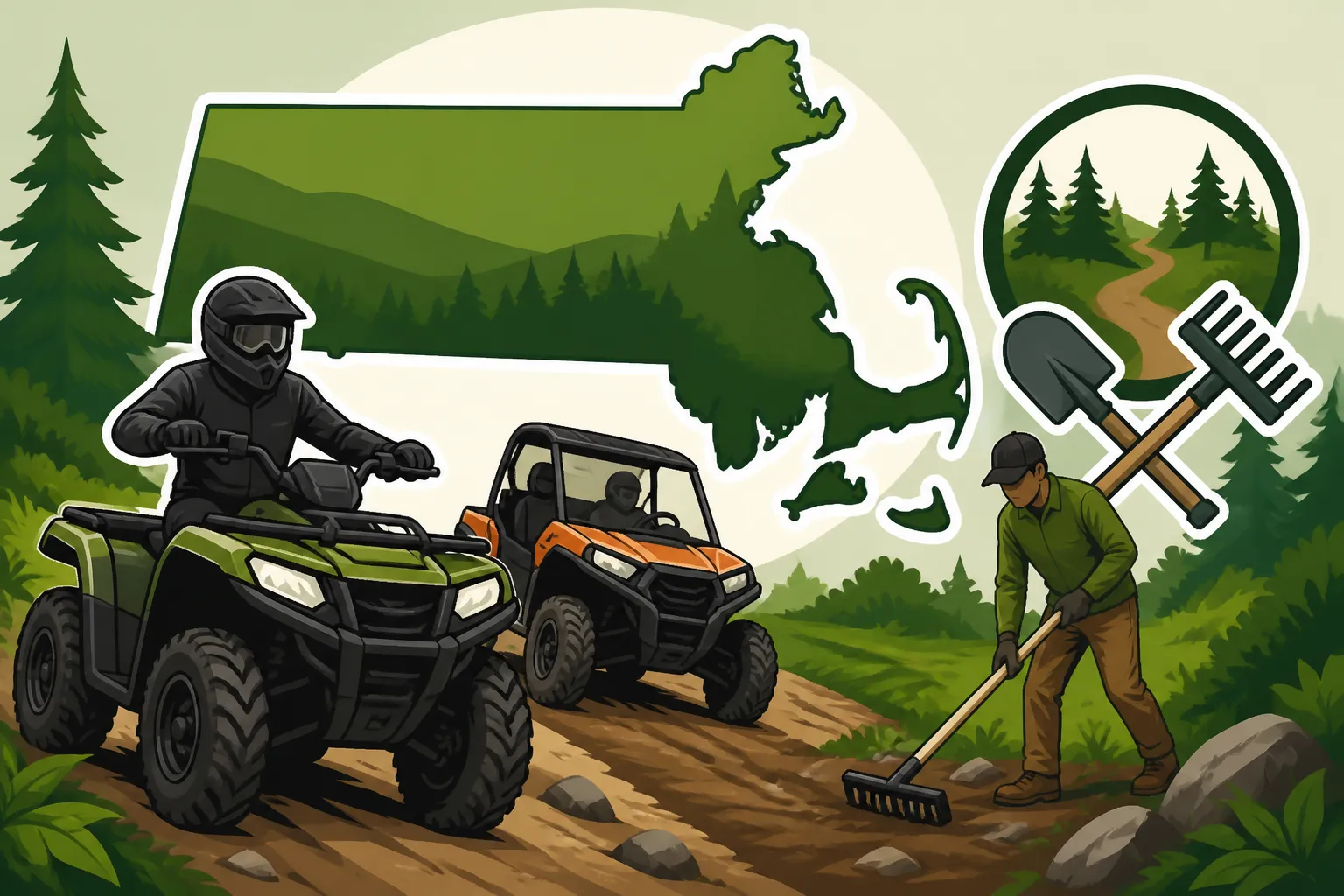
Trail clubs and volunteer groups can contribute labor, local knowledge, and equipment to trail maintenance. Work may include reporting fallen trees, clearing approved sections, helping with erosion control, picking up litter, or sharing information about conditions. This work matters most after weather events, when one blocked route can affect access or push riders toward a fragile area.
But maintaining a trail and authorizing public riding are different things. A volunteer group cannot turn an unapproved path into a legal ATV route simply by clearing it. On public land, the managing agency sets the rules, determines which routes are open to off-highway vehicles, and may close sections for safety, conservation, or maintenance. Private land requires the owner’s permission.
That distinction is easy to miss when a route appears on a map or has fresh tire tracks. A trail’s physical condition does not establish that it is open to OHVs. Before visiting, review [Massachusetts ATV Trail Map Downloads](Massachusetts ATV Trail Map Downloads) and check the relevant land manager’s current notices. For a broader look at the state’s designated riding areas, see [Massachusetts ATV Trails: Three Berkshire Forests](Massachusetts ATV Trails: Three Berkshire Forests).
Public agencies and volunteers have separate responsibilities
In Massachusetts, riders often focus on the Berkshire riding areas, including Beartown State Forest, October Mountain State Forest, and Pittsfield State Forest. These are not interchangeable with every nearby woodlot, logging road, or power-line cut. The state manages designated routes and can impose seasonal rules or closures. Volunteer organizations may support stewardship, but they do not replace that management role.
This division can feel frustrating when a trail needs attention and a volunteer is ready to help. Still, work on public land needs to be coordinated. Cutting vegetation, moving rocks, digging drainage channels, or using machinery without approval can create environmental damage or conflict with land-management plans. Even well-intentioned repairs can change water flow or widen a trail.
A club working with land managers can help direct volunteer effort toward useful, approved tasks. That coordination also gives officials a way to share priorities, such as where a storm has caused damage or where repeated riding is creating ruts. The relationship between volunteers and agency staff is discussed in [How the Berkshire Trails Council Works With Rangers](How the Berkshire Trails Council Works With Rangers).
What trail clubs and volunteers contribute
Routine stewardship keeps small problems from growing
Trail maintenance is not only dramatic work with chainsaws after a storm. Much of it is noticing small problems before they become larger ones. A shallow rut can deepen when riders repeatedly spin their tires through it. A drainage dip that is partly blocked can send water down the trail instead of off it. Litter left at a pull-off can attract more dumping and make a riding area harder to care for.
Clubs may help by passing along accurate observations, organizing approved work days, or encouraging members to stay on designated routes. That local knowledge is valuable: someone who rides regularly may notice that a trail has become difficult to pass, that a sign is missing, or that a downed tree is forcing riders to go around it and widen the corridor.
Volunteer activity does not necessarily mean every trail receives regular maintenance or that all routes are suitable for every machine. Conditions and resources vary. A responsible club explains what work is approved and where, rather than inviting riders to “fix” a trail on their own. For a closer look at post-storm volunteer efforts, read [Local Clubs That Clear Blowdowns After a Storm](Local Clubs That Clear Blowdowns After a Storm).
Trail etiquette is part of maintenance
How people ride can reduce the amount of repair a trail needs. Staying on the marked route, avoiding unnecessary wheel spin, and giving wet or vulnerable sections time to recover can help limit erosion. If a route is blocked, riding around the obstacle through brush may turn a narrow trail into a wider scar. It is usually better to report the obstruction and follow posted directions than to create a new route.
Sharing space thoughtfully matters too. Riders may encounter hikers, work crews, wildlife, or other trail users. Slow down where visibility is limited, yield when appropriate, and leave room for people to move safely. Avoid revving or accelerating aggressively near trailheads, campsites, and homes. These choices are not just courtesy; repeated noise, dust, and damage can undermine local support for riding access.
A useful rule is to leave a trail no worse than you found it. Pack out trash, do not move signs, and do not remove branches or barriers unless the managing agency has asked for that work. More practical guidance appears in [Massachusetts Trail Etiquette Locals Expect](Massachusetts Trail Etiquette Locals Expect) and [Riding Etiquette When You Meet Hikers](Riding Etiquette When You Meet Hikers).
Finding and supporting a Massachusetts riding club
Start with the area you actually ride
If you ride in the Berkshires, begin by looking for organizations connected to the local riding area and its land managers. The Berkshire Trails Council is one relevant organization to learn about when researching trail stewardship in the region. Ask what its current role is, whether it coordinates volunteer opportunities, and whether it works with the agency responsible for the land you plan to visit.
A club’s name or social-media page is not enough to establish that it is authorized to maintain a specific route. Ask which agency approves its work, what kinds of activities volunteers can do, and how closures or hazards are reported. If you are considering a group ride, confirm that the route is open to your vehicle type and that the group understands local rules. Riders looking for other ways to get involved can also review [Massachusetts ATV Clubs Worth Joining](Massachusetts ATV Clubs Worth Joining).
When evaluating a club, look for clear communication about safety, environmental care, and legal access. A responsible group should encourage members to follow posted restrictions, respect private property, and avoid riding on unauthorized paths. It should also be comfortable saying that a route is closed or that a particular volunteer task needs land-manager approval.
Ask specific questions before volunteering
Volunteer work should be useful, safe, and authorized. Before signing up, ask who will lead the work, whether the land manager has approved it, what tools or protective equipment are needed, and whether the task is appropriate for your experience. Do not assume that owning an ATV or UTV means you should bring it to a work day. Some projects call for hand tools, walking inspections, or reporting rather than machine access.
Clarify where to meet and which routes are accessible to volunteers. A work site may be far from the public trailhead, or it may be on a section where recreational riding is restricted. If you are asked to operate a machine, confirm what it will be used for and who is responsible for directing the work. Avoid taking on chainsaw, equipment, or construction tasks unless you are qualified and have been asked to do them.
There are also useful ways to help without performing physical maintenance. You can share accurate closure information, report a hazard through the appropriate channel, attend a public meeting, or encourage fellow riders to stay on designated trails. For a group outing, planning around route conditions and vehicle suitability can reduce the chance of damage; [Massachusetts Group Ride Planning](Massachusetts Group Ride Planning) offers related planning considerations.
| What a rider notices | A helpful response | What to avoid |
|---|---|---|
| A fallen tree blocks a designated route | Report its location to the land manager or approved club contact | Cutting it or making a new path around it without permission |
| A trail has deep ruts or standing water | Avoid worsening the damage and report the condition | Spinning tires through the wet section or widening the trail |
| A sign is missing or damaged | Share the location with the responsible agency | Replacing, moving, or altering signs yourself |
| Trash is left at a trailhead | Pack out what you can safely carry and report larger dumping | Leaving items behind or dumping collected debris elsewhere |
| A route appears on a digital map but has no clear signage | Check official access information before riding | Treating a map line or tire tracks as proof of legal access |
Preparing for a ride while respecting trail conditions
Confirm access, closures, and machine fit
Before you tow to a forest, check whether the riding area is open and whether any temporary closures or restrictions apply. A route can be closed because of weather damage, maintenance, environmental concerns, or other management needs. If you cannot confirm access, do not assume that a trail is open just because it was open on an earlier visit.
Check that the route permits your type and size of machine. A side-by-side may be too wide for a particular trail even when smaller OHVs are permitted. Width, turning room, and trail surface all matter. A map showing a route does not necessarily tell you whether a UTV can pass without leaving the designated corridor or damaging the trail edge. Review [Massachusetts Trails That Allow Side-by-Sides](Massachusetts Trails That Allow Side-by-Sides) before planning a UTV outing.
Digital maps can help with orientation, but they should be used as planning aids rather than permission documents. Some riders use onX Offroad to review routes and organize a ride. Compare any app information with the land manager’s official rules, posted signs, and current closure notices. If those sources conflict, follow the applicable land-manager guidance and do not ride a route whose status is unclear.
Pack and ride for changing conditions
Massachusetts trail conditions can shift quickly after heavy rain, wind, or seasonal changes. A route that was easy to pass on a dry day may become slippery or vulnerable to rutting when saturated. If a trail is visibly soft, avoid forcing a machine through it. Turning back is inconvenient, especially after a long drive, but it can prevent lasting damage and help preserve access for other riders.
Bring the essentials for your planned route, including water, basic recovery supplies, a way to communicate, and a paper backup for navigation when practical. Mobile coverage may be unreliable in some wooded or hilly areas. onX Offroad or another mapping tool can help with route awareness, but a phone battery, signal, or map layer should not be your only plan.
If you find a hazard, note its location as accurately as possible and report it through the relevant agency or club contact. A photo may help show what is happening, but do not block the trail or put yourself in danger while documenting it. If you are planning a trip around a particular forest, the local guidance in [Massachusetts Trail Conditions Before You Tow](Massachusetts Trail Conditions Before You Tow) and [Checking Rules Before a Long Drive to the Berkshires](Checking Rules Before a Long Drive to the Berkshires) can help you build a sensible pre-trip checklist.
Keeping access sustainable for riders and communities
Why responsible volunteer work benefits everyone
Well-coordinated maintenance can help keep designated routes usable while reducing avoidable damage. It can also improve communication between riders and land managers. When riders report conditions clearly and follow restrictions, officials have better information about what is happening on the ground. When clubs organize approved stewardship, volunteers can contribute without duplicating work or creating new problems.
That relationship depends on trust. If riders repeatedly ignore closures, cross private land without permission, or alter trails without authorization, it becomes harder for clubs to advocate for access. Neighbors may also become less willing to support riding nearby when noise, dust, or trespass becomes a recurring concern. A single ride may seem minor, but community impressions are shaped by repeated behavior.
The same principle applies when a club shares trail information online. Be precise about the route, identify whether it is officially designated, and avoid presenting an informal connection as an open riding trail. When someone asks about an unmarked path, pointing them toward official access information is more helpful than guessing.
A few habits make a meaningful difference
You do not have to be a club officer or trail-work specialist to support responsible riding. Start by learning which agency manages the area, checking current notices, and following signs on the ground. Respect property boundaries and closures, carry out what you bring in, and tell the appropriate contact when you find a safety issue.
If you want to contribute more, contact a club or land manager before organizing work or bringing equipment onto public land. Ask about approved tasks and whether there is a formal volunteer process. If you simply want to ride with others, choose a group that takes access rules seriously and is willing to change plans when conditions make a route inappropriate.
For riders, clubs, volunteers, and land managers, the shared goal is straightforward: care for the trails that are approved for riding without treating every visible path as available. That approach protects the land, reduces conflict, and gives Massachusetts riding areas a better chance of remaining open and well managed.
Disclaimer
This article is for general informational purposes only and does not constitute professional advice. Laws, prices and regulations vary by location and change over time. Consult a qualified professional for guidance on your specific situation.