Massachusetts ATV Trails: Three Berkshire Forests
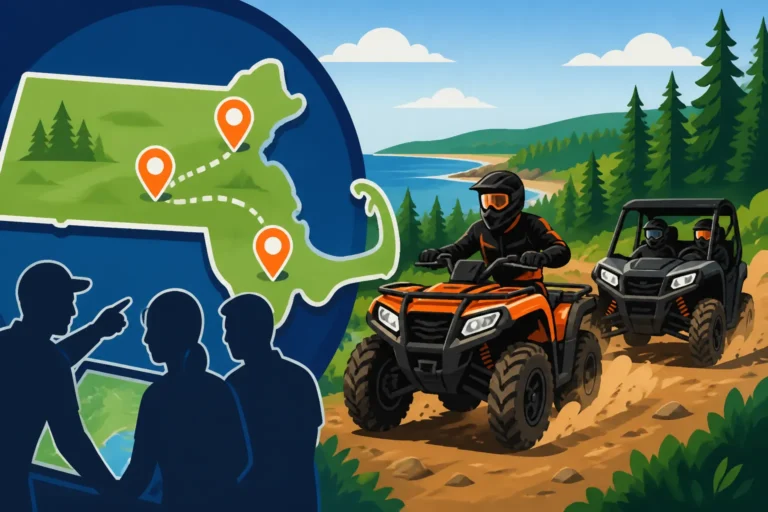
A Berkshire riding day can go sideways before the first trail if you tow to a forest that does not allow your machine, arrive outside the riding season, or discover the route is tougher than expected. This guide explains what to expect at Beartown, October Mountain, and Pittsfield State Forests, how to plan a responsible visit, and what to check before loading up.
The three Berkshire forests at a glance
Western Massachusetts has three state forests commonly associated with designated OHV riding: Beartown, October Mountain, and Pittsfield. They offer a chance to ride wooded routes in the Berkshires, but they are not interchangeable destinations. Trail mileage, terrain, access details, and the feel of a day on the machine differ from forest to forest.
The mileage figures below are useful for comparing the areas, not for promising that every listed mile will be open or suitable for every vehicle on every visit. Closures, trail conditions, and the routes authorized for a particular machine can affect the riding you can actually do. Check current official information before planning around a specific loop.
| Forest | Commonly cited riding mileage | What to keep in mind |
|---|---|---|
| Beartown State Forest | About 25 miles | A forested riding area where rocky, uneven terrain can make a short route feel demanding |
| October Mountain State Forest | About 30 miles | The largest of the three by commonly cited mileage; plan for a substantial day and changing conditions |
| Pittsfield State Forest | About 14 miles | A smaller riding area that may suit a more contained outing, though mileage alone does not determine difficulty |
Together, the three forests are often described as offering about 69 miles of OHV trails. That total is a broad comparison, not a guarantee of one continuous trail network. Routes may have separate access points, closures, or restrictions, and riders should stay on trails designated for their vehicle type.
Beartown State Forest
Beartown is often the first forest people consider when they want a Berkshire trail ride. The area is associated with roughly 25 miles of riding, but mileage does not tell you how quickly the route will go. Uneven ground, rocks, roots, mud, and changes in elevation can slow a ride considerably compared with cruising on a broad, smooth track.
Give yourself time to check where you are allowed to unload and where the designated routes begin. A large forest can have roads and paths that look rideable but are not necessarily open to OHVs. The right approach is to identify the approved riding area before you arrive, then follow posted directions and signs once you are there. For a closer look at the area, see [Beartown State Forest Riding in Massachusetts](Beartown State Forest Riding in Massachusetts).
Riders planning to explore Beartown should also think about the experience of everyone sharing the landscape. A quiet, controlled pace is especially important near trail junctions, walkers, campsites, and other areas where visibility is limited. Keep enough distance between machines to avoid swallowing another rider in dust or being caught by surprise if the lead machine stops.
October Mountain State Forest
October Mountain is commonly listed at about 30 miles of OHV riding, making it the largest of the three forests by the mileage figures commonly used for comparison. That does not mean every rider should try to cover every route in a single visit. A slower pace, a navigation stop, a change in weather, or a section that needs extra care can turn a planned loop into a full day.
Before heading out, decide what a comfortable ride looks like for your group. A first-time visitor may be happier with a modest route and time to get oriented than with an ambitious mileage target. Riders familiar with the area can still benefit from checking for current closures and trail conditions rather than assuming a route will be exactly as they remember it. More detail is available in [October Mountain State Forest Riding in Massachusetts](October Mountain State Forest Riding in Massachusetts).
October Mountain is also a place where preparation matters more than bravado. If a section looks beyond your machine or your group’s ability, turning around is a sound decision, not a failed ride. Take into account the least experienced rider, the capabilities of the least suitable machine, and the possibility that a route may be more challenging after rain.
Pittsfield State Forest
Pittsfield State Forest is commonly associated with about 14 miles of riding, less than either Beartown or October Mountain. A shorter mileage figure can make it easier to picture a compact visit, but it should not be taken as a promise that the trails are simple or that every section will be quick to ride.
The best way to plan a visit is to check which designated routes are open to your machine and how to reach the authorized riding area. Do not assume that roads within the forest are OHV routes. A sign, gate, or posted restriction takes precedence over what a line on a map might appear to show. For a forest-specific overview, see [Pittsfield State Forest Riding in Massachusetts](Pittsfield State Forest Riding in Massachusetts).
A smaller riding area can be a practical choice for a group that wants to keep a day manageable, but it still requires the same care as a larger destination. Bring a navigation plan, allow time for breaks, and avoid creating a tight schedule that pressures riders to move faster than the terrain allows.
What Berkshire OHV trails are like
Berkshire forest riding is not the same as riding a flat, maintained recreation path. Routes can pass through wooded terrain with rocks, roots, ruts, changing grades, and muddy sections. Even when a trail looks familiar on a map, its condition can feel different after a storm, during a wet stretch, or after heavy use.
No single description applies to every route or every day. A trail that feels comfortable to an experienced rider on a suitable machine may feel intimidating to someone new to off-road riding. Be honest about your group’s skills and choose a route accordingly. Trail difficulty is not just about steepness: footing, sight lines, width, surface conditions, and room to turn around all matter.
Expect uneven surfaces and changing conditions
A machine that feels steady on a gravel road may behave differently on a rocky or rutted trail. Take obstacles slowly, keep your weight balanced, and avoid sudden steering or throttle inputs when the surface is loose. If you are unsure how a section will feel, stop where it is safe to do so and look ahead before committing.
Rain can change a route quickly. A damp section may become slippery, while a muddy shortcut can tempt riders to widen the trail by going around the wet spot. That damages surrounding ground and can make the problem worse. Stay on the designated route rather than creating a new line around mud, standing water, or an obstacle.
The same caution applies to seasonal conditions. Leaves can hide rocks, holes, and roots, while spring thaw and heavy rain can leave trails soft or vulnerable to damage. If you encounter conditions that make a route unsafe or likely to be damaged by continued riding, turn back or choose another open route. [Massachusetts Trail Conditions Before You Tow](Massachusetts Trail Conditions Before You Tow) is a useful reminder to check the situation before making a long drive.
Mileage is not the same as difficulty
A 14-mile trail network is not automatically easy, and a 30-mile network is not automatically suitable for an advanced rider. Mileage tells you how much route may be available in broad terms. It does not tell you how long the ride will take, how demanding a section will be, or whether a particular machine can safely handle it.
Consider your group’s least experienced rider when choosing where to go and how much to attempt. A newer rider may need more time to practice braking, positioning, and responding to uneven ground. If the rest of the group chooses a route based only on the most confident rider, a fun day can turn into a stressful one for everyone.
Look for clear descriptions of route difficulty, but treat them as planning aids rather than guarantees. Conditions can change, and riders experience the same section differently depending on machine setup, tire condition, load, and comfort level. For more context on evaluating routes, see [Massachusetts Trail Difficulty Ratings](Massachusetts Trail Difficulty Ratings).
Keep your expectations realistic
A day in the Berkshires may involve slower progress than you expected. Riders stop to check junctions, let another group pass, adjust gear, take a break, or carefully work through an obstacle. It is better to finish a shorter ride feeling in control than to push for a mileage goal and rush through the final stretch.
Build flexibility into your schedule. If your group plans to ride for several hours, leave room for delays and a safe return to the parking area. Do not assume you will have strong cell service throughout a forest. Tell someone outside the group where you intend to ride and when you expect to be back.
If a route is not a good fit, there is no need to prove otherwise. Turning around protects riders, machines, and the trail. The most satisfying ride is often the one where everyone returns safely, the equipment is intact, and the group has enough energy to want to come back.
Plan your visit before towing
A little preparation can prevent the most frustrating trailhead surprises: arriving at the wrong entrance, finding that a route is closed, discovering your machine is not permitted on the route, or realizing you do not have the information needed to navigate back. Make the destination decision first, then check access, vehicle rules, parking, and trail status before loading.
Confirm the route and vehicle rules
Start by identifying the designated OHV riding area within the forest, not merely the forest’s general boundary. A map may show roads, paths, and trail connections that are not all open to OHV use. Follow official guidance and posted signs, and do not treat an unmarked or gated route as an invitation to continue.
Confirm that your machine type is permitted on the intended route. This matters especially when a group includes different vehicles, such as ATVs and side-by-sides. A route that suits one machine may have restrictions or practical limitations for another. Width, turning space, and obstacles can also affect whether a UTV is a reasonable choice even where riding is allowed.
Check the current information close to your planned visit. A route that was open on a past trip might be temporarily closed because of weather, maintenance, safety concerns, or other management needs. If the visit involves a long tow, call or consult the relevant forest or state information before leaving rather than relying on an old social media post or a remembered route.
Check the season, access, and parking
Massachusetts forest riding areas are seasonal. The Berkshire OHV riding season is commonly described as running from May through November, but the dates and access conditions for a particular visit should be verified. Opening periods can depend on forest management and trail conditions, so do not assume that a calendar date by itself confirms access. See [Massachusetts DCR Riding Season](Massachusetts DCR Riding Season) for related planning information.
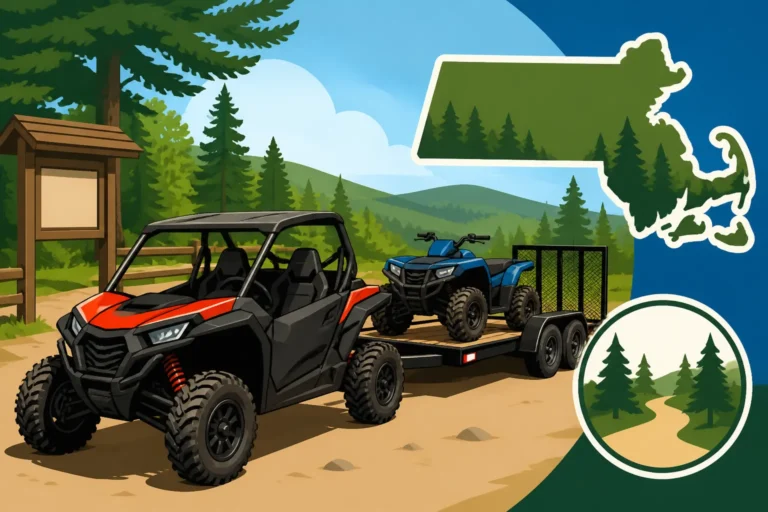
Parking is a separate part of your plan. Check where trailers are allowed, whether a parking area can accommodate your vehicle and trailer combination, and whether fees or access instructions apply. Arriving with a long trailer and no safe place to turn around is a miserable way to start the day, especially on a narrow forest road.
If you are bringing a group, agree on a meeting point and make sure every driver knows how to reach it. Do not assume everyone will have phone reception or be able to follow another vehicle in. A simple plan for where to meet, what to do if someone is delayed, and how to communicate at the trailhead can prevent a lot of confusion.
Use maps as planning tools, not permission slips
A map can help you understand the area, estimate travel time, and keep track of where you are. A digital mapping tool such as onX Offroad may be useful when you want to plan a route or review your position in the field. It should supplement, not replace, current official information and trail signs.
Before the trip, make sure you know how to use your chosen map without relying on a live connection. Save the relevant map information in advance if the tool allows it, and carry a backup plan such as a paper map or written directions. A phone that loses signal or runs out of battery should not leave the group guessing at a junction.
Use the map to stay oriented, not to justify riding an unapproved route. A mapped line does not necessarily establish that a trail is open, legal for your machine, or safe under current conditions. Check [Massachusetts Trail Planning and Closures](Massachusetts Trail Planning and Closures) before treating a route as part of your ride plan.
Registration, safety, and access basics
A forest trail ride is only one piece of the preparation. Riders also need to understand registration, safety requirements, and the rules that apply to the place where they are riding. Sorting out those details before the day of the trip is much easier than trying to resolve them at a trailhead.
Do not assume an out-of-state sticker is enough
Massachusetts has its own OHV registration requirements. A registration or sticker from another state does not automatically provide permission to ride in Massachusetts. Visitors should check what Massachusetts requires for an out-of-state machine before traveling, and residents should confirm that their own registration is current and properly displayed.
The required paperwork is not a substitute for permission to use a particular trail. Registration, forest access, and route authorization are different questions. A properly registered machine may still be prohibited from a road or trail that is not designated for OHVs.
Carry the required registration information with the machine and make sure decals are placed as directed. Riders who are unclear about the state’s registration system can review [Massachusetts Requires Its Own Registration](Massachusetts Requires Its Own Registration) and [The Registration Card You Must Carry in Massachusetts](The Registration Card You Must Carry in Massachusetts) before setting out.
Understand rider and machine requirements
Massachusetts has rules that may apply to a rider’s age, safety training, equipment, and conduct. Requirements can differ based on a rider’s age and the circumstances of the ride. Families should not assume that the same rules apply to every child or every setting, and a supervising adult should understand their responsibilities before bringing a young rider.
Check that the machine is in safe working condition. Brakes should work reliably, tires should be appropriate and in good shape, and the controls should respond as expected. A pre-ride inspection is especially valuable if the machine has been sitting through winter or has not been used since the previous season.
Helmet use and other safety practices are part of riding responsibly, even when a group is familiar with the area. Choose protective gear suited to the activity and conditions, and make sure it fits correctly. Before the trip, review the rules that apply to your specific group rather than relying on what another rider remembers.
Stay on designated routes and respect restrictions
A forest may contain public roads, service roads, walking paths, wildlife areas, and other routes that are not open to OHVs. The fact that a route is physically passable does not mean it is authorized. Gates, signs, barriers, and posted notices are there to guide access; do not go around them or continue beyond a restriction.
Access to land is not the same as permission to ride. Riders should respect landowner rights, designated boundaries, and local restrictions. Do not cut new routes, ride around barriers, or cross sensitive areas to get around a closure. These shortcuts can damage the landscape and undermine access for everyone.
If you are uncertain about whether a trail is authorized, stop and check rather than guessing. That pause may feel inconvenient, particularly when the group is ready to move, but it is much better than creating a trespass or trail-damage problem. The practical rules of sharing and respecting trails are covered in [Massachusetts Trail Etiquette Locals Expect](Massachusetts Trail Etiquette Locals Expect).
Choosing between an ATV and a side-by-side
The right machine depends on the route, the riders, and the conditions—not just on how many seats or how much cargo space you want. An ATV can feel more nimble on tight turns, while a side-by-side may offer a different seating arrangement and carrying capacity. Neither is automatically the better choice for every Berkshire forest route.
Consider route width and turning room
Before bringing a UTV, find out whether the intended route is suitable for its width and maneuverability. Narrow turns, uneven banks, rocks, and tight trail junctions can make a larger machine difficult to handle. A route that looks wide enough on a screen may feel very different when the vehicle has to negotiate an obstacle or pass another group.
Do not rely on the fact that a side-by-side fits on a road elsewhere in the forest. The relevant question is whether the specific designated riding route is appropriate and permitted for that vehicle. Check official rules and signs, and be prepared to choose a different destination or machine if the route does not suit your UTV.
Also consider trailer access and parking. A larger machine often means a larger tow vehicle or trailer, and not every parking area has room to turn or unload comfortably. Planning these details in advance helps avoid blocking other visitors or damaging the shoulder while trying to maneuver.
Match the machine to the group
For a family or mixed-skill group, the most capable machine is not necessarily the most suitable one. A vehicle that can carry extra passengers or equipment can also change how it handles on slopes, rough surfaces, and tight corners. Keep loads secure and within the machine’s design limits, and do not treat extra seating as a reason to carry more passengers than the vehicle is designed for.
Think about who will operate each machine and how confident they are with the terrain. A less experienced rider may be more comfortable on a familiar, manageable machine than on a powerful model that is difficult to control at low speed. Pairing riders thoughtfully can make the day safer and less stressful.
Plan for the limitations of the least suitable vehicle in the group. If one machine is too wide for a route or one rider is uneasy on a challenging section, adjust the plan for everyone. Splitting a group without a clear communication and meeting plan can create its own risks.
Prepare and inspect before the drive
Check the machine before loading, then check it again at the trailhead. Look over tires, brakes, steering, lights where needed, fuel, and any loose components. Secure tools and cargo so they cannot shift during transport or riding.
Bring gear that matches the conditions, including layers for changing mountain weather and rain protection when appropriate. A morning that feels mild near home can be cooler in the forest, and a wet ride can quickly become uncomfortable. Water and basic first-aid supplies are also sensible for a remote outing.
A side-by-side or ATV should be ready for a ride that may take longer than planned. Carry only what you can secure safely, and do not overload the machine. The goal is to be self-sufficient enough to handle an ordinary delay without turning the vehicle into a hazard.
Riding responsibly with other forest visitors
The Berkshire forests are shared places. OHV riders may encounter hikers, campers, forest staff, wildlife, and other riders. A respectful approach helps make those encounters predictable and helps protect the trails that make riding possible.
Slow down and communicate clearly
Reduce speed when approaching a blind corner, junction, parking area, or other place where people may appear unexpectedly. Keep enough space to stop safely, and avoid riding so close behind another machine that dust or a sudden stop becomes a problem. If visibility is poor, slower is safer.
When you meet another trail user, make your presence known without startling them. Give people room and be patient, especially where the route is narrow. Do not assume that everyone has heard your machine or knows which way you intend to go.
Group leaders can set the tone by choosing a reasonable pace and checking that riders remain together. Agree on a signal or regrouping plan before leaving the trailhead. If someone falls behind, stop in a safe place rather than letting the gap grow until communication becomes difficult.
Prevent avoidable trail damage
Stay on designated routes, especially when the surface is wet or soft. Riding around a puddle or rut can widen the trail and damage vegetation. If an obstacle or muddy stretch is unsafe, turn around rather than creating a new path.
Avoid aggressive throttle use that spins tires and tears up the trail. It can be tempting to power through a difficult section, but wheelspin can damage the surface and make the route more challenging for riders who follow. Smooth, controlled riding is better for both the machine and the trail.
Pack out anything you bring in. Do not leave food wrappers, broken straps, drink containers, or machine parts at a trailhead or along the route. A clean riding area is not just nicer to visit; it signals that riders are willing to care for the place they use.
Treat closures and staff directions seriously
A closed route may be inconvenient, especially if you traveled a long way, but ignoring a closure can create real safety and environmental problems. Find another open route or make the visit a shorter one. Do not move a barrier, ride around a closure sign, or follow another machine through a restricted area.
If a staff member gives directions, follow them calmly. Forest staff may be dealing with safety concerns, maintenance, weather, or access management that is not visible from the trailhead. Arguing at the entrance will not make an unsafe or closed route available.
Riders can also help by reporting a hazard or damaged sign through the appropriate forest channel. Share clear, useful details without creating a new trail or trying to repair a route yourself. Responsible reporting supports better decisions while keeping riders out of work zones.
A practical planning checklist for a Berkshire ride
A good outing begins before the tow vehicle leaves home. Use a checklist to keep the basics from slipping through the cracks, especially if several machines or families are traveling together. Once the group is at the trailhead, it is harder to correct a missing document, wrong turn, or unsuitable machine.
The day before
Choose one forest and identify the designated riding area you intend to use. Confirm the route is open, check any vehicle restrictions, and make sure the planned route is realistic for the least experienced rider. If you are unsure whether a route is available, seek clarification rather than relying on a map alone.
Check registration and required documents for every machine. Confirm that any out-of-state rider has taken care of Massachusetts requirements, and make sure the card and decals are in order. Review the group’s safety expectations, including helmet use, pace, and what to do if someone gets separated.
Check the tow vehicle, trailer, tie-downs, fuel, and basic riding gear. Look at the forecast and make a clothing plan for changing conditions. Share your destination and expected return time with someone who is not riding with you.
At the trailhead
Park and unload only where permitted. Keep the access area clear for other visitors and avoid blocking gates, roads, or emergency access. Before starting, confirm that each rider knows the intended route and the plan for regrouping.
Do a quick safety check of the machines. Confirm that cargo is secure, controls work, and everyone has the required documents and protective gear. If something looks unsafe, fix it before riding rather than hoping it will hold together on the trail.
Take a moment to read posted notices. They may include information about closures, route restrictions, seasonal access, or local conditions. A brief check can save the group from making a long detour or unintentionally riding somewhere they should not.
During and after the ride
Keep the group together at a pace that allows everyone to ride comfortably. Stop in safe places, not around blind corners or in the middle of a narrow route. If conditions change, adjust the plan instead of pressing on just because the group has already invested time in the ride.
Before leaving the forest, check that no gear or trash has been left behind. Secure machines properly for the drive home, and make a note of any maintenance issues while they are fresh. Mud, water, and debris can hide damage, so inspect the machines again once you are home.
If the group plans to return, record what worked and what did not. Note parking details, route junctions, weather, and any questions you still need to check before the next outing. A little reflection makes the next trip smoother and helps keep expectations realistic.
Disclaimer
This article is for general informational purposes only and does not constitute professional advice. Laws, prices and regulations vary by location and change over time. Consult a qualified professional for guidance on your specific situation.