Renewing Before the Season Opens
It's happened to all of us: that moment you're eagerly anticipating the first ride of the season, only to realize your ATV or UTV registration might be expired. The dread of a potential fine or, worse, being turned away from your favorite Massachusetts trail is a real headache. This guide is here to walk you through the ins and outs of renewing your off-highway vehicle (OHV) registration in Massachusetts before the DCR season officially opens, ensuring you're ready to hit the trails without a hitch.
Why Renewing Early Just Makes Sense for Massachusetts Riders
Let's be honest, nobody wants to be "that rider" stuck at the trailhead, fumbling through old papers or finding out their sticker expired last month. Renewing your OHV registration in Massachusetts ahead of time isn't just about avoiding a ticket; it's about pure peace of mind and ensuring you get to enjoy every precious minute of the riding season.
Avoiding the Last-Minute Rush and Trailhead Headaches
Imagine this: it's a beautiful May morning, the sun is out, the trails are calling, and you've got your machine loaded up, ready for a day in the Berkshires. You pull into the parking lot at October Mountain State Forest, excited to unload, and then it hits you – the little expiration date on your decal. Suddenly, that feeling of anticipation turns into a pit in your stomach. Riding an unregistered OHV in Massachusetts can lead to penalties, and trust me, an Environmental Police Officer won't care how excited you were for your first ride. By taking care of your renewal early, you skip the last-minute scramble, the potential for fines, and the sheer frustration of being sidelined when all you want to do is ride. The Massachusetts DCR riding season typically kicks off in May, so getting that sticker updated well before then means you're not missing a single moment.
Understanding Massachusetts Registration Terms and Expiration
Massachusetts has different registration terms depending on whether you're a resident or a non-resident. If you're a Massachusetts resident, your OHV registration is typically valid for two years. For our friends visiting from out of state, say from New Hampshire or Vermont, the non-resident registration is valid for one year. This difference in term length is super important for planning your renewal schedule.
Your current registration decal, which should be prominently displayed on your machine, will clearly show the expiration date. It's a good habit to check this at the end of each riding season or, even better, circle it on your calendar when you first get your sticker. Knowing your specific expiration date, and whether you're on a one-year or two-year cycle, is the first step to a smooth, stress-free renewal. You can learn more about these different cycles in [Massachusetts Registration Terms by Residency].
The Massachusetts ATV Registration Renewal Process
The good news is that renewing your ATV or UTV registration in Massachusetts is generally a straightforward process. The state has made it fairly accessible, with a couple of options to choose from, though online is definitely the most popular and often the quickest way to get things done.
Online Renewal: The Easiest Way to Get Your New Sticker
For most riders, renewing online is the absolute easiest path to a fresh sticker. The Massachusetts Environmental Police manage OHV registrations, and they've set up a user-friendly system. To renew online, you'll typically need:
- Your existing registration number: This is found on your current registration card or decal.
- Your vehicle identification number (VIN): Make sure you have this handy. It's usually stamped on the frame of your ATV or UTV.
- A valid payment method: Credit or debit cards are usually accepted.
The online system will guide you through entering your information, confirming your details, and processing your payment. It's quick, efficient, and you can do it from the comfort of your home, perhaps while planning your first spring ride. This convenient option is part of the broader [Massachusetts Online Registration System]. Just be sure to double-check all your entries before submitting to avoid any delays!
Renewing by Phone or Mail: If Online Isn't for You
While online renewal is convenient, it's not the only option. If you prefer to speak to someone or send things through the mail, those avenues are usually available too.
- By Phone: You can often call the Environmental Police's registration office. They'll ask for your registration number, VIN, and personal information, and you'll typically be able to pay with a credit card over the phone. Make sure you have all your details ready to make the call as smooth as possible.
- By Mail: For mail-in renewals, you'll usually need to print out a renewal form (if one was sent or available online), fill it out completely, and include a check or money order for the appropriate fee. Always make sure to send it with enough time for processing and mail delivery, especially if you're trying to beat the start of the riding season.
Always check the official Massachusetts Environmental Police website for the most current contact information and mailing addresses before sending anything.
What You'll Receive After Renewing
Once your renewal is processed, you won't get a "title" back (Massachusetts doesn't title ATVs, they issue a registration card, which is a common point of confusion you can read about in [Why the Environmental Police Issue a Card, Not a Title]). What you will receive is a brand new registration decal and an updated registration card.
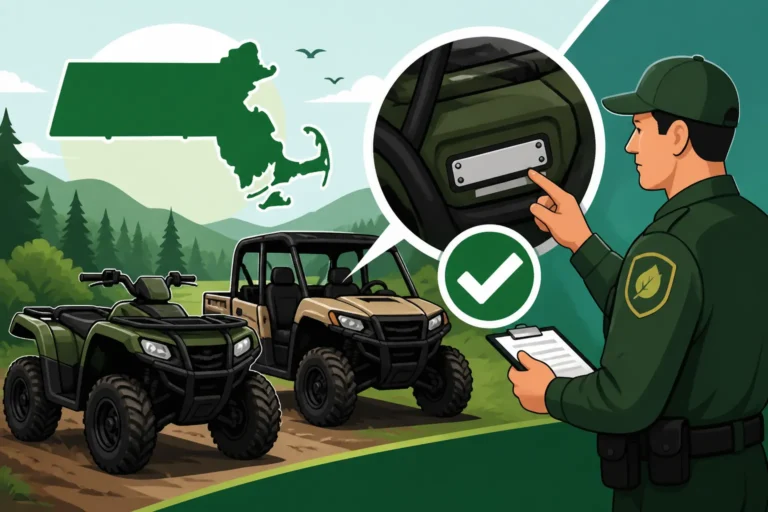
- New Decal: This sticker will show your new expiration date and needs to be affixed to your machine in the correct location. Massachusetts has specific rules about where these decals go, so pay attention to the instructions that come with your new sticker. Generally, decals need to be placed on the forward half of the machine, on both sides, with the expiration decal specifically on the left side. You can get all the details on proper placement in [Massachusetts Decal Placement Rules] and [Massachusetts Decals on Both Sides].
- Registration Card: This card is your proof of current registration. It's absolutely crucial that you carry this card with you whenever you're operating your OHV. This isn't just a suggestion; it's a legal requirement. An Environmental Police Officer may ask to see it, and not having it can lead to problems. Make sure it's kept safe, perhaps in a waterproof pouch, in your riding gear or on the machine itself. For more on this, check out [Massachusetts Registration Cards Carried on Board].
Common Renewal Questions and Scenarios
Even with a straightforward process, questions pop up. It's normal to wonder about specific situations, especially if you're trying to be proactive and get that renewal done before the first green shoots of spring even appear.
What If You Didn't Receive a Renewal Notice?
This is a really common frustration! You're sitting there, waiting for that official reminder to land in your mailbox, and it just never comes. Don't worry, you're not alone, and it doesn't mean you can't renew. The responsibility to renew your registration ultimately rests with you, the owner, regardless of whether a notice arrives.
If you don't receive a renewal notice, simply proceed with the online or phone renewal process using your existing registration card or decal for the necessary information (like your current registration number and VIN). The system doesn't require the notice itself to process a renewal. Just make sure you know when your sticker is set to expire. For more specific guidance, see [Renewing an OHV Sticker When No Notice Arrives].
Renewing a Lapsed or Expired Registration
So, you found this guide a little late, and your registration has already expired. Take a deep breath! While you definitely cannot ride your OHV on any public land or designated trails with an expired sticker (and doing so could lead to penalties like those mentioned in [Massachusetts Penalties for Riding Unregistered]), the good news is that Massachusetts typically doesn't impose a late fee for renewing. The renewal process itself is generally the same whether you're renewing before the expiration or after it has lapsed. Just get it done as soon as you realize it's expired to avoid any temptation to ride illegally. The goal is simply to get your machine legal again before you even think about hitting a trail.
Planning for the Massachusetts DCR Riding Season
The Massachusetts Department of Conservation and Recreation (DCR) typically opens its OHV trails from May 1st through November 30th. This means if you want to be out there on opening day, your registration needs to be current by then. Renewing in March or April gives you plenty of buffer time for the decals and cards to arrive in the mail and for you to get them affixed properly to your machine.
Thinking ahead to the riding season also means considering where you'll be riding. While state forests like Beartown, October Mountain, and Pittsfield State Forest offer miles of trails, some riders also enjoy private land. For those instances, ensuring you have proper permission is key. Tools like LawDepot can be incredibly helpful here. They offer customizable legal forms, including landowner permission agreements. Having a clear, written agreement can save a lot of headaches, whether you're riding a friend's property or even your own, if you want clear documentation. This ensures you're not just ready with your sticker, but also compliant with all land access rules. You can explore [Massachusetts DCR Riding Season] for more details on trail schedules.
Beyond the Sticker: Other Preparations for Riding Season
Getting your registration renewed is a massive step, but it's just one piece of the puzzle for a fantastic and safe riding season. Taking a little extra time for other preparations will pay dividends in enjoyment and safety.
Safety Certificates and Youth Rider Rules
If you have young riders in your family, or if you're new to the OHV scene and haven't gotten your own yet, remember Massachusetts has strict safety certificate requirements, especially for riders under 18. Anyone under the age of 18 must complete a Massachusetts Environmental Police-approved OHV safety course and carry the certificate when riding on public land. Even if your registration is current, a missing safety certificate for a youth rider can lead to citations. It's a great idea to check these requirements well before the season starts, especially if you're planning family rides. For all the details on who needs what, refer to [Massachusetts Safety Certificates Under 18].
Checking Your Machine and Gear
Spring is the perfect time for a thorough pre-season inspection of your ATV or UTV. After sitting all winter, even a well-stored machine can have issues. Check your tires for proper inflation and wear, test your brakes to ensure they're sharp, inspect all your lights, and make sure your muffler and spark arrestor are in good working order. It's also a good time to check your fluids (oil, coolant, brake fluid) and replace anything that looks suspect. Don't forget your personal riding gear either! Inspect your helmet for any cracks or damage, ensure your goggles are clean and unscratched, and check your protective clothing. A well-maintained machine and reliable gear are crucial for both safety and enjoyment.
Landowner Permission for Private Land Riding
Massachusetts has very clear rules about riding on private land: you must have written permission from the landowner. This isn't just a courtesy; it's a legal requirement designed to protect both riders and property owners. If you're planning to ride anywhere other than the designated DCR trails, you need to secure this permission.
This is another area where utilizing reliable resources like LawDepot can be incredibly beneficial. They provide templates for various legal documents, including explicit landowner permission forms. Using a standardized form helps ensure all necessary details are covered, such as the dates you're allowed to ride, specific areas of access, and any rules the landowner might have. This clarity can prevent misunderstandings and legal issues down the road, ensuring you can enjoy private land riding responsibly and legally. For more information on this vital requirement, be sure to read [Massachusetts Landowner Permission in Writing].
Resident vs. Non-Resident OHV Registration Renewal Terms
To help clarify the differences in registration terms for Massachusetts OHV riders, here's a quick overview:
| Feature | Massachusetts Resident OHV Registration | Non-Resident OHV Registration (Massachusetts) |
|---|---|---|
| Term Length | Two years | One year |
| Primary Use | Primarily for Massachusetts residents | For visitors from out of state |
| Expiration Date Shown | Month and Year | Month and Year |
| Renewal Period | Every two years | Annually |
| Purpose | Allows legal operation within MA | Allows legal operation within MA |
| Administered By | MA Environmental Police | MA Environmental Police |
This table should give you a clear picture of what to expect based on your residency status when it comes to keeping your OHV registered and ready for the Massachusetts trails.
Disclaimer
This article is for general informational purposes only and does not constitute professional advice. Laws, prices and regulations vary by location and change over time. Consult a qualified professional for guidance on your specific situation.