What an Environmental Police Officer Can Ask
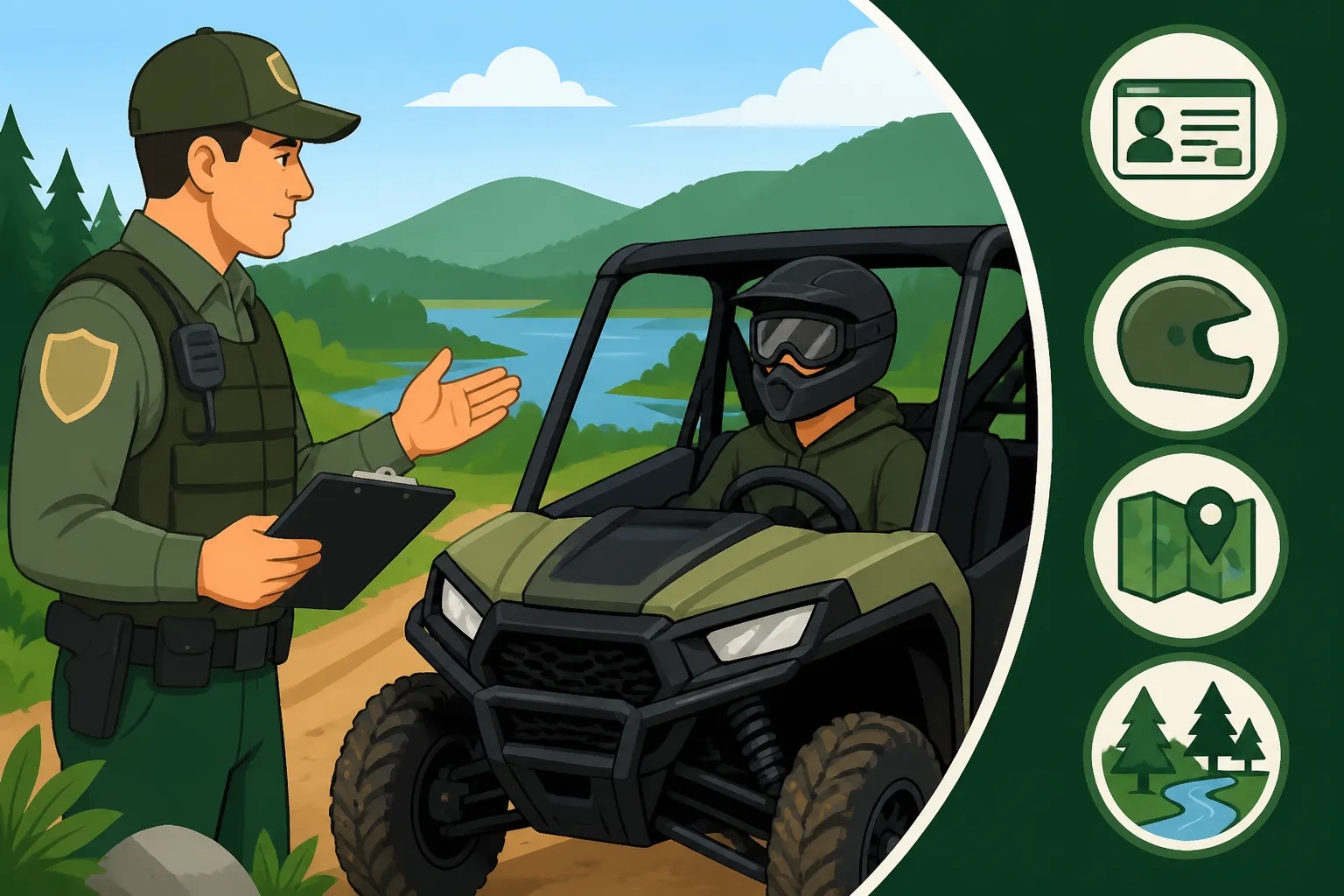
You're out enjoying the thrill of the Massachusetts trails, perhaps exploring the vastness of October Mountain or navigating the twists of Beartown State Forest, when suddenly you see the tell-tale green and white of an Environmental Police Officer (EPO). Your heart might do a little flutter, wondering exactly what an EPO is empowered to ask you. This guide is designed to clarify your rights and responsibilities during such an encounter, ensuring you're prepared and confident in what an EPO can inquire about regarding your ATV or UTV in the Bay State.
Initial Interaction: Your Identity and Purpose
When an EPO stops you on the trail, the first few questions are usually about establishing who you are and understanding your presence in the area. These initial inquiries are standard procedure and are designed to ensure everyone on the trails is operating within the law.
Requesting Your Identification
Just like any law enforcement officer, an Environmental Police Officer has the authority to ask for your identification. This isn't just about putting a name to a face; it's about verifying that you are of legal age to be operating an off-highway vehicle (OHV) in Massachusetts. If you're a minor, it's about identifying your supervising adult. They'll expect to see a valid driver's license or a state-issued identification card.
Imagine you’re cruising along a trail in Pittsfield State Forest, enjoying a perfect autumn afternoon. An EPO steps out, signals you to stop, and approaches your machine. One of the first things out of their mouth will almost certainly be, "May I see your license and registration, please?" Having your ID readily accessible, perhaps in a secure pouch or wallet, makes the interaction smoother and quicker for everyone involved. Think about [Carrying a Card in a Pocket] – it really helps. They might also ask for your full name, current address, and date of birth. This information helps them cross-reference any existing records and complete a report if necessary. A calm and cooperative demeanor always goes a long way.
Inquiring About Your Riding Activities and Route
EPOs are charged with enforcing the state's environmental laws and ensuring safe recreational practices. To do this effectively, they might ask about your riding plans, where you've been, and where you're headed. This line of questioning helps them determine if you're on authorized trails, if you might be trespassing, or if you're engaging in any activities that are prohibited.
For instance, if you find yourself deep within a conservation area where ATV and UTV use is strictly prohibited, an EPO's questions about your route become incredibly important. They might ask, "Are you aware that this particular area is restricted for OHV use?" or "Can you tell me which trail you used to enter this section?" It's crucial to be honest about your intentions, but more importantly, to know [Where Massachusetts Law Says You May Not Ride] before you even load up your machine. Ignorance of the law is rarely an excuse. They may also ask if you have [Massachusetts Landowner Permission in Writing] if you're on private property, which is often a requirement even if you think you're just cutting through. Knowing and respecting local rules, such as [Massachusetts's 150-Foot Dwelling Rule], which prohibits riding too close to residences without permission, is absolutely vital.
Proof of Ownership and Machine Registration Status
One of the most frequent reasons an EPO will stop an OHV rider is to verify the machine's legal status. Massachusetts has clear rules regarding registration and proof of ownership, and officers are diligent in enforcing them.
Demanding Your OHV Registration Card
For nearly all riding scenarios off private land in Massachusetts, carrying your current OHV registration card is a must. An EPO will unequivocally ask to see this card. It serves as proof that your machine is legally registered with the state, which is a prerequisite for riding on any authorized public trails.
Imagine you're pulling into the staging area at October Mountain State Forest on a busy Saturday. An EPO might be conducting routine checks, stopping every rider entering or exiting the trails. "Let me see your registration card, please," is a common request. If you're a Massachusetts resident, this card will reflect your [Massachusetts Two-Year OHV Registration]. If you're visiting from out of state, you'll have a [Massachusetts Non-Resident OHV Registration] card. Failure to produce a valid registration can lead to significant penalties, as outlined in [Massachusetts Penalties for Riding Unregistered]. It's also important that the information on the card accurately matches the machine you are operating. The officer will typically cross-reference the Vehicle Identification Number (VIN) on your card with the VIN stamped on your ATV or UTV. Remember, in Massachusetts, it's the registration card, not a title, that confirms your machine's registration status. The system is detailed in explanations like [Why the Environmental Police Issue a Card, Not a Title].
Verifying Decal Placement and Expiration
Beyond checking the registration card, EPOs pay close attention to your machine's physical decals. Massachusetts has specific regulations regarding the placement and visibility of these decals. Officers will be looking for correct placement and to ensure the decals are current.
Picture yourself stopped on a dusty trail in the Berkshires. The officer will do a quick visual scan of your ATV or UTV. Are the [Massachusetts Decals on Both Sides] of the forward half of your machine clearly visible? Is the [Massachusetts Expiration Decals on the Left] side of the machine current and not expired? Are they securely affixed and free from damage or obstruction by mud and dirt? These small but important details are not just bureaucratic; they allow officers to quickly identify legally registered machines and enforce compliance. If your decals are faded, peeling, or incorrectly placed, an EPO may question you about it and could issue a citation or instruct you to remedy the situation. It’s always best practice to ensure your decals are in excellent condition before you head out. These guidelines are further elaborated in [Massachusetts Decal Placement Rules].
Asking for Proof of Ownership for a Used Machine
While the registration card confirms your machine is registered to ride, an EPO might also delve into the actual ownership of the machine, especially if there are any inconsistencies or suspicions. For a used ATV or UTV, a clear and legitimate bill of sale is often the critical piece of documentation. This is where tools from companies like LawDepot can be incredibly helpful for drafting comprehensive and legally sound documents, particularly if you acquired your machine through a private sale.
Let's say you recently purchased a pre-owned quad from a private seller in a rural part of Massachusetts. You've gone through the proper registration steps, but an EPO stops you and asks how you came to possess the machine. Having a copy of your [Massachusetts Requires a Bill of Sale for a Used One] readily available—even a digital copy on your phone, if the officer permits—can quickly answer their questions and confirm your legitimate ownership. This document should explicitly state the buyer's and seller's full names, the date of sale, and a detailed description of the machine, including its VIN. LawDepot offers templates that help ensure all necessary information is included in a bill of sale, making the process smoother. They might also inquire about the sales tax you paid, as paying the sales or use tax is a prerequisite for registration in Massachusetts. If you claimed an exemption, such as receiving the machine as a gift, you would need to produce [Massachusetts Exemption Form ST-6E]. A well-prepared bill of sale, perhaps created using a reliable service like LawDepot, can save you a lot of hassle and quickly establish your rightful ownership.
Machine Compliance and Operator Safety
Massachusetts is serious about OHV safety and machine compliance. EPOs are trained to inspect machines for proper working order and to ensure operators meet legal age and certification requirements.
Checking Your Machine's Vehicle Identification Number (VIN)
A VIN check is a fundamental part of almost every EPO stop. This critical step verifies the machine's identity, confirms it matches the registration card, and allows officers to check if the ATV or UTV has been reported stolen. The VIN is unique to your machine, acting as its definitive fingerprint.
The officer will ask you to show them [Where to Find the VIN on an ATV or Side-by-Side]. It’s typically stamped into the frame of the vehicle. They will then meticulously compare this number against the VIN printed on your registration card. If these numbers do not match, you will have some serious explaining to do, which could escalate to further investigation or even the confiscation of your machine. This inconsistency is a red flag for stolen vehicles. Officers also routinely run the VIN through national stolen vehicle databases. This is a crucial, albeit routine, part of their job in deterring theft and ensuring that all machines on the trails are legitimately owned. Always ensure your VIN is clean, legible, and consistent with all your official paperwork.
Inquiring About Safety Equipment and Modifications
Massachusetts maintains specific equipment requirements for ATVs and UTVs to ensure they are safe for operation and do not negatively impact the environment or other trail users. An EPO has the authority to inspect your machine for compliance with these regulations, including checking for functional brakes, proper lighting, and an appropriate muffler. They want to confirm your machine is safe for the trails and that it isn't generating excessive noise.
Consider a scenario where you're riding in October Mountain as dusk begins to settle. An EPO might specifically inquire about your [Massachusetts Lighting After Sunset] to ensure you have both a working headlight and taillight, which become mandatory during these hours. They will also pay attention to your muffler, as [Massachusetts Muffler Requirements] are strictly enforced to minimize noise pollution in state forests and near residential areas. If your muffler seems excessively loud, they might ask about it. Additionally, an officer may ask about any aftermarket modifications you've made to your machine. While many modifications are perfectly acceptable, others, such as installing an overly loud exhaust system or removing a spark arrester, can be violations that result in a citation. Be prepared to discuss any changes you've made and to demonstrate that your machine still complies with all state safety and environmental standards.
Verifying Age Requirements and Safety Certificates
Massachusetts has some of the most stringent age and supervision laws for OHV operation in the country. An EPO will absolutely inquire about the age of the operator and whether they possess the required safety certificate. This line of questioning is particularly common when young riders are present.
If you are riding with a youth, the officer will ask for their age and whether they have successfully completed the [Massachusetts Safety Certificates Under 18]. It's important to remember that for riders under 14, operating ATVs is generally prohibited, even on private land, with very limited exceptions for sanctioned events. EPOs are fully informed about [Massachusetts ATV Age Requirements] and the implications of [Sean's Law and Massachusetts Youth Riders]. They will also want to confirm that any rider under the age of 16 is under the direct, continuous visual supervision of an adult as defined by law. This means knowing who the [Massachusetts Supervising Adult Defined] is and understanding that [Massachusetts Supervisors Held Liable] for any violations committed by the minor in their charge. Having your safety certificate (if applicable) and being thoroughly aware of these regulations is paramount to a smooth interaction.
Environmental Compliance and Trail Etiquette
EPOs play a critical role in safeguarding Massachusetts's natural resources. Their inquiries often extend beyond just registration and safety to cover environmental responsibility and proper trail etiquette, ensuring the preservation of our outdoor spaces for everyone.
Asking About Trail Impact and Environmental Responsibility
A key part of an EPO's mandate is to protect the diverse natural landscapes of Massachusetts. As such, they may inquire about your awareness of trail conditions, whether you're strictly adhering to marked trails, and if you're taking any actions that could potentially cause environmental damage.
For example, if the trails are particularly wet or muddy after a period of heavy rain, an EPO might approach you and ask about your understanding of [Massachusetts Mud Season and Trail Damage], and whether you are making conscious efforts to minimize your impact on the soft ground. They might also question you about any signs of illegal dumping or unauthorized trail construction you may have observed. Furthermore, an officer could inquire about your knowledge of sensitive ecosystems, such as fragile wetlands or coastal dunes, and whether you comprehend why areas like those detailed in [Massachusetts Bans Beach and Dune Damage] are strictly off-limits to OHVs. Their questions are fundamentally aimed at ensuring that all riders are responsible stewards of the natural land.
Inquiring About Waste and "Leave No Trace" Practices
Littering and improper waste disposal on trails are taken very seriously by EPOs. They may ask about any trash or refuse you have on your person or machine, and whether you are familiar with and practice the "Leave No Trace" principles. The goal is to preserve the pristine condition of our state forests and recreational areas.
A common scenario might involve an EPO spotting a discarded snack wrapper or a plastic bottle near a trail. They might approach a nearby rider and ask if they dropped it, or if they are carrying a designated bag for their refuse. This is a proactive measure to maintain the cleanliness of areas like Beartown State Forest. [Leaving a Forest Trailhead Tidy] is not just a matter of good manners; it is often a legal expectation that aligns with environmental protection laws. Officers might also ask if you've brought in any outside firewood, which could potentially introduce invasive species to the forest ecosystem. These types of questions stem directly from the Environmental Police's commitment to safeguarding the health and beauty of Massachusetts’s natural recreational lands for all to enjoy.
Important Documents Summary
To help you remember what an Environmental Police Officer might ask for or check during a stop, here’s a quick summary of key items and actions. Keeping these in mind can make any interaction smooth and stress-free.
| Category | What an EPO May Ask For | Required Document/Action |
|---|---|---|
| Identity | Your Name, Address, Photo ID | Valid Photo ID (Driver's License/State ID) |
| Registration | Current OHV Registration Card, Decal Placement, Expiration | [Massachusetts Registration Cards Carried on Board], Visible & Current Decals |
| Ownership | How you acquired the machine, Proof of purchase | [Massachusetts Requires a Bill of Sale for a Used One], MCO for new machines |
| Machine Status | VIN verification, Safety equipment (brakes, lights, muffler) | Clear & Matching VIN, Functional Brakes/Lights, Compliant Muffler |
| Operator Age/Cert. | Your age, OHV Safety Certificate (if under 18) | [Massachusetts Safety Certificates Under 18] (if applicable) |
| Land Use | Where you're riding, Permission for private land | [Massachusetts Landowner Permission in Writing] (on private land), Stay on Authorized Trails |
Disclaimer
This article is for general informational purposes only and does not constitute professional advice. Laws, prices and regulations vary by location and change over time. Consult a qualified professional for guidance on your specific situation.