Buying From a Private Seller in Massachusetts
Buying an ATV or UTV from a private seller in Massachusetts can feel like navigating a maze of paperwork, tax rules, and legal requirements, leaving many buyers feeling uncertain about whether they're doing everything correctly. This comprehensive guide will walk you through every step of the private purchase process, from initial inspections and essential documentation to sales tax obligations and official registration, ensuring your new-to-you machine is legally ready for the Bay State's trails.
The Initial Checks Before You Even Meet the Seller
Before you even think about handing over cash, there are critical preliminary steps to take. It's not just about kicking tires; it's about protecting yourself from potential legal headaches and ensuring the machine you're eyeing is legitimately available for sale. Many a Bay Stater has learned the hard way that a great deal can quickly turn into a nightmare if the background checks aren't thorough.
Verifying Ownership and Machine History
The first red flag to watch out for is a seller who seems evasive about the machine's history or ownership documents. In Massachusetts, off-highway vehicles (OHVs) like ATVs and UTVs don't have traditional titles like cars do. Instead, the Massachusetts Environmental Police issue a registration card. This card is your primary proof of current registration, but it's not the same as a title of ownership that tracks changes over time. However, it's still vital to see the current registration card. It should match the seller's name and the machine's Vehicle Identification Number (VIN).
Always ask the seller for the VIN well in advance of any in-person meeting. This unique 17-digit code is your best friend in verifying the machine's identity. Once you have it, take a moment to perform a quick online search to see if the machine has been reported stolen. There are public databases available that can help with this. Getting stuck with a stolen ATV, even unknowingly, can lead to seizure by law enforcement and a complete loss of your investment. It's a simple, free step that can save you immense trouble later on. A smart move is to use a service for [Checking Whether a Used Quad Was Reported Stolen] to ensure you're not buying someone else's headache. If the seller balks at providing the VIN or the current registration information, consider that a serious warning sign. Transparency is key when buying privately.
Understanding Massachusetts's Unique Laws for OHVs
Massachusetts has some specific quirks when it comes to OHV ownership and registration that differ significantly from other vehicles. As mentioned, OHVs are registered by the Massachusetts Environmental Police (DEP), not the Registry of Motor Vehicles (RMV). This means you won't get a traditional title, but rather a registration card and decals. Understanding [Why the Environmental Police Issue a Card, Not a Title] is crucial for private buyers. This distinction is often a point of confusion, especially for buyers from states where ATVs do have titles. What this ultimately means for you as a buyer is that a proper, detailed bill of sale becomes paramount as your primary proof of ownership transfer, alongside the previous owner's registration card.
It's also a good idea to have a basic understanding of general [Massachusetts ATV Laws Under Chapter 90B] even before you buy. Knowing the age restrictions, helmet laws, and where you can and cannot ride will inform your purchase decisions and help you understand the responsibilities of ownership right from the start. For example, if you're buying a youth quad for a younger rider, you'll need to be aware of the specific engine size limits and safety course requirements for their age group. Knowing these rules can prevent an immediate citation once you hit the trails.
Navigating the Purchase Transaction Smoothly
Once you've done your homework and feel good about the machine and the seller, it's time to arrange the actual transaction. This is where meticulous documentation and careful payment methods come into play. Many private sales go sideways not because of bad intentions, but simply due to a lack of clear understanding and proper paperwork.
The All-Important Bill of Sale
A legally sound bill of sale is not just a formality; it's your most important document when buying an ATV or UTV from a private seller in Massachusetts. Because there's no traditional title to transfer, the bill of sale acts as undeniable proof that ownership has legitimately moved from the seller to you. Without it, you could face significant hurdles when trying to register the machine in your name, and you'd have little recourse if disputes arose later. The Massachusetts Environmental Police will absolutely require a comprehensive bill of sale for registration.
So, what absolutely must be included in this crucial document?
- Full Names and Addresses of Both Buyer and Seller: Include phone numbers too, for good measure.
- Date of Sale: This is important for tax purposes, as you have a filing deadline.
- Full Description of the ATV/UTV: Make, model, year, color, and most importantly, the complete VIN. Double-check that the VIN on the bill of sale exactly matches the VIN on the machine itself.
- Purchase Price: Clearly state the amount paid. This will be the basis for calculating your sales tax.
- Signatures of Both Buyer and Seller: This signifies agreement to the terms of the sale. Some buyers even prefer to have the signatures notarized for added legal weight, though it's not strictly required by the Environmental Police for registration.
You can find numerous generic bill of sale templates online, but sometimes they lack the specific details pertinent to Massachusetts OHV sales or omit important clauses that protect both parties. Utilizing a reputable online legal document service, like LawDepot, can be a great way to ensure you have a comprehensive and legally sound bill of sale that covers all necessary bases for your Massachusetts ATV or UTV purchase. They often have customizable templates that help you create a robust agreement, making sure you don't forget any critical information needed for registration and tax purposes. Remember, [What a Bill of Sale Must Show to Register] is a precise list of requirements that must be fulfilled to ensure a smooth process. One common frustration is [Registering When the Seller Left Out Their Address]; a good template will prompt you for all required fields.
Payment Methods and Safety Considerations
When it comes to payment, safety and security should be your top priorities. Carrying a large amount of cash to a transaction can be risky.
- Certified Check or Bank Check: These are generally safer than cash as they are drawn directly from the bank's funds, guaranteeing availability. However, these can still be faked, so if you go this route, consider meeting at the seller's bank to complete the transaction, where the bank can verify the check's authenticity.
- Electronic Transfer: Services like PayPal, Venmo, or Zelle can be convenient, but they offer varying levels of buyer/seller protection. Understand the terms of service for any platform you use, and be wary of requests to send money to accounts that don't match the seller's name.
- Cash: If you must pay with cash, try to keep the amount manageable. Insist on meeting in a very public place, perhaps even a police station parking lot, which many departments offer as a safe transaction zone. Always bring a friend or family member with you.
Before you hand over any money, conduct a thorough inspection of the ATV or UTV. Don't be shy.
- Visual Inspection: Look for cracks in the frame, bent components, excessive rust, or signs of major repairs or collisions.
- Fluid Levels: Check oil, coolant, and brake fluid.
- Tires: Inspect tread wear and look for cracks or bulges.
- Brakes: Test both front and rear brakes for proper function.
- Engine: Start it up. Listen for unusual noises, smoke, or hesitation. Test drive it if possible (on private land with permission, of course).
- VIN Match: Crucially, verify that the VIN on the machine itself (usually stamped on the frame) matches the VIN on the seller's registration card and the bill of sale you're about to sign. This confirms you're buying the exact machine you've inspected. This step, [Checking a Serial Number Before You Hand Over Cash], is non-negotiable.
Post-Purchase: Getting Your "New" Machine Legal in Massachusetts
The sale is complete, the bill of sale is signed, and you're the proud new owner. But before you can legally hit those trails, you have two more essential steps: paying your sales tax and registering the machine. Skip either of these, and you could face fines, penalties, or even have your machine impounded.
Tackling Massachusetts Sales Tax
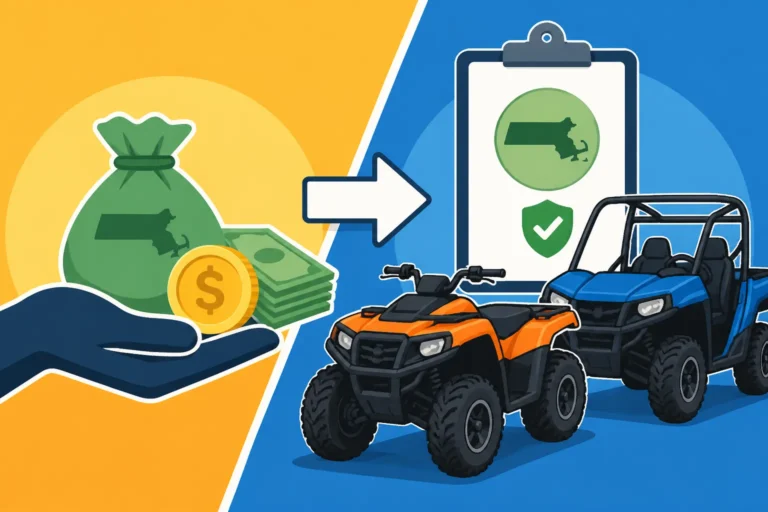
This is a step many private buyers overlook or misunderstand, often leading to unwelcome surprises. In Massachusetts, you are required to pay sales tax on an ATV or UTV purchased from a private seller, just as you would from a dealer. The current sales tax rate is 6.25% of the purchase price. This isn't collected by the seller; it's your responsibility as the buyer to remit it to the Massachusetts Department of Revenue (DOR).
You generally have 20 days from the date of purchase to file and pay this sales tax. You'll do this by filing Form ST-6, "Sales Tax on Motor Vehicles, Trailers, and Other Vehicles." If the ATV or UTV was a genuine gift (meaning no money or other consideration exchanged hands), you would file Form ST-6E, "Certificate of Exemption From Sales or Use Tax for a Motor Vehicle, Trailer, or Other Vehicle." Even for a gift, you still need to complete the form. The Environmental Police will require proof that this tax obligation has been met before they will register your machine. You can learn more about this by reviewing [Massachusetts Sales Tax Forms at Registration] and [Massachusetts's 6.25 Percent Sales Tax].
The easiest way to file your sales or use tax is online through MassTaxConnect. You'll need to set up an account if you don't already have one. It's crucial to meet that 20-day deadline to avoid penalties. The Environmental Police cross-reference registrations with tax filings, so they will know if you've skipped this step. For detailed guidance on the process, remember to review [Filing Your Sales Tax Within 20 Days] and understand [Why You File on MassTaxConnect, Not at a Counter].
Here’s a quick summary of the tax form requirements:
| Scenario | Form Required | Key Detail | Filing Deadline |
|---|---|---|---|
| Private Purchase | ST-6 | Pay 6.25% of purchase price | 20 days from purchase |
| Genuine Gift (no money exchanged) | ST-6E | Claim exemption, but still file the form | 20 days from "purchase" |
| Out-of-State Purchase | ST-6 | Massachusetts Use Tax applies if brought into MA for use | 20 days from bringing into MA |
Registering Your Off-Highway Vehicle
With your bill of sale in hand and sales tax taken care of, you're ready for the final step: registration. As noted earlier, you'll be registering your ATV or UTV with the Massachusetts Environmental Police (MEP), not the RMV. This can be done online, by mail, or in person at certain MEP offices. The online system is often the most convenient route for many. You can access their portal directly for [How to Register an ATV in Massachusetts].
When you go to register, you'll need a few key documents:
- Completed Application Form: Available on the MEP website.
- The Original Bill of Sale: This is where that comprehensive document from LawDepot really shines, as it contains all the necessary information. [Massachusetts Requires a Bill of Sale for a Used One] is a hard rule.
- Proof of Sales Tax Payment (or Exemption): This could be a printed receipt from MassTaxConnect or your filed ST-6E form.
- Current or Previous Registration Card (if available): While not always mandatory for a private sale (especially if the seller lost it), it certainly helps and provides extra verification.
- Payment for the Registration Fee: For Massachusetts residents, the fee is generally [Massachusetts Charges $44 for Residents] for a two-year sticker. Non-residents have a different fee and term.
Once your application is processed and approved, the Environmental Police will issue you a new registration card and two decals. The card must be carried on board the machine whenever it's being operated, and the decals must be affixed according to specific rules, usually on both sides of the machine's forward half. Remember to keep the registration card in a safe, weatherproof pouch on your machine or in your riding gear, so it's always accessible if an Environmental Police officer asks to see it.
Common Pitfalls and How to Avoid Them
Even with the best intentions, private sales can sometimes present unexpected challenges. Being aware of these common pitfalls can help you steer clear of them.
The "No Paperwork" Trap
One of the most dangerous situations for a private buyer is encountering a seller who claims to have "lost" all the paperwork. They might offer a very low price, making it seem like a great deal. However, buying an ATV or UTV without a proper bill of sale or any previous registration documents is a huge risk. The Massachusetts Environmental Police will likely refuse to register a machine for which you cannot prove legitimate ownership. This leaves you with an expensive piece of metal that you can't legally ride anywhere. It's truly not worth the risk, no matter how good the price seems. For more on this, check out [Massachusetts Machines With No Paperwork]. Always insist on a valid bill of sale with all required information. If a seller truly can't provide one, it's best to walk away.
Misunderstandings About "Street Legal"
Some private sellers, either out of ignorance or deliberate deception, might try to convince you that their ATV or UTV is "street legal" or can easily be made so in Massachusetts. Let me be absolutely clear: in Massachusetts, there is no conversion path for ATVs or UTVs to be registered as street-legal vehicles. They are explicitly designed and regulated as Off-Highway Vehicles (OHVs). While you can cross public ways in specific, regulated circumstances, you cannot generally ride them on public roads, highways, or even most municipal streets. Do not let a seller's claims about street legality sway your decision. Your machine will be restricted to designated OHV trails and private land with permission. For clarity on this, consult [Massachusetts Has No Street Legal Path]. Equipping an ATV with turn signals and a horn does not change its legal status for road use.
Ensuring a Smooth Transfer and Avoiding Legal Headaches
To truly ensure a smooth transfer, it's about both parties understanding their obligations. The seller needs to provide a clear, signed bill of sale and, ideally, their old registration card. You, as the buyer, need to ensure the bill of sale is complete, pay your sales tax, and register the machine promptly. Using a detailed, formal bill of sale, perhaps generated through a service like LawDepot, helps protect both you and the seller by clearly documenting the transaction. This can prevent future disputes about the sale price, the condition of the machine at the time of sale, or even questions of ownership. For the seller's perspective, they should be aware of [Selling a Registered Machine in Massachusetts] which also emphasizes the importance of a clear bill of sale and notifying the Environmental Police of the sale.
By taking the time to understand these steps and paying close attention to the details, you can confidently navigate the process of buying an ATV or UTV from a private seller in Massachusetts and enjoy your new machine on the state's incredible trails.
Disclaimer
This article is for general informational purposes only and does not constitute professional advice. Laws, prices and regulations vary by location and change over time. Consult a qualified professional for guidance on your specific situation.