Massachusetts Registration Processing Time
Oh, the anticipation! You've just bought that shiny new ATV or UTV, or maybe you've just moved to Massachusetts and need to get your beloved machine street-legal for the trails, and now you're left wondering: "How long is this going to take?" It's a completely valid question, and the wait can be agonizing when all you want to do is hit the beautiful Berkshire trails. This guide is here to shed some light on the Massachusetts ATV and UTV registration processing times, helping you set realistic expectations and avoid unnecessary delays, so you can spend less time stressing and more time planning your next adventure.
Understanding the Massachusetts ATV & UTV Registration Process
Getting your off-highway vehicle (OHV) registered in Massachusetts isn't quite like registering a car. Instead of the Registry of Motor Vehicles (RMV), your application goes through the Massachusetts Environmental Police. This distinct pathway means a slightly different process and, often, different timelines than you might be used to. Understanding this journey from submission to receiving your decals and card is key to managing your expectations and ensuring a smooth experience.
The Initial Application Submission
When you decide it's time to register your ATV or UTV, you have a few avenues to get your application into the system. The most common and often quickest methods are through the state's online portal or by phone. Many riders find the [Massachusetts Online Registration System] to be the most convenient, allowing them to complete much of the paperwork from the comfort of their home. For those who prefer a more personal touch or have specific questions, the option of [Massachusetts Registration by Phone] is also available. You can also mail in your application or, in some cases, submit it in person at an Environmental Police office. Each method kicks off a different backend process, which ultimately impacts how quickly your registration moves along.
Once you hit "submit" or hang up the phone, your application enters a queue. This initial stage is where your information is first reviewed for completeness. While the online system might give you an instant confirmation number, that doesn't mean your registration is magically complete. It simply means your application has been received and is waiting for a human eye to ensure all necessary fields are filled out and all required documents are accounted for. This is often where the first significant delays can occur if something is missing or unclear, leading to a back-and-forth that can add days, or even weeks, to your total wait time.
Required Documents and Common Delays
Let's be real, paperwork can be a real headache, and a single missing document or incorrect piece of information can bring your entire registration process to a screeching halt. For new machines, you'll absolutely need the Manufacturer's Certificate of Origin (MCO). If you're registering a used ATV or UTV, a clear and properly completed Bill of Sale is non-negotiable. Both forms must clearly show the Vehicle Identification Number (VIN), which is another critical piece of information. The Environmental Police will also require proof that you've paid the Massachusetts sales tax, typically through a completed [Massachusetts Sales Tax Forms at Registration] or, if applicable, an exemption form like ST-6E.
It's astonishing how often a seemingly small detail can cause a major holdup. Perhaps the VIN on your [Massachusetts Requires a Bill of Sale for a Used One] doesn't perfectly match the one on your [Massachusetts Requires a VIN on the Application], or maybe a signature is missing. Sometimes, even the way the sales tax is documented can lead to questions from the registration office. This is precisely why having all your ducks in a row before you submit is so crucial. Resources like LawDepot can be incredibly helpful here, offering standardized, legally sound templates for documents like a bill of sale. Using such a template can significantly reduce the chances of errors that could otherwise send your application to the "correction pile" and add frustrating weeks to your wait.
What to Expect: Typical Processing Times
So, how long does it really take to get your Massachusetts OHV registration through? The answer, as with many things, isn't always a simple one-size-fits-all, but we can give you some solid expectations based on how most applications are handled. Generally speaking, the method of submission plays a huge role, as does the time of year.
Online and Phone Registrations
For many riders, submitting their application through the [Massachusetts Online Registration System] or by phone is the quickest route. Once all your information is correctly entered and any required digital documents are uploaded, the Environmental Police typically process these applications within a reasonable timeframe. You might hear back with a confirmation of approval or a request for additional information within a few business days to a week. Once approved, the physical decals and your registration card, which [Massachusetts Issues Decals and a Card], are usually mailed out shortly thereafter.
Realistically, for online or phone submissions, you're often looking at a total turnaround time of 2-4 weeks from the moment you submit a perfectly complete application to the moment those coveted decals land in your mailbox. However, it's vital to remember that this estimate can fluctuate. During peak season—think early spring as riders get ready for the May trail openings, or leading up to major riding holidays—the volume of applications surges, and even digital submissions can experience delays. It's always best to apply well in advance of when you plan to hit the trails, especially if you're aiming for a specific riding date.
Mail-In and In-Person Submissions
While less common these days for initial applications, some riders still opt to mail in their paperwork or submit it in person. If you're mailing your application, be prepared for a longer wait. The time it takes for your envelope to reach the Environmental Police office, be sorted, manually processed, and then for your decals and card to be mailed back to you, can easily extend the timeline. Factor in standard postal delivery times both ways, and you could be looking at 4-6 weeks or even longer for a mail-in registration, especially if any corrections are needed.
Submitting in person at an Environmental Police office, while seemingly faster, still involves a queue. While you might get an immediate review of your documents, ensuring everything is present and correct, the actual processing and issuance of decals might not happen on the spot. The Environmental Police handle all OHV registrations, a distinct process from the RMV that registers cars. So, while you're physically present, the same backend processes apply. It might cut down on mail transit time, but it doesn't necessarily mean instant registration. Always call ahead to the specific office if you plan to visit, to confirm their operating hours and any specific procedures for in-person OHV registration, as policies can vary.
Factors Influencing Your Massachusetts Registration Timeline
Beyond the method of submission, several key factors can significantly impact how quickly your Massachusetts ATV or UTV registration is processed. Being aware of these elements can help you proactively smooth out your experience and avoid frustrating setbacks.
Accuracy of Your Application
This cannot be stressed enough: the single biggest determinant of your registration timeline is the accuracy and completeness of your application. Every single detail matters. A simple typo in a name, an incorrect digit in the VIN, a missing signature, or an incomplete address can trigger a request for more information, effectively putting your application on hold. Imagine the scenario: you submit your paperwork, feeling confident. A week later, you get a letter or email stating that the Environmental Police need clarification on your purchase date or that the sales tax form (ST-6) you included had an error. Now, you have to find the correct information, complete a new form, and resubmit it, sending you right back to the beginning of the queue.
This back-and-forth communication adds considerable time to the process. It's not just the time it takes for you to respond; it's also the time it takes for the Environmental Police to receive your correction, re-evaluate it, and then proceed. Therefore, meticulously reviewing your [Massachusetts Registration Paperwork Checklist] before submission is paramount. Consider having a second set of eyes look over everything, especially critical information like the VIN and any financial figures. For those moments where you need a standard, error-proof document, a platform like LawDepot can be invaluable. Their pre-formatted templates for things like bills of sale can help ensure that all necessary fields are included and properly structured, minimizing the chance of an oversight leading to a delay.
Time of Year and Volume of Applications
Just like many state services, the Environmental Police's OHV registration office experiences ebbs and flows in its workload. There's a definite "seasonal rush" when it comes to ATV and UTV registrations in Massachusetts. As the snow melts and the official riding season (typically May through November for DCR trails) approaches, the volume of new and renewal applications skyrockets. Everyone wants to be ready for that first warm weekend, and this surge in demand can naturally lead to extended processing times. If you submit your application in early April, you're likely joining a much longer queue than if you had done so in, say, January or February.
Conversely, applying during the off-peak months, such as late fall or winter, generally results in a faster turnaround. The staff aren't overwhelmed with the sheer number of applications, allowing them to process each one more quickly. If you're looking to renew your sticker or register a new machine bought outside of the main riding season, taking advantage of these quieter periods can save you a good amount of waiting time. Planning ahead and submitting your registration far in advance of when you actually intend to ride is always the wisest strategy to avoid any seasonal bottlenecks.
Communication and Follow-Up
While patience is a virtue, especially when dealing with government processes, there's a fine line between waiting patiently and letting a potential issue go unaddressed. If you've waited beyond the typical processing times (e.g., more than a month for an online submission during a non-peak season) and haven't heard anything, it's perfectly reasonable to follow up. However, knowing when and how to do so effectively can make a difference. The Environmental Police have dedicated channels for registration inquiries, and it's best to use those. Don't call daily; give them a reasonable window.
When you do call, make sure you have all your application details readily available. This includes your name, contact information, the date you submitted your application, the VIN of your machine, and any confirmation numbers you received. Having this information at your fingertips will allow the person assisting you to quickly locate your application and provide an update. For general questions or to check on your application status, [Who to Call About a Massachusetts OHV Registration] provides the specific contact details you'll need. Remember, a polite and organized inquiry is more likely to yield a helpful response than a frustrated or ill-prepared one.
What to Do While You Wait: Riding Legally in the Interim
This is the burning question for many eager riders: "I've applied, I'm waiting for my decals, can I just go for a quick spin?" It's a tempting thought, especially when the weather is perfect, but it's crucial to understand the rules.
The "No Riding Until Registered" Rule
Let's get straight to the point: In Massachusetts, you cannot legally operate your ATV or UTV on public lands, designated trails, or even on private land unless you have explicit written permission and your machine is properly registered. The state's law is quite clear on this: you must have a current and valid registration decal affixed to your machine, and your [Massachusetts Registration Cards Carried on Board] (usually in your wallet or a waterproof pouch on the machine) before you can legally ride anywhere beyond your own private property. This applies even if you're just waiting for the physical sticker to arrive in the mail.
Attempting to ride an unregistered machine, even if you've already submitted the paperwork, can lead to significant penalties. Environmental Police officers patrol the trails and public lands, and they do check for current registration. If caught, you could face fines, and your machine could even be impounded. It's a risk that simply isn't worth taking. The fines for riding unregistered machines can be substantial, making it a very expensive shortcut. For a full rundown of potential consequences, you might want to review [Massachusetts Penalties for Riding Unregistered]. It's always better to exercise patience and ensure you're fully compliant before heading out.
Planning Your First Ride
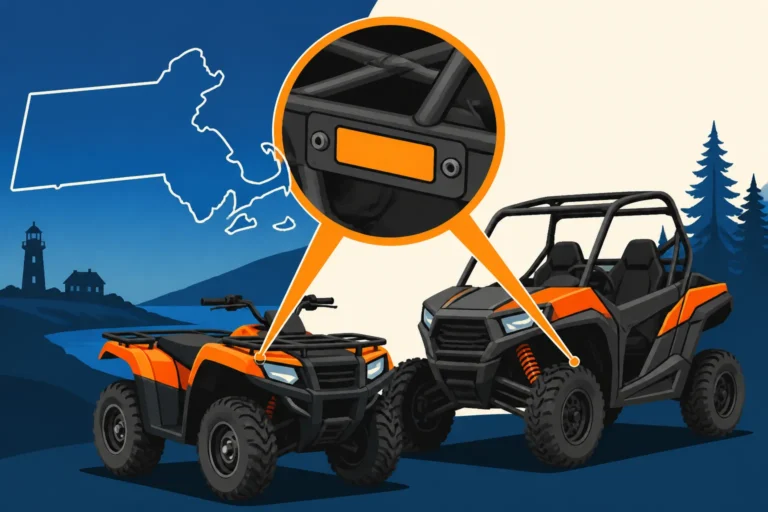
While you're waiting for your decals and registration card to arrive, it's the perfect time to get all your other ducks in a row for when your machine is legally ready to roll. Take this time to ensure your machine is in top mechanical condition, check your tires, oil, and brakes, and ensure all safety equipment, especially your helmet, is up to Massachusetts standards. You can also research local trails and map out your first adventure. Remember, Massachusetts requires your decals to be prominently displayed on both sides of the machine, usually on the forward half. [Massachusetts Decals on Both Sides] explains this in more detail.
If you have access to private land and have secured written permission from the landowner, you might be able to use your machine there without a state registration if it's solely on that private property and never touches any public way or state-managed land. However, even on private land, all other Massachusetts OHV laws still apply, including age restrictions, helmet laws, and noise ordinances. For riding on private property, a formal permission slip can be helpful. Again, a tool like LawDepot can provide clear, concise templates for landowner permission forms, ensuring you have documented consent should any questions arise. This meticulous preparation will make your first legal ride all the more enjoyable when your registration finally arrives.
Here's a quick reference for typical Massachusetts OHV registration processing times:
| Submission Method | Typical Processing Time (Approx.) | Potential Factors for Delay |
|---|---|---|
| Online / Phone | 2-4 Weeks | Incomplete application, peak season, missing documents |
| Mail-In | 4-6 Weeks or More | Mail transit, incomplete application, peak season |
| In-Person (at office) | 3-5 Weeks | Manual processing queue, incomplete application, peak season |
Remember, these are estimates for a perfectly submitted application during non-peak times. Always err on the side of applying early!
Disclaimer
This article is for general informational purposes only and does not constitute professional advice. Laws, prices and regulations vary by location and change over time. Consult a qualified professional for guidance on your specific situation.