Massachusetts Two-Year OHV Registration
It can feel like navigating a maze when you're trying to figure out all the ins and outs of legally riding your ATV or UTV here in Massachusetts. The rules can seem a little complicated, especially when it comes to getting your machine properly registered. This comprehensive guide is here to cut through the confusion and walk you step-by-step through everything you need to know about securing your two-year OHV registration as a Massachusetts resident, ensuring you're ready for the trails.
Understanding the Massachusetts Two-Year OHV Registration
When you're eager to hit the trails or get some work done on your property with your ATV or UTV, the very first hurdle is often understanding the registration process. In Massachusetts, for residents, the standard off-highway vehicle (OHV) registration is issued for a two-year period, offering a bit of peace of mind compared to annual renewals. This isn't just a suggestion; it's a legal requirement if you plan to operate your machine anywhere beyond your own private land where you have exclusive permission to ride. It's the state's way of ensuring accountability, funding trail maintenance, and making sure everyone operating these powerful machines is doing so within the legal framework.
Who Qualifies for the Resident Sticker
So, who exactly gets to enjoy this two-year resident perk? Simply put, if your primary residence is in Massachusetts, you qualify. This means your address on your driver's license or state ID should be a Massachusetts address, and your machine will be primarily garaged or stored here. It's not uncommon for folks who own vacation homes or seasonal camps in the Bay State to wonder if they can register as a resident. However, the intent is for machines primarily used by actual Massachusetts residents. Proving residency usually isn't a huge hurdle; often, your driver's license details are sufficient, but sometimes the state might ask for additional proof, like a utility bill, just to confirm. This distinction is important because the cost and the term of the registration differ significantly for non-residents.
Why It's a Two-Year Term
The decision to offer a two-year registration for residents is a practical one, benefiting both the state and the rider. For you, the rider, it means less frequent paperwork and one less thing to remember each year. You get to enjoy two full seasons of riding without worrying about an annual renewal. For the state, it streamlines administrative processes, reducing the volume of transactions they need to handle annually. It also helps in longer-term planning for the [Massachusetts Registration Fees Fund Trails]. This structure acknowledges that residents are more consistently using and contributing to the state's OHV resources over time. While non-residents get a one-year sticker, the two-year option for residents is a clear advantage, making it easier to stay legal and enjoy the trails.
What Your OHV Sticker Covers
Getting that sticker isn't just about avoiding a fine; it opens up a world of legal riding opportunities. Your Massachusetts OHV registration, once properly affixed to your machine, grants you permission to ride on designated public lands, such as specific state forests, and legally cross public ways where allowed. It signifies that your machine has met the state's basic requirements for operation, including proper ownership documentation and payment of associated fees and taxes. It's your ticket to exploring trails like those in October Mountain State Forest or Pittsfield State Forest. However, it's crucial to remember that registration doesn't give you free rein anywhere you please. You still need to adhere to all other state laws regarding age limits, helmet use, speed, noise, and, most importantly, having written permission if you're on private land that isn't your own. It's a foundational step, not a universal permission slip.
The Step-by-Step Process for a Resident Two-Year Registration
The thought of government paperwork can make anyone groan, but registering your OHV in Massachusetts doesn't have to be a nightmare. Whether you're bringing home a brand-new quad or buying a used side-by-side from a private seller, the process has a few key steps that, once understood, are straightforward. The goal is to ensure your machine is properly identified, ownership is verified, and all necessary fees and taxes are paid. This detailed walkthrough will help you gather what you need and guide you through the submission process, setting you up for success.
Gathering Your Essential Paperwork
Before you even think about filling out a form, you need to have your ducks in a row when it comes to documentation. For a brand-new machine purchased from a dealer, you'll absolutely need the Manufacturer's Certificate of Origin (MCO). This is essentially the birth certificate of your OHV. [Massachusetts Requires an MCO for a New Machine] because it establishes the chain of ownership from the manufacturer to you. For a used machine, whether from a dealer or a private seller, you'll need a clear bill of sale. [Massachusetts Requires a Bill of Sale for a Used One] and it must include specific details: the buyer and seller's names and addresses, the date of sale, the purchase price, and a full description of the machine including its Vehicle Identification Number (VIN).
Don't forget about sales tax! You'll likely need to fill out a Form ST-6 (Sales Tax Payment Form) or Form ST-6E (Sales Tax Exemption Form). [Massachusetts Sales Tax Forms at Registration] are mandatory even if you believe you're exempt, such as for a gift or a trade-in. The VIN is paramount, as it's how your machine is uniquely identified and recorded. Double-check that all these documents are complete and accurate before moving forward.
Navigating the Massachusetts Online Registration System
Once your paperwork is in order, the easiest and most common way to register your OHV is through the [Massachusetts Online Registration System]. This portal, managed by the Environmental Police, is designed to be user-friendly, allowing you to complete most of the process from the comfort of your home. You'll start by creating an account or logging in, then selecting the option for a new OHV registration. The system will prompt you to input all the details from your MCO or bill of sale, including the VIN, make, model, year, and engine size. This is where you'll also declare whether the machine is new or used and provide your residency information.
You'll upload digital copies of your MCO or bill of sale, and any relevant tax forms. It's critical to make sure your scanned documents are clear and legible to avoid delays. The system will then calculate the fees due, including the two-year resident registration cost, which for residents is typically [Massachusetts Charges $44 for Residents], and any applicable sales tax. You'll pay securely online, often with a credit or debit card. Take your time, review all entries, and ensure everything matches your physical documents. It might feel like a lot of clicking, but it's much faster than an in-person visit.
What Happens After You Apply
The waiting game begins! After you successfully submit your application and payment online, you'll usually receive an email confirmation that your application is under review. The Environmental Police will process your submission, verifying all the details and documents you provided. While the system aims for efficiency, processing times can vary, especially during peak riding seasons in the spring and early summer. It’s always a good idea to apply well in advance of when you plan to ride.
Once approved, the state will mail you your official registration card and your two new OHV decals. [Massachusetts Issues Decals and a Card] as proof of your registration. The card is a crucial document that you must carry with you whenever you operate the machine. The decals, typically one for each side of your OHV, are what visually identify your machine as legally registered. Keep an eye on your mailbox, and once they arrive, make sure to affix the decals properly and store your registration card safely, perhaps in a waterproof pouch on your machine or in your riding gear.
Costs Associated with Your Two-Year OHV Sticker
Nobody likes unexpected costs, especially when it comes to getting out and enjoying the great outdoors. Understanding the financial commitment upfront for your two-year OHV registration in Massachusetts can help you budget accordingly and avoid any last-minute surprises. Beyond the sticker fee itself, there are sales tax considerations and the often-overlooked contribution your fees make to the very trails you ride. It’s all part of being a responsible OHV owner in the Commonwealth.
The Resident Registration Fee Breakdown
The primary cost you'll face is the registration fee itself. For Massachusetts residents, this is a fixed amount for the two-year term. As mentioned earlier, [Massachusetts Charges $44 for Residents] for this two-year sticker. This fee is non-refundable and covers the administrative costs associated with processing your registration, maintaining records, and issuing your decals and card. It's an investment in your legal right to ride. While the amount might seem small in the grand scheme of an ATV or UTV purchase, it's a vital part of the overall expenses for owning and operating a machine in Massachusetts. This money helps support the overall OHV program, ensuring that resources are available to manage and regulate off-highway recreation safely and responsibly.
Addressing Sales Tax at Registration
This is where many new owners get tripped up! Massachusetts has a 6.25% sales tax on most purchases, and ATVs and UTVs are no exception. If you bought your machine from a licensed dealer in Massachusetts, they would typically collect this sales tax at the time of purchase and remit it to the state for you. However, if you bought your OHV from a private seller, you are responsible for paying the sales tax directly to the Massachusetts Department of Revenue. This is usually done by filing a Form ST-6. You cannot complete your OHV registration until the sales tax has been paid or you've successfully claimed an exemption.
Sometimes, people receive an OHV as a gift. In this case, you might be exempt from sales tax, but you still need to prove it. You'd file a [Massachusetts Exemption Form ST-6E], which essentially certifies that the machine was a gift and no money exchanged hands. Even for trade-ins, the tax calculation can be specific. Always clarify your sales tax obligations based on how you acquired your machine before heading to the registration portal, as an unpaid tax bill will halt your registration process dead in its tracks.
Understanding the Trail Fund Contribution
Here's some good news about where your money goes! A significant portion of your OHV registration fee, specifically 25%, is directed into the Massachusetts Off-Highway Vehicle Recreation Program Fund, often simply called the OHV Trail Fund. This fund is absolutely crucial for the riding community in Massachusetts. [The OHV Trail Fund Your Sticker Pays Into] is directly used for the acquisition, development, and maintenance of OHV trails and facilities across the state. This means the money you pay for your sticker helps to create new riding areas, maintain existing ones by clearing fallen trees, grading trails, and improving signage, and even contribute to educational programs.
So, when you pay your registration fee, you're not just getting a sticker; you're actively contributing to the sustainability and expansion of OHV recreation opportunities in Massachusetts. It’s a direct investment in the trails you love to ride. Knowing this can turn what might feel like a bureaucratic chore into a positive contribution to the sport.
Displaying Your Two-Year OHV Decals and Card Correctly
Getting your registration sorted is a huge step, but it’s not quite the end of the line. Once those precious decals and the registration card arrive in the mail, you need to know exactly what to do with them. Incorrect placement of decals or failing to carry your card can lead to citations, even if your machine is technically registered. The state has specific rules for a reason – primarily for easy identification by law enforcement and to ensure you have proof of registration readily available. Don’t let a simple oversight spoil your ride.
Proper Decal Placement on Your Machine
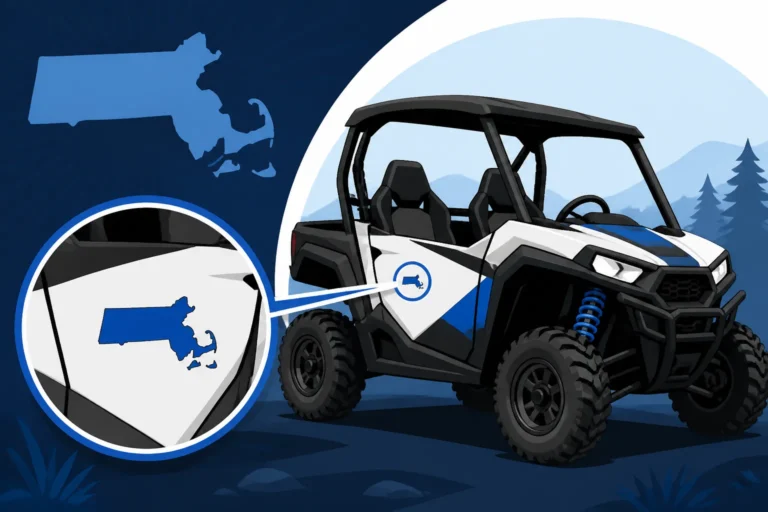
The Environmental Police are particular about where those decals go. You receive two decals, and they must be affixed to the forward half of each side of your ATV or UTV. For example, on an ATV, they typically go on the front fenders or plastics, one on the right side and one on the left. On a side-by-side, they'll usually go on the front doors or the front fender area. The key is visibility and permanence. The decals must be clearly visible and permanently affixed, meaning you shouldn't put them on with tape or in a way that allows them to be easily removed.
Additionally, you'll receive a small expiration decal, which usually goes on the left side of your machine, clearly showing the month and year your registration expires. [Massachusetts Decal Placement Rules] are in place to make it easy for officers to quickly verify your registration status without having to stop you unnecessarily. If your decals get covered by mud or become obscured, you could still be questioned. So, keep them clean and unobstructed.
Carrying Your Registration Card
This is perhaps one of the most critical, yet sometimes forgotten, pieces of the puzzle. Your physical registration card is the official document proving your machine is legally registered in Massachusetts. The law explicitly states that you must carry this card with you whenever you are operating the OHV off-highway. [Massachusetts Registration Cards Carried on Board] is not just a suggestion, it's a requirement. This means having it in your wallet, a waterproof bag on your machine, or even a secure pocket in your riding jacket.
Leaving it at home, or relying on a photo on your phone, is generally not sufficient. If an Environmental Police officer or other law enforcement official stops you, they will ask to see this card. Failure to produce it on demand can result in a fine or other penalties, even if you know for a fact your machine is registered. Treat this card like you would your driver's license for your car – it's that important.
Common Decal and Card Issues
Life happens, and sometimes decals peel off, fade, or get damaged. Registration cards can get lost or destroyed. Don't panic, but don't ignore it either. If your decals become unreadable or fall off, you’ll need to order replacements. [Massachusetts Decal Replacement If Lost] or damaged is a straightforward process, usually available through the online system or by contacting the Environmental Police directly. There is typically a small fee for duplicates, but it's far less costly than a citation for improperly displayed registration.
Similarly, if you lose your registration card, you can request a duplicate. It's much better to have a fresh, legible card than to risk riding without proof of registration. It's also a good idea to ensure your contact information, particularly your mailing address, is always up to date with the Environmental Police, so any replacement decals or cards reach you without delay. Proactively addressing these minor issues keeps you in good standing and ensures your riding adventures remain hassle-free.
Renewing Your Massachusetts Two-Year OHV Registration
That two-year term will fly by faster than you think, and before you know it, it'll be time to renew your OHV registration. Just like with vehicle registrations, it's crucial to stay on top of your renewal to avoid any lapses in legal riding privileges. Knowing when and how to renew, and what the consequences are if you don't, will save you a headache and potential fines down the road. It’s all about planning ahead so you can seamlessly transition from one registration period to the next.
When and How to Renew
Your two-year resident OHV registration has a clear expiration date printed on your decal and registration card. It's typically a specific month and year. You'll want to mark this down and plan to renew before that date. The Environmental Police usually send out renewal reminders, often via email if you're signed up for electronic notifications, but it's ultimately your responsibility to track the expiration.
The renewal process is generally just as simple as the initial registration, often completed through the [Massachusetts Online Registration System]. You'll log into your account, find your registered machine, and select the renewal option. The system will guide you through confirming your information and paying the two-year resident fee. [Massachusetts ATV Registration Renewal] is designed to be quick and easy, allowing you to get new decals mailed out to you well before your old ones expire. Don't wait until the last minute, especially if you plan to ride early in the season!
Addressing Expired Stickers
Riding with an expired OHV sticker in Massachusetts is a definite no-no and can lead to immediate penalties. An expired registration is essentially the same as riding unregistered, and the Environmental Police are very diligent about enforcement. If you're caught, you could face significant fines, and in some cases, your machine could even be impounded. [Massachusetts Penalties for Riding Unregistered] are not something you want to experience.
It's tempting to think you can "just get away with it" for a quick ride, but the risks far outweigh any perceived convenience. The best course of action is always to ensure your registration is current before you ever load up your machine or head to a trailhead. If you realize your sticker has expired, stop riding immediately, renew it online, and wait for your new decals to arrive before operating your OHV on public lands or trails.
What Changes Mean for Renewal
Life is dynamic, and sometimes things change between registration periods. Did you move to a new house? Did you install a new engine in your machine? While simple address changes can often be updated within your online account or by contacting the Environmental Police, more significant changes might require slightly different steps. For instance, if you've physically moved and your new primary residence is outside of Massachusetts, you would then need to consider non-resident registration rules.
Similarly, if you've modified your machine significantly, like changing the engine size, it’s wise to ensure your registration details reflect these changes, though this is less common for standard renewals. The most common change is an address update. [Massachusetts Registration Address Change] is a simple but important step. Ensuring your information is current ensures you receive all official communications, including those crucial renewal reminders, and that your registration accurately reflects your current situation.
Troubleshooting Common Registration Challenges
Even with the best intentions and careful planning, sometimes you hit a snag in the registration process. Perhaps you bought a used machine without perfect paperwork, or you're new to the state and unfamiliar with local requirements. These situations are common, and thankfully, there are often pathways to resolve them. It's about knowing who to ask and what alternatives the state might accept to get you on the path to a legal two-year OHV registration.
Registering Without a Bill of Sale
This is a scenario that causes a lot of stress for new owners. You bought a used ATV or UTV, perhaps from a friend, or years ago, and now you can't find the original bill of sale. Or maybe the seller didn't provide one with all the required information. While a clear, complete bill of sale is preferred, it's not always impossible to register without it. In some cases, the Environmental Police might accept an affidavit, which is a sworn written statement, detailing how and when you acquired the machine, along with the seller's information if available, and the machine's VIN.
You can find templates for these kinds of legal documents online, for instance, through a service like LawDepot. A well-crafted affidavit can sometimes bridge the gap if you're missing a formal bill of sale. The key is providing as much verifiable information as possible about the machine and its ownership history. It's always best to contact the Environmental Police directly in these situations to understand what specific documentation they will accept to prove ownership in lieu of a standard bill of sale. [Massachusetts Registration Without a Bill of Sale] requires extra effort but is often achievable.
Moving to Massachusetts with an OHV
Welcome to the Bay State! If you're a new resident bringing your OHV with you from another state, you'll need to register it here. Massachusetts does not recognize out-of-state OHV registrations for residents. Once you establish residency, your out-of-state sticker becomes invalid for use in Massachusetts. You'll follow the same process as any other Massachusetts resident registering an OHV, though the exact paperwork might differ slightly depending on your previous state's titling or registration practices.
You'll need proof of ownership from your previous state, such as a title or a previous registration document, along with a bill of sale if you recently acquired the machine. The state will want to confirm that you legally owned the machine before bringing it into Massachusetts. You'll then proceed to the online registration system, pay the two-year resident fee, and follow the steps for a new registration. It's important to do this sooner rather than later after becoming a resident to avoid any issues if you decide to ride. [Massachusetts Registration for a New Resident] is an important step to ensure your machine is legally recognized here.
Dealing with Transfers and Duplicates
Sometimes you want to sell your registered machine and buy a new one, or perhaps you've simply lost your existing sticker or card. The state offers mechanisms for these common occurrences. If you sell a registered machine, the registration does not transfer to the new owner. They will need to register it in their name from scratch. However, if you purchase a new machine and want to transfer your existing registration decal (and the remaining time on it) from your old machine to the new one, that's often possible. There is a specific process and a [Massachusetts Transfer Fee of $16.50] for this. It's usually more cost-effective than buying a brand-new two-year sticker if you have a lot of time left on your old one.
For lost or damaged decals or registration cards, as mentioned, you can obtain duplicates. The fee for a replacement sticker is typically [Massachusetts Duplicate Sticker at $5.50]. It's a small price to pay for compliance and peace of mind. Whether you're transferring a sticker to a different machine or simply replacing a lost one, the online system or a call to the Environmental Police can guide you through the specific steps to ensure your machine is always legally and visibly registered.
| Document Type | Required For | Key Details to Include | Where to Get It |
|---|---|---|---|
| Manufacturer's Certificate of Origin (MCO) | New machines from a dealer | VIN, make, model, year, engine size, manufacturer's name, dealer's name | Provided by the dealer at purchase |
| Bill of Sale | Used machines (dealer or private) | Buyer/seller names & addresses, date, purchase price, full machine description, VIN | Provided by seller (private) or dealer (used) – consider LawDepot for templates |
| Form ST-6 (Sales Tax Payment Form) | Private sale where tax is owed | Machine details, purchase price, tax calculation, your identification | Massachusetts Department of Revenue (MassTaxConnect) |
| Form ST-6E (Sales Tax Exemption Form) | Gift, trade-in, or other exemption | Machine details, exemption reason, your identification | Massachusetts Department of Revenue (MassTaxConnect) |
| Previous Registration/Title | New residents (from out-of-state) | Proof of prior ownership and legal status in former state | Provided by your previous state's registration authority |
| Affidavit of Ownership | Missing bill of sale | Detailed explanation of acquisition, VIN, seller info (if available), sworn statement | Self-prepared (using resources like LawDepot for guidance) |
| Proof of MA Residency | All resident registrations | MA Driver's License, State ID, utility bill, etc. (usually verified through state records) | Your personal identification documents |
Disclaimer
This article is for general informational purposes only and does not constitute professional advice. Laws, prices and regulations vary by location and change over time. Consult a qualified professional for guidance on your specific situation.