Massachusetts Riding Near Great Barrington
Great Barrington is a useful base for a Berkshire ride, but finding a legal trail nearby is not as simple as following a forest road on a map. This guide explains where to start looking, how to check access before towing, what to expect from local terrain, and how to plan a ride without assuming every road or trail is open to ATVs or UTVs.
Where to ride near Great Barrington
Start with Beartown State Forest
Beartown State Forest is one of the closest places to investigate if you are staying near Great Barrington. It sits in the southern Berkshires, where the landscape changes quickly from developed roads and village centers to wooded hills, rocky ground, and forest access roads. That proximity makes it an appealing starting point, but it does not mean every road in or around the forest is open to off-highway vehicles.
Before you load up, look for the forest’s current official riding information and designated OHV routes. Pay attention to the map’s legend, any access restrictions, and notices about seasonal or weather-related closures. A road that appears to connect two areas on a general map may be closed to motorized recreation, reserved for other users, or unsuitable for your machine.
For a closer look at the area, see [Beartown State Forest Riding in Massachusetts]. It is also helpful to compare the region with [Massachusetts ATV Trails: Three Berkshire Forests], especially if you are deciding whether to stay near Great Barrington or drive to another established Berkshire riding area.
Consider other Berkshire riding areas
Great Barrington is not the only possible base for a Berkshire trip. October Mountain State Forest and Pittsfield State Forest are also commonly discussed among the region’s designated riding areas, though they are farther from town and each has its own access details. A nearby forest is not automatically a better choice: the best fit depends on which routes are open, what machine you have, how long you want to ride, and whether you need a particular level of trail difficulty.
If you are comparing the drive and riding options, use [Massachusetts Riding Near Lee] and [Massachusetts Riding Near Pittsfield] as starting points for researching those areas. Treat each forest as a separate trip-planning decision. Do not assume that a permit, route, parking arrangement, or trail rule at one location applies at another.
A practical approach is to choose one primary riding area and one backup, then check both shortly before leaving. That way, if a trailhead is busy or a route is closed, you can decide whether the alternate location is genuinely workable instead of improvising from a highway pull-off. For the broadest planning view, keep your choices within recognized riding areas rather than trying to piece together routes across unverified town roads.
Check access before you tow
Confirm the current route and season
Trail access can change with the season, maintenance work, storms, or damage to the trail surface. This is especially important in the Berkshires, where steep slopes, exposed rock, roots, and water crossings can make a route more vulnerable after heavy rain. A trail shown as open in an old screenshot or saved map may not be open when you arrive.
Check for official notices and current forest information close to your departure date. If a route is listed as closed, do not ride around a gate or look for an unofficial bypass. A closure may protect a damaged trail, keep riders out of a hazardous area, or reflect a land-management decision. Respecting it helps protect access for everyone who uses the forest.
Before a long drive, review [Massachusetts Trail Conditions Before You Tow] and [Massachusetts Trail Closures After a Storm]. If an office or ranger station publishes contact details, call with a specific question: ask whether the designated OHV routes are open, whether there are machine restrictions, and whether parking or permits have changed.
Distinguish an open road from an authorized riding route
A line on a map does not tell you by itself that you may ride there. Forest roads, utility corridors, old logging tracks, and town roads can look like natural trail connections, but access depends on the land manager and the rules for that particular route. A path that is open to hikers or bicycles may not be open to ATVs or UTVs.
This is one reason route planning apps need to be used carefully. onX Offroad can help riders explore mapped routes and organize a trip, but an app should not replace official access information. Confirm that a route is approved for motorized use and open to your type of machine before relying on it. A suggested connection on a screen is not permission to ride.
If your route crosses a public way, do not assume that the crossing makes the road itself an ATV route. Know where crossings are allowed, stop as required, and follow posted signs and local rules. The practical rule is simple: ride only on routes expressly open to your vehicle, and turn around when the legal route ends.
| Before you leave | What to verify | Why it matters |
|---|---|---|
| Riding area | That it is an established OHV area | Not every forest or public parcel allows motorized riding |
| Route | That the specific trail is open to your machine | A mapped road may be closed or restricted |
| Season and conditions | Current closures, storm damage, and seasonal notices | Conditions can change after rain or maintenance |
| Vehicle | Any width, type, or equipment restrictions | Some routes may not accommodate a UTV or a wider machine |
| Parking | Legal trailer parking and any access requirements | A good route is not useful if you cannot stage legally |
| Backup plan | Another verified riding option | Reduces pressure to ride an unofficial connection |
Choose a route that fits your machine and experience
Expect rocky, uneven Berkshire terrain
The Berkshires are not flat, sandy riding country. Depending on the designated route, riders may encounter rock, roots, ruts, rolling grades, and narrow sections. Water and leaf cover can hide obstacles, while loose stone may shift under tires. Even a short ride can feel demanding if you are new to uneven terrain or unfamiliar with how your machine handles a descent.
Plan your first outing conservatively. A route that looks manageable on a map may take longer than expected when you are moving carefully over rocks or waiting for other trail users. If you are riding with friends who have different experience levels, agree on a pace and regrouping points before you start. Avoid letting the fastest rider set the pace for everyone else.
Before choosing equipment or a route, read [Massachusetts Trail Difficulty Ratings]. Inspect your tires, brakes, steering, and protective equipment, and make sure your machine is suitable for the terrain you plan to ride. If a trail is muddy or heavily rutted, turn back rather than trying to power through. Spinning tires can deepen damage and make the route worse for the next rider.
Do not assume a UTV can use an ATV route
Side-by-sides can be wider, longer, and heavier than ATVs. On a narrow trail, that difference matters: a machine that fits between trees on an open road may not fit safely through a tight turn, between barriers, or along a rocky section. Width restrictions and route eligibility can vary, so check the rules for the specific riding area and trail before bringing a UTV.
Do not rely on a general statement that a forest allows OHVs. Verify that the designated route is open to your vehicle category and that your machine’s dimensions are appropriate. If the map or posted information is unclear, ask the managing office before traveling. Turning around at a narrow obstacle can be difficult, and discovering a restriction at the trailhead is a frustrating way to start a day.
For more focused planning, review [Massachusetts Trails That Allow Side-by-Sides]. A route’s suitability also depends on your driving experience, passenger load, and how comfortable you are handling a larger machine on uneven ground. If there is uncertainty, choose a clearly authorized route that is appropriate for your vehicle rather than trying to squeeze through a questionable connection.
Prepare your trip from Great Barrington
Plan the drive, parking, and trailhead arrival
A ride starts before you reach the trail. Confirm the route to the trailhead, identify where trailers may be parked, and avoid assuming that a roadside shoulder or a closed gate area is an acceptable staging spot. Parking arrangements can differ by forest, and a lot that works for a passenger car may be awkward for a truck and trailer.
Leave enough time to unload without blocking access for other visitors. Keep ramps, tie-downs, and gear contained, and do not spread equipment into a travel lane or neighboring parking spaces. If you arrive and the lot is full, do not create an informal overflow area on a road or in a way that blocks emergency access. A backup plan should include a different verified location, not an improvised place to leave a trailer.
For route planning, onX Offroad may be useful for reviewing mapped terrain and saving information for a trip. Download or save what you need before you lose reliable service, but compare the route against official forest information. Cell coverage can be inconsistent in hilly, wooded areas, so a phone-only plan may leave you without dependable navigation when you need it.
Pack for changing weather and limited service
Weather can feel different in the hills than it does in downtown Great Barrington. A cool start, a passing shower, or a breezy ridge can change how comfortable a ride feels, particularly if you are moving slowly or stopping often. Bring layers, rain protection, water, and basic first-aid supplies. Wear appropriate protective equipment, including a properly fitted helmet and eye protection.
Carry a charged phone, but do not depend on it as your only source of navigation or emergency planning. Let someone know where you intend to ride and when you expect to return. If you are traveling with a group, agree on what to do if riders become separated or a machine breaks down. A simple plan prevents confusion when people are tired, out of service, or unsure which fork they took.
A paper map can be valuable if your phone battery dies or a screen becomes difficult to use in rain or bright sunlight. See [Carrying a Paper Map in a State Forest] for another layer of preparation. Whatever tools you bring, make sure everyone in the group understands the route and knows which trails are off limits.
Ride responsibly and protect local access
Share the forest thoughtfully
Designated OHV routes may be used alongside other outdoor recreation, and a quiet, predictable approach makes the experience better for everyone. Slow down when visibility is limited, around blind corners, and when approaching hikers or other trail users. Give people room, avoid sudden acceleration, and do not assume they can hear or see you coming.
Respect barriers, signs, private property boundaries, and posted restrictions. If a trail appears to continue beyond an authorized route, do not treat that as an invitation to explore. Riding outside designated areas can damage vegetation and soil, create conflict with nearby residents, and jeopardize access for other riders.
Review [Massachusetts Trail Etiquette Locals Expect] before a group trip. It is also worth discussing behavior with newer riders before unloading: stay together where practical, stop in safe places, and make sure nobody feels pressured to ride beyond their comfort level. Good etiquette is not just about avoiding complaints; it helps maintain the limited places where motorized riding is allowed.
Leave the route in good condition
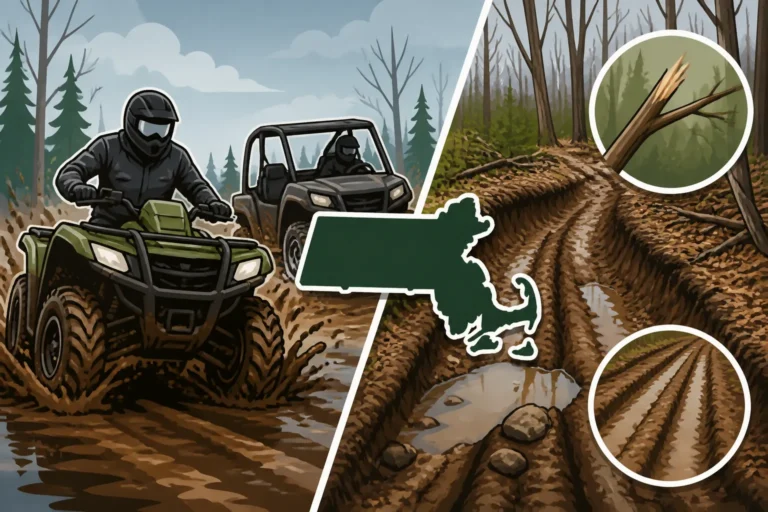
Berkshire trails can be particularly vulnerable when the ground is wet. Tires that dig into soft soil can leave deep ruts, redirect water, and make a trail harder to use after the ride. If conditions are muddy or the route is visibly deteriorating, turn back and choose a different activity rather than trying to push through.
Keep noise under control and make sure your machine is maintained. A damaged muffler or an unnecessarily loud exhaust can affect people living near the forest and other visitors seeking a quieter outdoor experience. Pack out everything you bring in, including food packaging, drink containers, and broken equipment.
When you finish, check the machine and trailer for mud, loose parts, or anything that could fall onto the road. If you notice a blocked route, damaged sign, or hazard, report it through the appropriate forest contact rather than trying to repair or bypass it yourself. A clean, respectful visit helps keep the area welcoming to riders and non-riders alike.
Disclaimer
This article is for general informational purposes only and does not constitute professional advice. Laws, prices and regulations vary by location and change over time. Consult a qualified professional for guidance on your specific situation.