Massachusetts Registration for a Club Machine
Trying to navigate the ins and outs of registering an ATV or UTV for your off-road club in Massachusetts can feel like trying to find a hidden trail without a map. It's not always clear who needs to sign what, or if there are special rules just for organizations. This guide is here to cut through that confusion, walking you through the practical steps and considerations for properly registering your club's machines with the Massachusetts Environmental Police, ensuring your adventures stay on the right side of the law.
Understanding "Club Machines" in Massachusetts Registration
First things first, let's clarify what we mean by a "club machine" when it comes to Massachusetts ATV and UTV registration. The state doesn't have a separate, distinct category specifically called "club registration" that operates under a totally different set of rules from individual ownership. Instead, when an ATV or UTV is owned by a club – whether it's a formal non-profit, an informal riding group, or a formalized LLC for a specific purpose – that club is simply considered the owner of the machine.
This means that the core registration process, the forms required, and the fees involved are essentially the same as if an individual were registering a machine. The key difference, and where many clubs encounter their first hurdle, lies in the "who." Who represents the club? Who signs the documents? And what proof of ownership is accepted when the owner isn't a person with a driver's license? It's these administrative nuances that can make it feel like a different beast entirely, but once you understand that the club is the owner in the state's eyes, things become much clearer.
Think of it this way: your club, as an entity, is taking on the responsibilities of ownership. This machine isn't registered to "John Smith, member of XYZ Club," but rather to "XYZ Off-Road Club." This distinction is incredibly important for maintaining legal clarity and ensuring that the club, as a whole, is compliant with all state regulations. It also means that the club leadership needs to be diligent about record-keeping, as any machine owned and registered by the club reflects directly on the organization.
Key Paperwork for Registering a Club-Owned OHV
When you're looking to register an ATV or UTV that your club owns, getting the paperwork absolutely right is paramount. It’s essentially the same documentation an individual needs, but with the added layer of proving the club’s existence and its right to own the machine. Without this foundational paperwork in order, your application will hit a roadblock.
Proof of Club Ownership
The most critical piece of the puzzle is establishing clear ownership by the club itself. For a new machine, this means the original Manufacturer's Certificate of Origin (MCO) must list the club's official name as the purchaser. If your club bought a used machine, you'll need a comprehensive bill of sale. This isn't just a scribble on a napkin; it needs to be a legally sound document that clearly states the club's name, address, the seller's information, the machine's make, model, year, and most importantly, its Vehicle Identification Number (VIN). [Massachusetts Requires a Bill of Sale for a Used One] is a great resource to ensure you have all the necessary components. A template from a reputable source like LawDepot can be invaluable here, ensuring all legal bases are covered and the transfer of ownership to the club is unambiguous. This also helps should you ever need to sell the machine in the future, as clear documentation streamlines the process.
Supporting Club Documentation
Beyond the direct proof of ownership for the machine, the Environmental Police may require documentation that substantiates your club as a legitimate entity. While not always explicitly asked for upfront, having it ready can prevent delays. This could include:
- Articles of Incorporation or Organization: If your club is a formally registered non-profit or LLC, these documents legally establish your club's existence and who is authorized to act on its behalf.
- Meeting Minutes or Resolutions: For less formal clubs, a resolution from a club meeting, officially voting to purchase and register the ATV/UTV in the club's name, and designating a specific officer (e.g., President, Treasurer) to handle the registration, can serve as proof of internal authorization.
- EIN (Employer Identification Number): If your club has an EIN for tax purposes, this number helps to solidify its identity as a recognized entity.
These documents aren't just bureaucratic hurdles; they protect the club and its members by clearly defining ownership and responsibility. Imagine a scenario where a machine is involved in an incident; clear ownership documentation ensures that the club, rather than an individual member, is correctly identified.
Step-by-Step Registration for a Club Machine
The actual process of getting your club's ATV or UTV registered follows the same basic steps as an individual registration, but with careful attention to the "owner" details. Remember, the goal is to register the machine in the club's name, not an individual member's name.
Gathering Your Documents
Before you even think about filling out forms, compile everything you'll need. This includes:
- Proof of Ownership: MCO for a new machine, or a detailed bill of sale for a used one. Ensure the club's full legal name is on this document.
- Supporting Club Documents: Have your Articles of Incorporation, club bylaws, or meeting minutes ready to present if requested. These establish the legitimacy of the club as an owner.
- Massachusetts Registration Application: This is available through the Massachusetts Environmental Police. You can often find a downloadable version or process it directly through the [Massachusetts Online Registration System].
- Sales Tax Form ST-6 (or ST-6E for exemptions): You'll need to prove you've paid Massachusetts sales tax on the purchase price, or that you qualify for an exemption, such as a gift. Even non-profits might need to document this. [Massachusetts Sales Tax Forms at Registration] provides more detail.
- VIN Verification: Ensure the VIN is clearly legible on your documentation and matches the machine. [Massachusetts Requires a VIN on the Application] is a standard requirement.
- Payment: Be ready to pay the applicable registration fees. [Massachusetts Charges $44 for Residents] covers the standard two-year resident fee, which your club, if based in Massachusetts, would pay.
Filling Out the Application
This is where meticulousness pays off. When filling out the registration application:
- Owner's Name: Clearly write the full, legal name of your club as the owner. Avoid abbreviations or nicknames.
- Owner's Address: Use the club's official mailing address. This might be a P.O. Box or the address of a designated club officer, depending on how your club is structured.
- Signature: A designated club officer, authorized by the club's bylaws or a formal resolution, should sign the application. Make sure their title (e.g., President, Treasurer) is clearly stated alongside their signature. It’s wise to have an official club stamp or seal, if available, to authenticate the signature.
- Machine Details: Accurately provide the make, model, year, and VIN of the ATV/UTV.
If you're unsure about any specific field, it's always better to call the Environmental Police's boat and recreation vehicle safety bureau for clarification rather than making an assumption. Getting it wrong can lead to rejection and delays.
Submitting Your Application
Once all forms are filled out and supporting documents are organized, you can submit your application. Massachusetts generally offers a few methods:
- Online: If your club is paying the standard fee and all documentation can be uploaded digitally, the online system is often the fastest.
- Mail: You can mail your completed application and supporting documents to the Environmental Police. Be sure to send it via certified mail with a return receipt requested for your records.
- In Person: In some cases, especially if you have complex questions or unusual documentation, visiting an Environmental Police office in person might be the best option. This allows for immediate clarification and ensures all documents are reviewed on the spot.
Once submitted, the Environmental Police will process your application. Upon approval, your club will receive the registration card and decals. Remember, the [Massachusetts Registration Cards Carried on Board] rule applies to club machines too; the card must be with the machine whenever it's being operated.
Fees and Renewal for Club-Owned ATVs/UTVs
Understanding the financial aspects of registering and maintaining a club-owned ATV or UTV is crucial for proper budgeting and ensuring continuous compliance. Just like an individually owned machine, there are fees involved, and the registration isn't a one-time affair.
Initial Registration and Renewal Fees
The fees for registering a club machine are the same as for a resident-owned machine. Currently, the standard resident registration is for a two-year period. [Massachusetts Charges $44 for Residents] for this two-year sticker. This fee goes directly to support off-highway vehicle programs and trail maintenance in the state, so your club's registration actually contributes to the very trails you ride! [Massachusetts Registration Fees Fund Trails] is a key initiative supported by these fees.
When it comes time for renewal, the process is largely the same as the initial registration, primarily handled through the [Massachusetts Online Registration System]. You'll want to keep an eye on the expiration date, which will be printed on the decal and your registration card. Renewing your OHV sticker when no notice arrives is a common issue, so keep a reminder on your calendar, perhaps linked to your club's annual meeting or fiscal year start.
Transferring and Duplicate Fees
Life happens, and sometimes a club might need to transfer a registration or replace a lost decal.
- Transfer Fee: If your club purchases a new ATV/UTV and wants to transfer an existing registration from an older, outgoing club machine, there's a [Massachusetts Transfer Fee of $16.50]. This is beneficial if you're upgrading your fleet but don't want to pay the full new registration fee again. The machine must be disposed of before you can transfer its registration to a new one.
- Duplicate Decal/Card: Should a decal get damaged, peel off, or be lost, or if the registration card goes missing, your club can request a duplicate. This typically incurs a small fee, such as [Massachusetts Duplicate Sticker at $5.50]. It's crucial to replace these promptly to avoid issues with law enforcement while riding. Your club's records will be vital here for proving ownership when requesting duplicates.
It's wise for clubs to factor these potential fees into their annual budget. While they may seem small individually, they add up, and proactive budgeting prevents last-minute scrambles or, worse, riding with expired or missing documentation.
| Registration Action | Cost Basis (Check Current) | Key Requirement | Who Pays |
|---|---|---|---|
| New/Renewal Registration | Two-year Resident Sticker | Proof of Ownership to Club | Club Treasurer / Designated Officer |
| Transfer Registration | Transfer Fee | Existing Registration & New Machine Proof | Club Treasurer / Designated Officer |
| Duplicate Decal/Card | Duplicate Fee | Proof of Existing Registration | Club Treasurer / Designated Officer |
| Sales Tax | 6.25% of Purchase Price (if applicable) | Form ST-6 or ST-6E | Club (or documented as exempt) |
Note: Always verify current fees directly with the Massachusetts Environmental Police as they are subject to change.
Maintaining Compliance for Club-Owned Machines
Registering your club's ATV or UTV is just the first step. Ongoing compliance is essential to avoid penalties and ensure your club can continue to enjoy the trails without legal headaches. This involves proper decal placement, adherence to riding laws, and diligent record-keeping.
Decal Placement and Display
Once your club receives the registration decals, proper placement is critical. Massachusetts has specific rules for this:
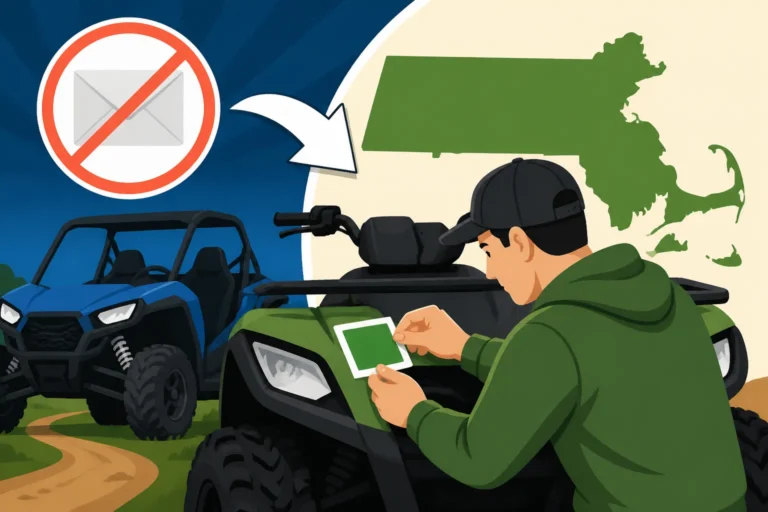
- Both Sides: Decals must be affixed to both sides of the machine, clearly visible. [Massachusetts Decals on Both Sides] ensures that environmental police officers can easily identify your registered machine.
- Forward Half: They typically need to be on the forward half of the vehicle.
- Expiration Decal: A smaller expiration decal goes on the left side, indicating when your registration period ends. [Massachusetts Expiration Decals on the Left] ensures this information is readily accessible.
Ensuring your decals are securely affixed and in the correct locations not only fulfills legal requirements but also shows respect for the system that maintains our trails. Damaged or peeling decals should be replaced promptly.
Adhering to Massachusetts OHV Laws
Club machines, like all ATVs and UTVs in Massachusetts, are subject to the comprehensive set of state laws under Chapter 90B. This includes age restrictions, helmet requirements, and rules regarding where and when you can ride.
- Age and Supervision: Even if the machine is owned by the club, the operator must still comply with [Massachusetts ATV Age Requirements] and supervision rules. For example, riders under 14 are generally banned from operating ATVs, even on private land, with very few exceptions. Young riders often need to carry a [Massachusetts Safety Certificates Under 18].
- Helmets: [Massachusetts ATV Helmet Law] mandates that all riders, regardless of age, wear a helmet that meets specific safety standards whenever operating an OHV.
- Trail Access and Landowner Permission: Club machines are generally restricted to designated trails in state forests (like October Mountain State Forest Riding in Massachusetts or Beartown State Forest Riding in Massachusetts) or private land with explicit written permission. [Massachusetts Requires Written Permission] from landowners for riding on private property. Your club should have robust processes in place for securing and tracking these permissions. Using a legal document service like LawDepot to generate standardized landowner permission forms can protect both the club and the landowner.
- Equipment: Machines must meet certain equipment requirements, such as working brakes, an adequate muffler, and appropriate lighting for night riding.
It's a good practice for clubs to have a designated safety officer or committee that stays up-to-date on these laws and educates members on compliance. Ignorance of the law is no excuse, and violations by a club member operating a club machine could reflect poorly on the entire organization.
Record Keeping and Administrative Best Practices
Maintaining thorough records is a non-negotiable for any club operating ATVs or UTVs. This not only supports registration needs but also protects the club legally and financially.
- Registration Documents: Keep physical and digital copies of all registration applications, MCOs, bills of sale, and current registration cards. This provides a clear audit trail.
- Club Resolutions/Bylaws: Documents authorizing machine purchases, designating signing officers, and outlining maintenance responsibilities should be easily accessible.
- Maintenance Logs: Maintain detailed logs of all maintenance performed on club machines. This is invaluable for resale value, troubleshooting, and proving due diligence in case of an incident.
- Insurance Records: While Massachusetts does not mandate OHV insurance, many clubs choose to carry liability coverage for their machines and operations. Keeping these policies current and accessible is vital. [Does Massachusetts Require Insurance on a Registered ATV?] discusses this in more detail.
- Rider Agreements: For members using club machines, having signed agreements that acknowledge club rules, safety guidelines, and liability waivers is a strong protective measure. Again, LawDepot offers templates for various legal agreements that can be customized for your club's needs.
By proactively managing these administrative duties, your club ensures it’s always prepared, protects its assets, and upholds its reputation as a responsible and law-abiding organization within the Massachusetts OHV community. [Massachusetts Group Ride Planning] also touches on the importance of preparation and responsibility for organized rides.
Disclaimer
This article is for general informational purposes only and does not constitute professional advice. Laws, prices and regulations vary by location and change over time. Consult a qualified professional for guidance on your specific situation.