Spark Arrestor Checks at a Park Gate
A spark arrestor can look like a small detail until an attendant asks to inspect your ATV or UTV before entry. In Massachusetts, gate checks may depend on the riding area and its rules; there isn’t one assumption that safely covers every park or trail. Here’s what the part does, what an inspector may look for, and how to avoid a gate-side delay.
What a Spark Arrestor Check Is For
A spark arrestor is a device in the exhaust system that helps prevent hot particles from leaving the muffler and starting a fire. It is not the same thing as a muffler, and it does not automatically make a machine quiet. A machine can have a muffler and still lack a required spark arrestor, or have a spark arrestor and still be too loud for a riding area.
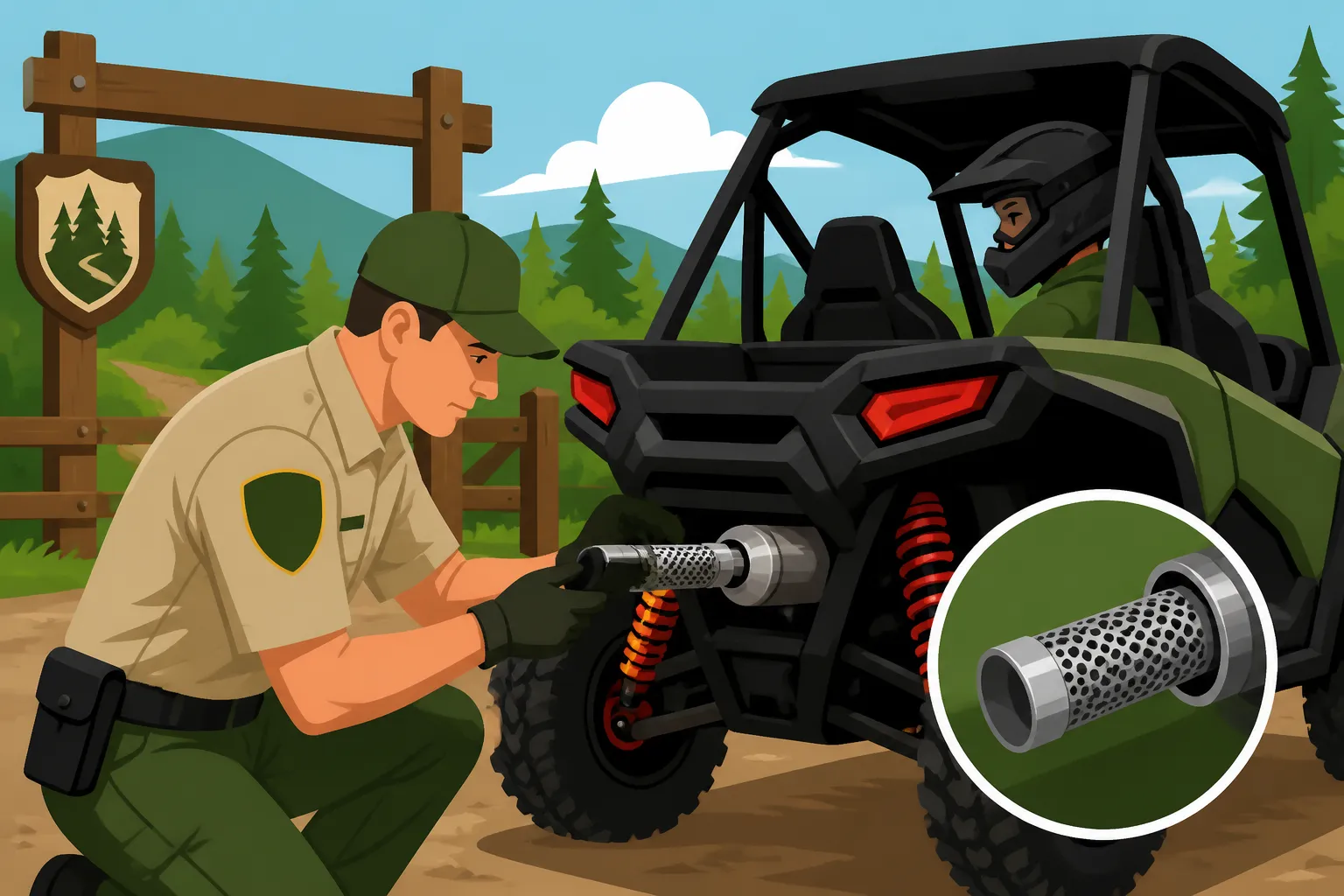
At a park gate, staff may ask whether your machine has an arrestor, look for a marking or visible component, or ask you to show that it is installed. The details depend on the site. A private riding area can set its own entry conditions, while land managers may have separate requirements for public land. Don’t assume a check at one location tells you what another location will accept.
It also helps to separate three questions that can get mixed together:
- Does the riding area require a spark arrestor? Check the rules for that specific property and machine type.
- Is the arrestor installed and in usable condition? A missing, damaged, or modified part may not meet the site’s requirement.
- Does the machine meet noise rules? A spark arrestor is not a substitute for an acceptable exhaust system or a sound check.
For public-land riding, check the applicable Massachusetts Equipment Requirements and Massachusetts Sound Limits on State Land. Private parks may have their own inspection process, waiver, or equipment conditions; review Massachusetts Private Park Waivers and Rules before hauling out. Rules can vary, so confirm directly with the property rather than relying on another rider’s experience at a different gate.
A gate check is usually a practical screening step, not a full mechanical inspection. Staff may be trying to confirm that equipment meets the site’s conditions and reduce safety or fire risks. Still, the park’s staff decide what documentation or inspection they accept. If the rule is unclear, ask before you travel.
What Staff May Look For at the Gate
The inspection can be quick, but it is worth knowing what might prompt a closer look. Depending on the park, an attendant may ask you to identify the exhaust outlet, point out the arrestor, or show a marking on the exhaust component. Some sites may use a written equipment checklist; others may have staff inspect machines informally.
A common issue is assuming that a stock muffler proves the machine has an acceptable arrestor. That may not be enough. The arrestor can be a separate part inside or at the end of the exhaust system, and its location and construction vary by machine. Likewise, a replacement muffler or aftermarket exhaust does not guarantee that the required device is present.
| What staff may check | Why it matters | What to do before arriving |
|---|---|---|
| Presence of an arrestor | The park may require one as a condition of entry | Confirm the rule for your machine and riding area |
| Installation and condition | A loose, damaged, or altered part may not pass inspection | Inspect the exhaust when the machine is cool |
| Identification or marking | Staff may need a way to verify the component | Ask what proof or marking the park accepts |
| Exhaust noise | Noise rules are separate from spark-arrestor requirements | Keep the exhaust system intact and check park rules |
| Machine type and fit | A rule may differ for an ATV, UTV, or dirt bike | Confirm that the rule covers your vehicle category |
Do not remove or modify an exhaust component just to make the machine seem easier to inspect. If a device has been altered, its appearance may not demonstrate that it still performs as intended. And if you are unsure whether an aftermarket part is acceptable, ask the park and the part’s manufacturer before the ride.
An attendant may not be able to identify every exhaust design by sight. Be ready to explain what is installed, but don’t treat a verbal explanation as a substitute for documentation if the park requires proof. If you have an owner’s manual, manufacturer information, or part documentation that identifies the exhaust component, keep it accessible. Call ahead to ask whether the park needs any of that; many gate delays come from discovering requirements only after unloading.
Also keep the machine cool before anyone handles or examines the exhaust. Exhaust parts can remain hot after a short ride or trailer unload. Staff should not need to touch a hot outlet to confirm what is installed, and you should not put your hand near it to demonstrate anything.
How to Prepare Before You Tow
The most useful step is to verify the requirement for the exact place and type of machine you plan to bring. A park’s website, posted rules, or direct call can clarify whether an arrestor is required, what counts as acceptable, and whether staff inspect it at the entrance. Ask specifically about ATVs and UTVs if you’re bringing one of those rather than a motorcycle; requirements or inspection practices may not be identical.
Use a short pre-trip check:
- Identify the riding area and land manager. Don’t rely on the rules for a different park, forest, or trail network.
- Ask about the spark-arrestor requirement. Find out whether it applies to your vehicle and what proof staff accept.
- Inspect the exhaust while it is cool. Look for loose parts, damage, unusual gaps, or signs that a component has been removed.
- Check the machine’s manual and exhaust documentation. Confirm what the installed equipment is, especially if the exhaust has been replaced or modified.
- Keep relevant information available. Save the park’s instructions and any manufacturer or part details you may need to show.
- Recheck before departure. Rules, closures, and access conditions can change. Confirm current details before a long drive; Massachusetts Trail Conditions Before You Tow is a useful reminder to check more than just the machine.
If you’re replacing an exhaust component, verify compatibility with the exact make, model, and year of your machine. A listing that says “fits ATV” is not enough to establish that it fits your model or meets the park’s requirements. Online marketplaces, including Amazon, can make it easy to find parts, but confirm the part number and documentation with the manufacturer or a qualified repair shop before ordering. Don’t infer compliance from a product photo or a seller’s broad description.
A good repair shop can help identify the exhaust configuration and whether a part is missing or damaged. Ask for the component description and any available documentation, especially if the machine has a non-stock exhaust. If the shop cannot verify that the setup meets a particular park’s rule, get the park’s interpretation before your trip.
Plan for a possible inspection when you load the machine. Keep the exhaust area accessible rather than burying it under gear, and avoid arriving with a machine so hot that it cannot be safely examined. If your group is bringing multiple machines, check every one. A compliant ATV does not make a second machine’s exhaust acceptable.
If Your Machine Fails the Check
If staff say the machine does not meet the requirement, stay calm and ask what specific issue they found. Is the arrestor missing, is the component damaged, or does the park need proof that it is an acceptable type? A clear answer helps you decide whether the problem can be resolved safely or whether you’ll need to take the machine home.
Don’t attempt a roadside exhaust repair with improvised materials, and don’t remove another component to get past the inspection. That can create new safety, noise, or fire concerns and may violate the park’s conditions. If a part is loose or damaged, have the machine inspected and repaired before riding. If the issue is documentation, ask whether the park can explain what form of verification it accepts for a future visit.
A failed gate check may mean you cannot ride that day, even if the machine has been used elsewhere. Private parks can enforce their entry rules, and public land has its own requirements. If you believe staff misunderstood what is installed, ask politely whether a manager can review the issue. Keep the conversation factual: identify the exhaust part, show relevant documentation if available, and ask which written rule applies. Do not ride onto the property while the question is unresolved.
The same preparation applies when choosing a different riding area. A park that permits your machine is not necessarily a good substitute if its vehicle limits or other entry conditions differ. For example, check Massachusetts Trails That Allow Side-by-Sides if you’re taking a UTV, and review Massachusetts DCR Riding Season before planning a public-land trip. A spark-arrestor check is only one part of confirming access; registration, permitted vehicle types, operating dates, and other site rules may matter too.
Keep in mind that passing an inspection once does not guarantee the setup will pass every later check. Components can loosen, wear, or be changed during maintenance. Before each trip, verify that the exhaust remains intact and that the destination’s current rules still fit your machine. That small check is easier to manage at home than at a gate after a long tow.
Disclaimer
This article is for general informational purposes only and does not constitute professional advice. Laws, prices and regulations vary by location and change over time. Consult a qualified professional for guidance on your specific situation.